Department of Orthopaedics, Jingjiang People's Hospital, Jingjiang, China.
Radiology Department, Jingjiang People's Hospital, Jingjiang, China.
Orthop Surg. 2022 Oct;14(10):2563-2570. doi: 10.1111/os.13444. Epub 2022 Sep 3.
To compare the clinical results of the direct anterior approach (DAA) and posterolateral approach (PLA) in total hip arthroplasty (THA) patients.
From January 2017 to September 2019, 80 patients who received primary THA in our hospital were retrospectively selected based on the propensity score matching (PSM) method. Baseline characteristics of patients who underwent the DAA and PLA were collected. Moreover, the incision length, intraoperative blood loss, operative time, length of stay, and Harris hip score were compared between patients in the two groups. The CK level was used to assess muscle damage between patients in the DAA and PLA groups. The complications of these two approaches were also evaluated at patients' 12-month follow-up evaluation.
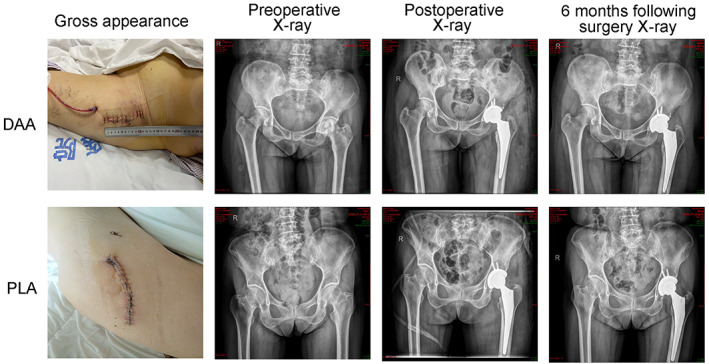
There was no significant difference in baseline characteristics between patients in the two groups (p > 0.05). The patients in the DAA group had a shorter incision length (9.2 ± 0.2 vs 14.7 ± 0.5, respectively; p < 0.05) and shorter length of hospital stay (9.5 ± 0.7 vs 12.9 ± 0.8, respectively, p < 0.05) than patients in the PLA group. Moreover, the DAA was associated with a decrease in intraoperative blood loss compared with the PLA (109.1 ± 12.6 vs 305.1 ± 14.1 ml, respectively, p < 0.05). However, the operation time was longer in patients in the DAA group (130.7 ± 1.7) than in patients in the PLA group (112.6 ± 1.3 min, p < 0.05). The CK level of patients in the DAA group was lower than that of patients in the PLA group (p < 0.05). The CK level at 48 h post-surgery was negatively correlated with the Harris hip scores at 6 months after THA (r = -0.538, p = 0.000). Compared with patients in the PLA group, the muscle strength of patients in the DAA group was significantly higher than that of patients in the DAA group at 4 days (p < 0.05) and 7 days (p < 0.05) after THA. The Harris hip scores of patients in the DAA group and PLA group were 81.0 ± 0.8 vs 70.8 ± 0.7 at 6 weeks, 93.4 ± 0.9 vs 86.4 ± 0.6 at 3 months, and 96.8 ± 1.1 vs 93.4 ± 0.8 at 6 months, respectively, both p < 0.05. There was no significant difference in the incidence of complications between patients in the DAA and PLA groups (p > 0.05).
DAA was superior to the PLA in improving hip function after THA. Compared with the PLA, the DAA could reduce muscle damage, which is negatively correlated with hip function. Further multi-institution studies are required with longer follow-up durations, and larger patient populations are needed to provide more definitive conclusions.
比较直接前入路(DAA)和后外侧入路(PLA)在全髋关节置换术(THA)患者中的临床效果。
根据倾向性评分匹配(PSM)方法,回顾性选取 2017 年 1 月至 2019 年 9 月期间在我院接受初次 THA 的 80 例患者。收集行 DAA 和 PLA 的患者的基线特征。比较两组患者的切口长度、术中失血量、手术时间、住院时间和 Harris 髋关节评分。采用 CK 水平评估 DAA 和 PLA 组患者的肌肉损伤情况。在患者 12 个月随访评估时,还评估了这两种方法的并发症。
两组患者的基线特征无统计学差异(p>0.05)。DAA 组患者的切口长度更短(分别为 9.2±0.2cm 和 14.7±0.5cm,p<0.05)和住院时间更短(分别为 9.5±0.7d 和 12.9±0.8d,p<0.05)。此外,与 PLA 相比,DAA 术中出血量减少(分别为 109.1±12.6ml 和 305.1±14.1ml,p<0.05)。然而,DAA 组的手术时间较长(130.7±1.7min),而 PLA 组的手术时间较短(112.6±1.3min,p<0.05)。DAA 组的 CK 水平低于 PLA 组(p<0.05)。THA 后 6 个月的 Harris 髋关节评分与术后 48h 的 CK 水平呈负相关(r=-0.538,p=0.000)。与 PLA 组相比,DAA 组患者在 THA 后 4 天(p<0.05)和 7 天(p<0.05)时的肌肉力量明显高于 DAA 组。DAA 组和 PLA 组患者的 Harris 髋关节评分分别为 6 周时 81.0±0.8 分和 70.8±0.7 分,3 个月时 93.4±0.9 分和 86.4±0.6 分,6 个月时 96.8±1.1 分和 93.4±0.8 分,均 p<0.05。DAA 组和 PLA 组患者的并发症发生率无统计学差异(p>0.05)。
DAA 可改善 THA 后髋关节功能,优于 PLA。与 PLA 相比,DAA 可减少肌肉损伤,与髋关节功能呈负相关。需要进一步进行更长随访时间和更大患者人群的多中心研究,以提供更明确的结论。