Laboratory for Neuropathology, Department of Imaging and Pathology, Leuven Brain Institute (LBI), KU Leuven, Herestraat 49, 3000, Leuven, Belgium.
Laboratory for the Research of Neurodegenerative Diseases, Department of Neurosciences, Leuven Brain Institute (LBI), KU Leuven, Leuven, Belgium.
Acta Neuropathol Commun. 2022 Sep 3;10(1):128. doi: 10.1186/s40478-022-01432-6.
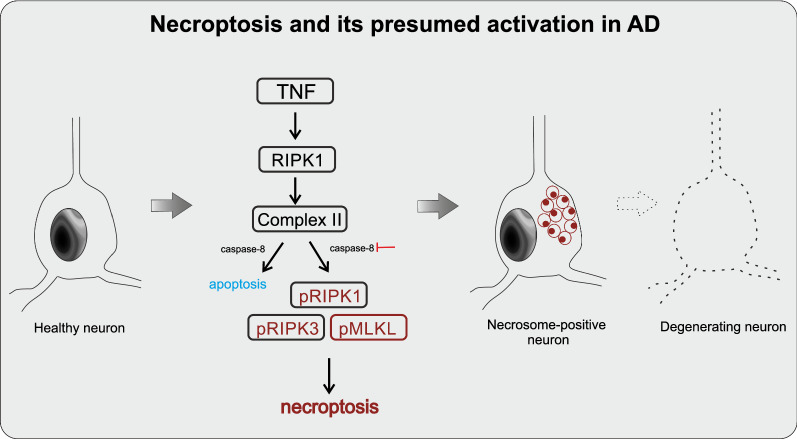
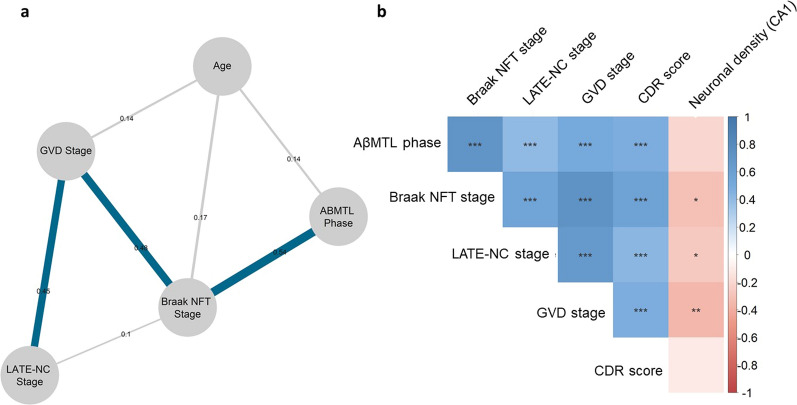
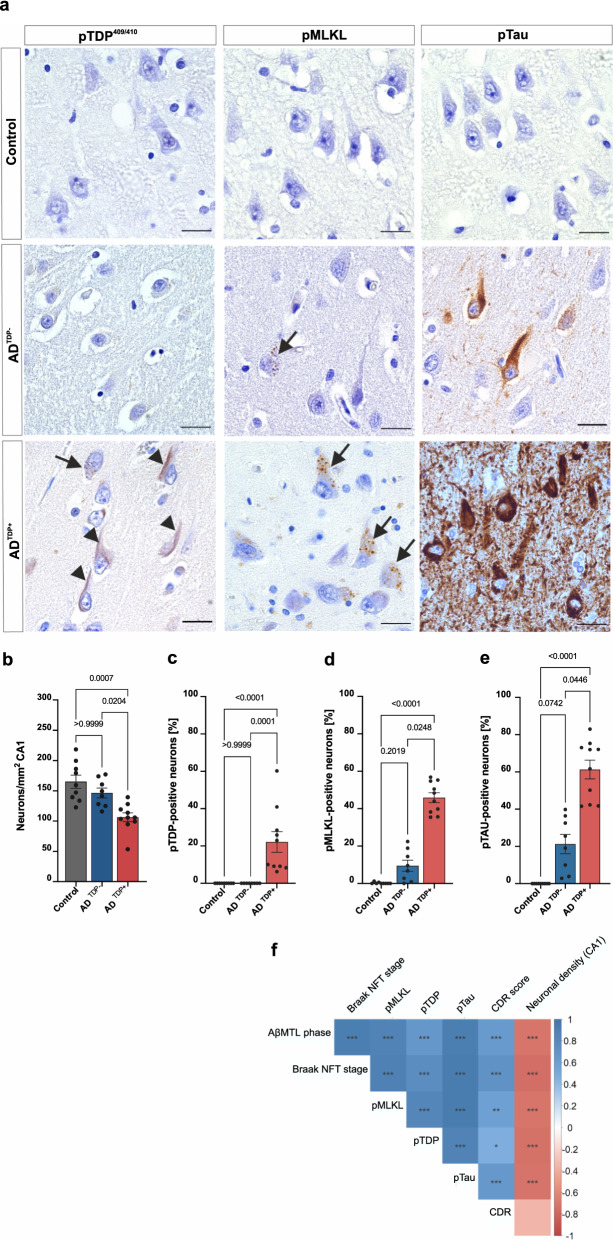
It has become evident that Alzheimer's Disease (AD) is not only linked to its hallmark lesions-amyloid plaques and neurofibrillary tangles (NFTs)-but also to other co-occurring pathologies. This may lead to synergistic effects of the respective cellular and molecular players, resulting in neuronal death. One of these co-pathologies is the accumulation of phosphorylated transactive-response DNA binding protein 43 (pTDP-43) as neuronal cytoplasmic inclusions, currently considered to represent limbic-predominant age-related TDP-43 encephalopathy neuropathological changes (LATE-NC), in up to 70% of symptomatic AD cases. Granulovacuolar degeneration (GVD) is another AD co-pathology, which also contains TDP-43 and other AD-related proteins. Recently, we found that all proteins required for necroptosis execution, a previously defined programmed form of neuronal cell death, are present in GVD, such as the phosphorylated necroptosis executioner mixed-lineage kinase domain-like protein (pMLKL). Accordingly, this protein is a reliable marker for GVD lesions, similar to other known GVD proteins. Importantly, it is not yet known whether the presence of LATE-NC in symptomatic AD cases is associated with necroptosis pathway activation, presumably contributing to neuron loss by cell death execution. In this study, we investigated the impact of LATE-NC on the severity of necroptosis-associated GVD lesions, phosphorylated tau (pTau) pathology and neuronal density. First, we used 230 human post-mortem cases, including 82 controls without AD neuropathological changes (non-ADNC), 81 non-demented cases with ADNC, i.e.: pathologically-defined preclinical AD (p-preAD) and 67 demented cases with ADNC. We found that Braak NFT stage and LATE-NC stage were good predictors for GVD expansion and neuronal loss in the hippocampal CA1 region. Further, we compared the impact of TDP-43 accumulation on hippocampal expression of pMLKL-positive GVD, pTau as well as on neuronal density in a subset of nine non-ADNC controls, ten symptomatic AD cases with (AD) and eight without LATE-NC (AD). Here, we observed increased levels of pMLKL-positive, GVD-exhibiting neurons in AD cases, compared to AD and controls, which was accompanied by augmented pTau pathology. Neuronal loss in the CA1 region was increased in AD compared to AD cases. These data suggest that co-morbid LATE-NC in AD impacts not only pTau pathology but also GVD-mediated necroptosis pathway activation, which results in an accelerated neuronal demise. This further highlights the cumulative and synergistic effects of comorbid pathologies leading to neuronal loss in AD. Accordingly, protection against necroptotic neuronal death appears to be a promising therapeutic option for AD and LATE.
很明显,阿尔茨海默病(AD)不仅与标志性病变——淀粉样斑块和神经原纤维缠结(NFTs)——有关,还与其他同时发生的病变有关。这可能导致各自的细胞和分子成分产生协同作用,导致神经元死亡。同时发生的病变之一是磷酸化转录激活反应 DNA 结合蛋白 43(pTDP-43)作为神经元细胞质包含物的积累,目前被认为代表与年龄相关的颞叶为主的 TDP-43 脑病病理变化(LATE-NC),在多达 70%的有症状的 AD 病例中。颗粒空泡变性(GVD)是另一种 AD 同时发生的病变,其中也包含 TDP-43 和其他 AD 相关蛋白。最近,我们发现坏死性凋亡执行所需的所有蛋白都存在于 GVD 中,这是一种先前定义的神经元细胞死亡的程序性形式,如磷酸化坏死性凋亡执行者混合谱系激酶结构域样蛋白(pMLKL)。因此,这种蛋白是 GVD 病变的可靠标志物,与其他已知的 GVD 蛋白相似。重要的是,目前尚不清楚在有症状的 AD 病例中 LATE-NC 的存在是否与坏死性凋亡途径的激活有关,可能通过细胞死亡执行导致神经元丧失。在这项研究中,我们研究了 LATE-NC 对坏死性凋亡相关 GVD 病变、磷酸化 tau(pTau)病理和神经元密度严重程度的影响。首先,我们使用了 230 个人体尸检病例,包括 82 例无 AD 神经病理学变化(非 ADNC)的对照,81 例非痴呆 ADNC 病例,即:病理性定义的临床前期 AD(p-preAD)和 67 例痴呆 ADNC 病例。我们发现,Braak NFT 阶段和 LATE-NC 阶段是 GVD 扩张和海马 CA1 区神经元丢失的良好预测因子。此外,我们比较了 TDP-43 积累对海马体中 pMLKL 阳性 GVD、pTau 以及非 ADNC 中 9 例对照、10 例有(AD)和 8 例无 LATE-NC(AD)的 AD 病例中神经元密度的影响。在这里,我们观察到 AD 病例中 pMLKL 阳性、GVD 表现的神经元水平升高,与 AD 和对照相比,这伴随着 pTau 病理的增加。与 AD 相比,CA1 区的神经元丢失增加。这些数据表明,AD 中的合并 LATE-NC 不仅影响 pTau 病理,还影响 GVD 介导的坏死性凋亡途径激活,从而导致神经元迅速死亡。这进一步强调了合并病理导致 AD 中神经元丢失的累积和协同作用。因此,针对坏死性凋亡性神经元死亡的保护似乎是 AD 和 LATE 的一种很有前途的治疗选择。