Division of Medical Oncology, Department of Medicine, Stanford University, Stanford, CA, USA.
Division of Geriatrics, University of California, San Francisco Veterans Affairs Medical Center, San Francisco, CA, USA.
J Geriatr Oncol. 2023 Mar;14(2):101366. doi: 10.1016/j.jgo.2022.08.015. Epub 2022 Sep 1.
Functional outcomes during non-small cell lung cancer (NSCLC) treatment are critically important to older adults. Yet, data on physical function and which measures best capture functional change remain limited.
This multisite, mixed methods cohort study recruited adults ≥65 years with advanced NSCLC starting systemic treatment (i.e., chemotherapy, immunotherapy, and/or targeted therapy) with non-curative intent. Participants underwent serial geriatric assessments prior to starting treatment and at one, two, four, and six months, which included the Karnofsky Performance Scale (KPS, range: 0-100%), instrumental activities of daily living (IADL, range: 0-14), European Organisation for Research and Treatment of Cancer Quality of Life Questionnaire Physical Functioning subscale (EORTC QLQ-C30 PF, range: 0-100), and Life-Space Assessment (LSA, range: 0-120). For all measures, higher scores represent better functioning. In a qualitative substudy, 20 patients completed semi-structured interviews prior to starting treatment and at two and six months to explore how treatment affected their daily functioning. We created joint displays for each interview participant that integrated their longitudinal KPS, IADL, EORTC QLQ-C30 PF, and LSA scores with patient quotes describing their function.
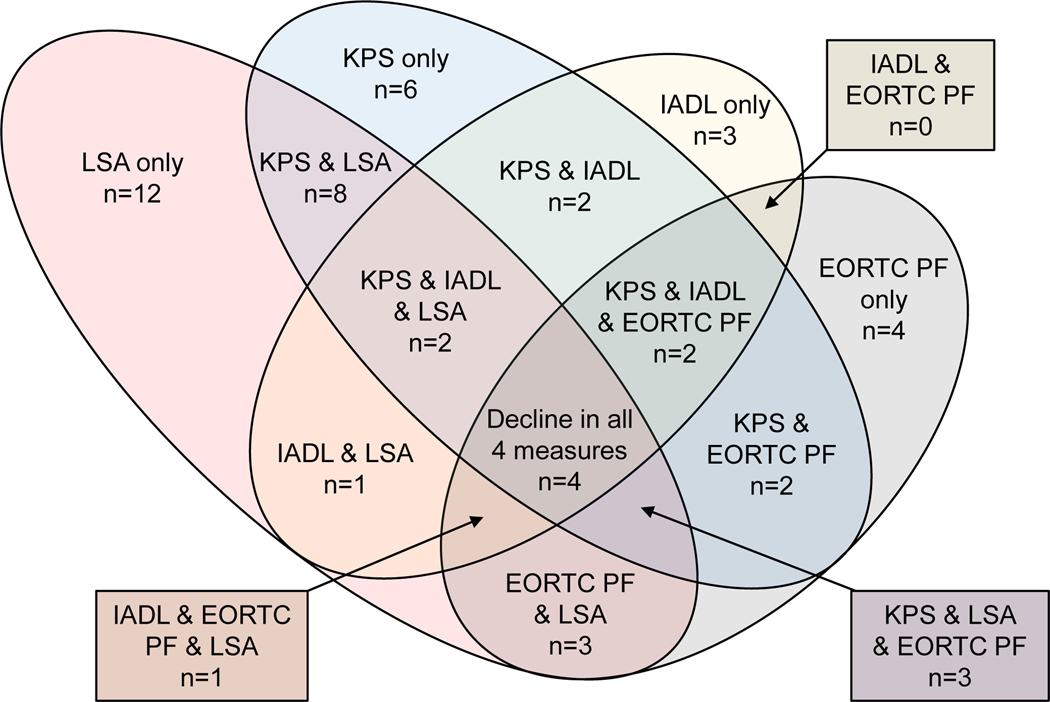
Among 87 patients, median age was 73 years (range 65-96). Mean pretreatment KPS score was 79% (standard deviation [SD] 13), EORTC QLQ-C30 PF was 69 (SD 23), and LSA was 67 (SD 28); median IADL was 13 (interquartile range [IQR] 10-14). At two months after treatment initiation, 70% of patients experienced functional decline on at least one measure, with only 13% of these patients recovering at six months. At two and six months, decline in LSA was the most common (48% and 35%, respectively). Joint displays revealed heterogeneity in how well each quantitative measure of physical function captured the qualitative patient experience.
Functional decline during NSCLC treatment is common among older adults. LSA is a useful measure to detect subtle functional decline that may be missed by other measures. Given heterogeneity in how well each quantitative measure captures changes in physical function, there is value to including more than one functional measure in geriatric oncology research studies.
非小细胞肺癌(NSCLC)治疗期间的功能结果对老年人至关重要。然而,关于身体功能以及哪些指标能最好地捕捉功能变化的数据仍然有限。
这项多地点、混合方法的队列研究招募了年龄≥65 岁、接受非治愈性系统治疗(即化疗、免疫治疗和/或靶向治疗)的晚期 NSCLC 患者。参与者在开始治疗前和治疗后 1、2、4 和 6 个月接受了一系列老年评估,其中包括卡氏功能状态量表(KPS,范围:0-100%)、工具性日常生活活动(IADL,范围:0-14)、欧洲癌症研究与治疗组织生活质量问卷身体功能子量表(EORTC QLQ-C30 PF,范围:0-100)和生活空间评估(LSA,范围:0-120)。对于所有指标,得分越高表示功能越好。在一项定性子研究中,20 名患者在开始治疗前和治疗后 2 个月和 6 个月完成了半结构式访谈,以探讨治疗如何影响他们的日常功能。我们为每位接受访谈的参与者创建了联合展示,其中整合了他们的纵向 KPS、IADL、EORTC QLQ-C30 PF 和 LSA 得分以及描述其功能的患者言论。
在 87 名患者中,中位年龄为 73 岁(范围 65-96 岁)。治疗前 KPS 评分的平均值为 79%(标准差[SD] 13),EORTC QLQ-C30 PF 为 69(SD 23),LSA 为 67(SD 28);IADL 的中位数为 13(四分位距[IQR] 10-14)。在治疗开始后两个月,70%的患者在至少一项指标上出现功能下降,其中只有 13%的患者在六个月时恢复。在两个月和六个月时,LSA 的下降最为常见(分别为 48%和 35%)。联合展示揭示了每个身体功能的定量测量指标在捕捉患者的定性体验方面的差异。
在 NSCLC 治疗期间,老年人的功能下降很常见。LSA 是一种有用的测量方法,可以检测到其他测量方法可能错过的细微功能下降。鉴于每个定量测量指标在捕捉身体功能变化方面的效果存在差异,在老年肿瘤学研究中包含多种功能测量指标具有价值。