Fleischer Michael, Coskun Bayram, Stolte Benjamin, Della-Marina Adela, Kölbel Heike, Lax Hildegard, Nonnemacher Michael, Kleinschnitz Christoph, Schara-Schmidt Ulrike, Hagenacker Tim
Department of Neurology and Center for Translational Neuro- and Behavioral Science, University Medicine Essen, Hufelandstraße 55, 45147, Essen, Germany.
Division of Neuropediatrics, Department of Pediatrics 1, University Medicine Essen, Essen, Germany.
Neurol Res Pract. 2022 Sep 5;4(1):41. doi: 10.1186/s42466-022-00206-8.
With the optimization of medical care structures and the rapid progress in the development of new therapeutic methods, an increase in life expectancy is observed in patients with neuromuscular diseases. This leads to an expansion of the phenotypic spectrum, whereby new or previously less relevant disease manifestations in different organ systems gain more importance. The care of adolescents and young adults with neuromuscular diseases, therefore, requires increasingly close interdisciplinary collaboration within neuromuscular centers.
How can the transition process from pediatric to adult care be structured so that the individual disciplines are efficiently integrated into the complex treatment and care process, and the patients' quality of life is improved?
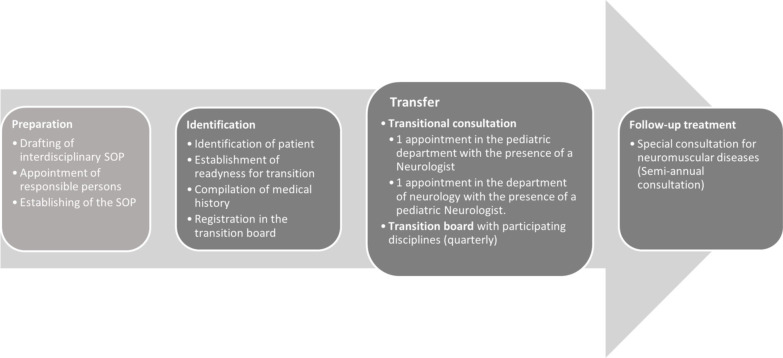
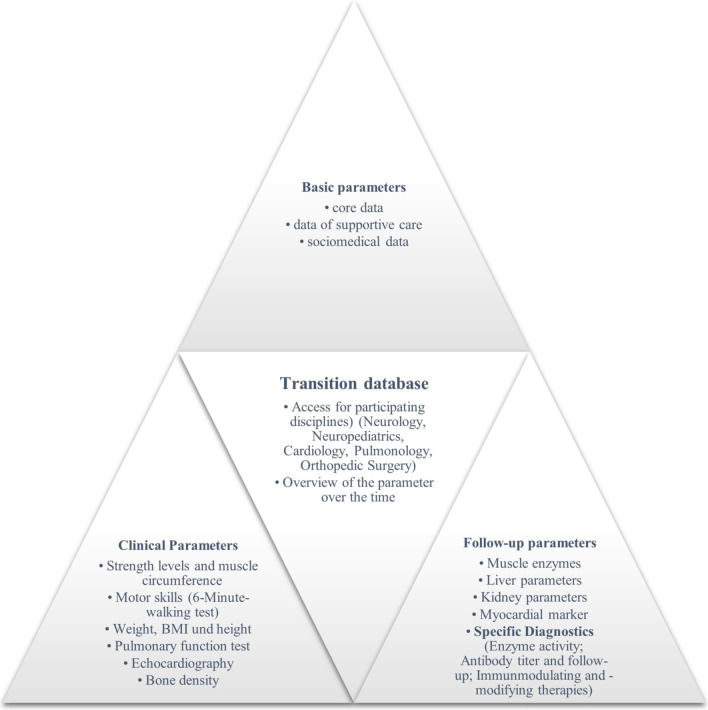
A structured transition process was established at the University Hospital in Essen, Germany. Exemplarily, a comparable care concept was developed based on Pompe disease, Duchenne muscular dystrophy, and juvenile myasthenia gravis comprising four elements: (1) With the introduction of cross-department standard operating procedures, the logistical processes, as well as the diagnostic and therapeutic measures, are uniformly coordinated, and the transition process is bindingly defined. (2) To ensure a seamless transition, young patients are seen with their parents during joint consultations before they reach their 17th birthday. This creates an opportunity for patients to get to know the subsequent department structure and build a lasting relationship of trust. (3) A quarterly "transition board" regularly brings together the participating disciplines from pediatric and adult care systems for a case-related interdisciplinary exchange and continuous optimization of the transition process. (4) A cross-department "Transition Database", in which medical findings and parameters are recorded, was implemented as a common information platform and database.
The Essen Transition Model aims to close the gap in care for young patients with neuromuscular diseases during the critical transition from pediatric to adult medicine and to create a successful continuation of treatment in adulthood.
随着医疗结构的优化和新治疗方法的快速发展,观察到神经肌肉疾病患者的预期寿命有所增加。这导致了表型谱的扩展,不同器官系统中新的或以前不太相关的疾病表现变得更加重要。因此,对患有神经肌肉疾病的青少年和年轻人的护理需要神经肌肉中心内越来越密切的跨学科合作。
如何构建从儿科护理到成人护理的过渡过程,以便将各个学科有效地整合到复杂的治疗和护理过程中,并提高患者的生活质量?
德国埃森大学医院建立了一个结构化的过渡过程。例如,基于庞贝病、杜兴氏肌营养不良症和青少年重症肌无力开发了一个类似的护理概念,包括四个要素:(1)通过引入跨部门标准操作程序,统一协调后勤流程以及诊断和治疗措施,并明确界定过渡过程。(2)为确保无缝过渡,年轻患者在年满17岁之前与父母一起参加联合咨询。这为患者提供了了解后续科室结构并建立持久信任关系的机会。(3)每季度举行一次“过渡委员会”会议,定期召集儿科和成人护理系统的参与学科进行与病例相关的跨学科交流,并持续优化过渡过程。(4)实施了一个跨部门的“过渡数据库”,作为一个共同的信息平台和数据库,记录医疗发现和参数。
埃森过渡模型旨在弥合患有神经肌肉疾病的年轻患者在从儿科医学向成人医学的关键过渡期间的护理差距,并在成年期实现成功的治疗延续。