Department of Neurology and Institute of Neurology, Ruijin Hospital, Shanghai Jiao Tong University School of Medicine, Shanghai, 200025, China.
Lab for Translational Research of Neurodegenerative Diseases, Shanghai Institute for Advanced Immunochemical Studies (SIAIS), Shanghai Tech University, Shanghai, 201210, China.
J Neuroinflammation. 2022 Sep 4;19(1):215. doi: 10.1186/s12974-022-02580-1.
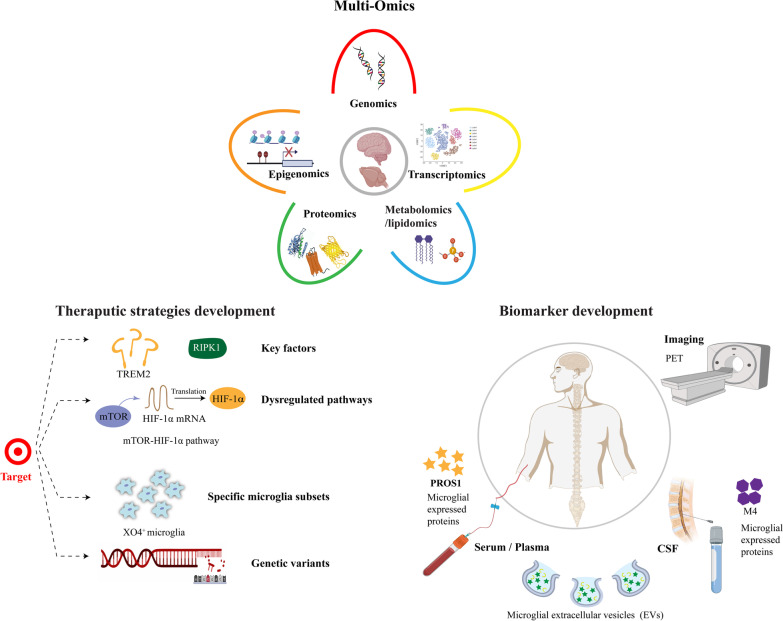
Alzheimer's disease (AD) is the most common neurodegenerative disease and the most common cause of dementia. Among various pathophysiological aspects, microglia are considered to play important roles in the pathogenesis of AD. Genome wide association studies (GWAS) showed that the majority of AD risk genes are highly or exclusively expressed in microglia, underscoring the critical roles of microglia in AD pathogenesis. Recently, omics technologies have greatly advanced our knowledge of microglia biology in AD. Omics approaches, including genomics, epigenomics, transcriptomics, proteomics, and metabolomics/lipidomics, present remarkable opportunities to delineate the underlying mechanisms, discover novel diagnostic biomarkers, monitor disease progression, and shape therapeutic strategies for diseases. In this review, we summarized research based on microglial "omics" analysis in AD, especially the recent research advances in the identification of AD-associated microglial subsets. This review reinforces the important role of microglia in AD and advances our understanding of the mechanism of microglia in AD pathogenesis. Moreover, we proposed the value of microglia-based omics in the development of therapeutic strategies and biomarkers for AD.
阿尔茨海默病(AD)是最常见的神经退行性疾病,也是痴呆症最常见的病因。在各种病理生理方面,小胶质细胞被认为在 AD 的发病机制中发挥重要作用。全基因组关联研究(GWAS)表明,大多数 AD 风险基因在小胶质细胞中高度或专门表达,这突显了小胶质细胞在 AD 发病机制中的关键作用。最近,组学技术极大地提高了我们对 AD 中小胶质细胞生物学的认识。组学方法,包括基因组学、表观基因组学、转录组学、蛋白质组学和代谢组学/脂质组学,为阐明潜在机制、发现新的诊断生物标志物、监测疾病进展以及为疾病制定治疗策略提供了显著的机会。在这篇综述中,我们总结了基于 AD 中小胶质细胞“组学”分析的研究,特别是在鉴定 AD 相关小胶质细胞亚群方面的最新研究进展。这篇综述强调了小胶质细胞在 AD 中的重要作用,并加深了我们对小胶质细胞在 AD 发病机制中的作用机制的理解。此外,我们提出了基于小胶质细胞的组学在 AD 治疗策略和生物标志物开发中的价值。