Rehabilitation Treatment, Department of Speech Therapy, Shanghai Second Rehabilitation Hospital, Shanghai, China (mainland).
Center of Rehabilitation, Yueyang Hospital of Integrated Traditional Chinese and Western Medicine, Shanghai University of Traditional Chinese Medicine, Shanghai, China (mainland).
Med Sci Monit. 2022 Sep 5;28:e937572. doi: 10.12659/MSM.937572.
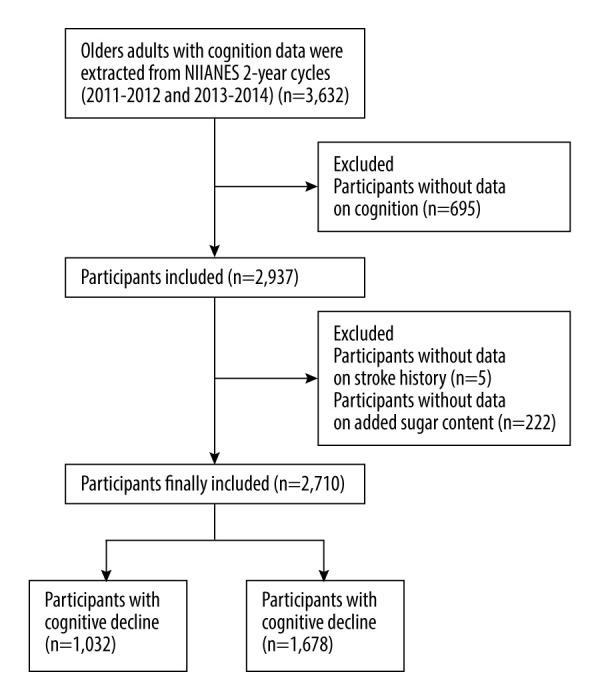
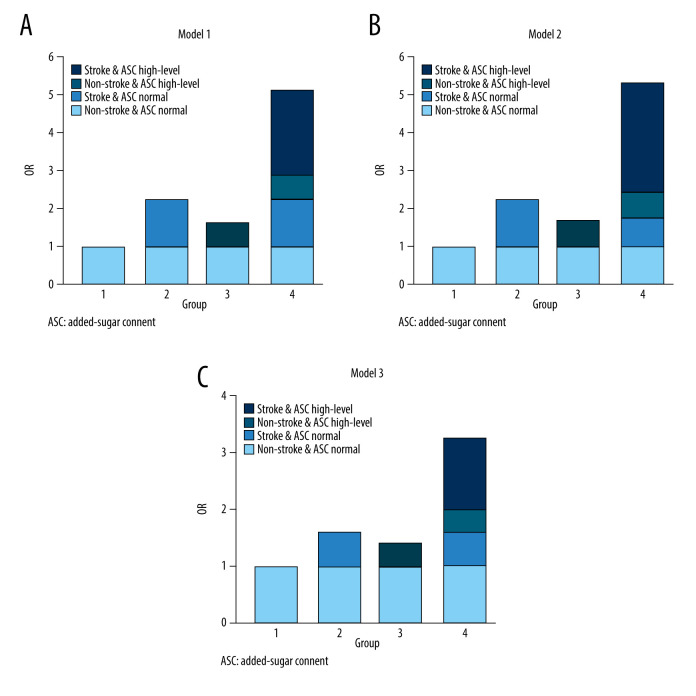
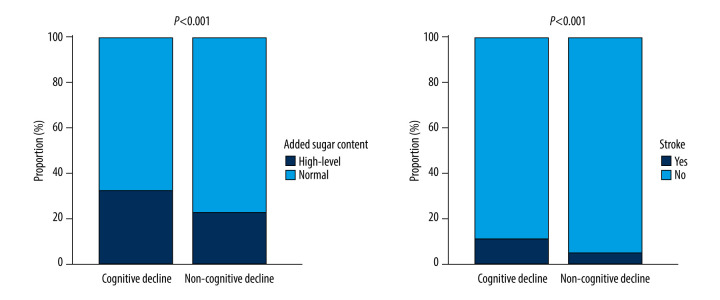
BACKGROUND Cognitive decline has become a public health concern as it causes adverse economic and socio-psychological outcomes. Studies have assessed the effects of history of stroke or high-sugar diet on cognitive decline of older adults, but whether there was interaction between high-sugar diet and history of stroke in affecting cognitive decline was still unclear. The present study explored the interaction between high-sugar diet and history of stroke in affecting the risk of cognitive decline in older adults. MATERIAL AND METHODS This cross-sectional study included 2710 subjects. Univariate analysis was applied to explore the associations of high-sugar diet or history of stroke in affecting cognitive decline. The relative excess risk of interaction (RERI), synergy index (SI), and attributable proportion of interaction (API) were used to assess the interaction of high-sugar diet and history of stroke in risk of cognitive decline. RESULTS An increased risk of cognitive decline was observed in people with history of stroke [odds ratio (OR)=1.826, 95% confidence interval (CI): 1.124-2.968] and high-sugar diet (OR=1.509, 95% CI: 1.109-2.052). The confidence intervals of interaction indicators RERI=1.257 (95% CI: 0.188-2.326) and API=0.386 (95% CI: 0.135-0.638) did not contain 0 and were both >0; the confidence interval of SI=2.261 (95% CI: 1.063-4.809) did not contain 1 and were >1. CONCLUSIONS A high-sugar diet and history of stroke interacted synergically in association with cognitive decline in older adults, which might provide a reference for management of cognition in older adults.
认知能力下降已成为公共健康问题,因为它会导致不良的经济和社会心理后果。已有研究评估了中风史或高糖饮食对老年人认知能力下降的影响,但高糖饮食和中风史之间是否存在相互作用从而影响认知能力下降尚不清楚。本研究旨在探讨高糖饮食和中风史之间的相互作用对老年人认知能力下降风险的影响。
本横断面研究纳入了 2710 名受试者。采用单因素分析来探讨高糖饮食或中风史对认知能力下降的影响。应用相对超额危险度(RERI)、协同指数(SI)和交互归因比例(API)来评估高糖饮食和中风史在认知能力下降风险中的交互作用。
与无中风史和低糖饮食者相比,有中风史(比值比[OR]=1.826,95%置信区间[CI]:1.124-2.968)和高糖饮食(OR=1.509,95% CI:1.109-2.052)者认知能力下降的风险增加。交互作用指标 RERI(95% CI:0.188-2.326)的置信区间不包含 0 且大于 0,API(95% CI:0.135-0.638)的置信区间不包含 0 且大于 0,SI(95% CI:1.063-4.809)的置信区间不包含 1 且大于 1。
高糖饮食和中风史与老年人认知能力下降存在协同交互作用,这可能为老年人的认知管理提供参考。