Wuhan Jinyintan Hospital, Tongji Medical College of Huazhong University of Science and Technology, Wuhan, China.
The First Affiliated Hospital of University of Science and Technology of China (USTC), Division of Life Sciences and Medicine, University of Science and Technology of China, Hefei, China.
Front Immunol. 2022 Aug 18;13:973089. doi: 10.3389/fimmu.2022.973089. eCollection 2022.
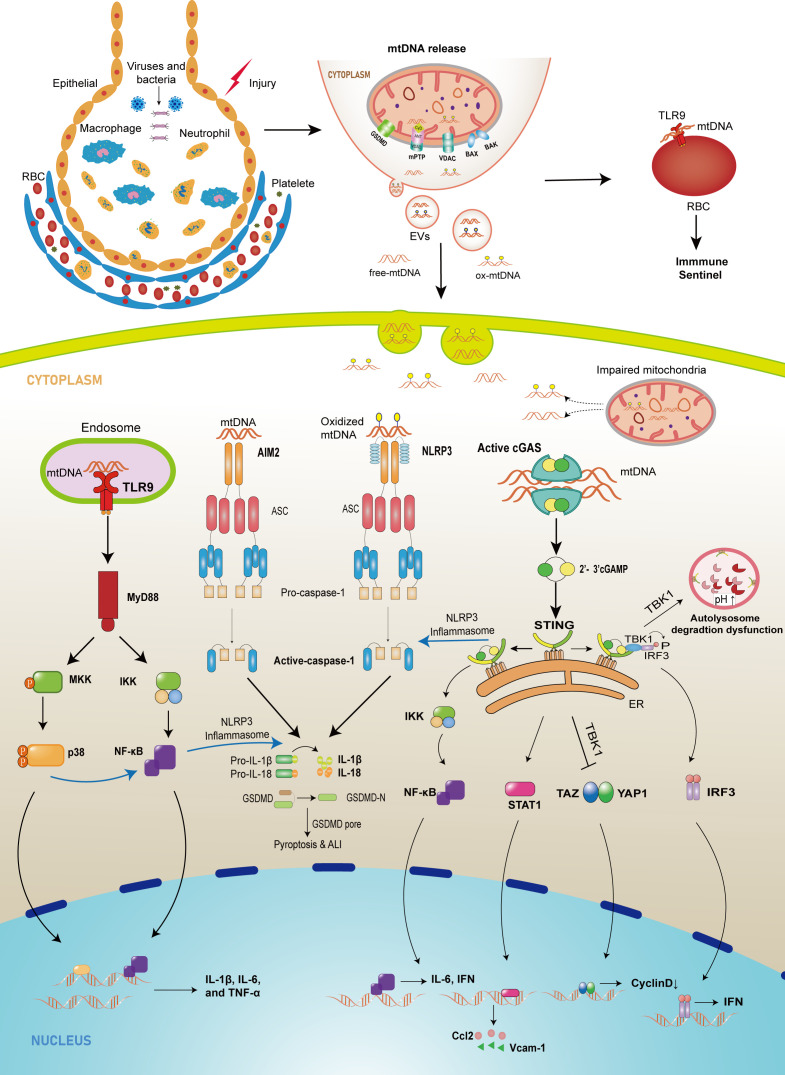
Acute lung injury(ALI)/acute respiratory distress syndrome(ARDS) is a form of acute-onset hypoxemic respiratory failure characterised by an acute, diffuse, inflammatory lung injury, and increased alveolar-capillary permeability, which is caused by a variety of pulmonary or nonpulmonary insults. Recently, aberrant mitochondria and mitochondrial DNA(mtDNA) level are associated with the development of ALI/ARDS, and plasma mtDNA level shows the potential to be a promising biomarker for clinical diagnosis and evaluation of lung injury severity. In mechanism, the mtDNA and its oxidised form, which are released from impaired mitochondria, play a crucial role in the inflammatory response and histopathological changes in the lung. In this review, we discuss mitochondrial outer membrane permeabilisation (MOMP), mitochondrial permeability transition pore(mPTP), extracellular vesicles (EVs), extracellular traps (ETs), and passive release as the principal mechanisms for the release of mitochondrial DNA into the cytoplasm and extracellular compartments respectively. Further, we explain how the released mtDNA and its oxidised form can induce inflammatory cytokine production and aggravate lung injury through the Toll-like receptor 9(TLR9) signalling, cytosolic cGAS-stimulator of interferon genes (STING) signalling (cGAS-STING) pathway, and inflammasomes activation. Additionally, we propose targeting mtDNA-mediated inflammatory pathways as a novel therapeutic approach for treating ALI/ARDS.
急性肺损伤(ALI)/急性呼吸窘迫综合征(ARDS)是一种以急性、弥漫性、炎症性肺损伤和肺泡毛细血管通透性增加为特征的急性低氧性呼吸衰竭形式,由多种肺或非肺损伤引起。最近,异常的线粒体和线粒体 DNA(mtDNA)水平与 ALI/ARDS 的发展有关,血浆 mtDNA 水平显示出作为临床诊断和评估肺损伤严重程度的有前途的生物标志物的潜力。在机制上,受损线粒体释放的 mtDNA 及其氧化形式在肺部的炎症反应和组织病理学变化中发挥着关键作用。在这篇综述中,我们分别讨论了线粒体外膜通透性(MOMP)、线粒体通透性转换孔(mPTP)、细胞外囊泡(EVs)、细胞外陷阱(ETs)和被动释放作为线粒体 DNA 分别释放到细胞质和细胞外区室的主要机制。此外,我们解释了释放的 mtDNA 和其氧化形式如何通过 Toll 样受体 9(TLR9)信号转导、细胞质 cGAS-干扰素基因刺激物(STING)信号转导(cGAS-STING)途径和炎症小体激活诱导炎性细胞因子的产生并加重肺损伤。此外,我们提出靶向 mtDNA 介导的炎症途径作为治疗 ALI/ARDS 的一种新的治疗方法。