Zhai Yanlei, Fan Zhiyi, Cui Yuanyuan, Gu Xiaojiao, Chen Shangwu, Ma Huiqin
College of Horticulture, China Agricultural University, Beijing, China.
College of Food Science and Nutritional Engineering, China Agricultural University, Beijing, China.
Front Plant Sci. 2022 Aug 18;13:979348. doi: 10.3389/fpls.2022.979348. eCollection 2022.
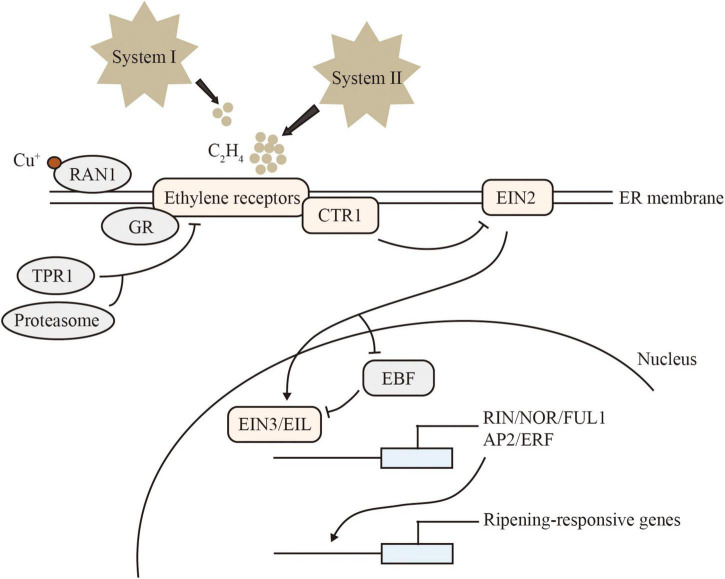
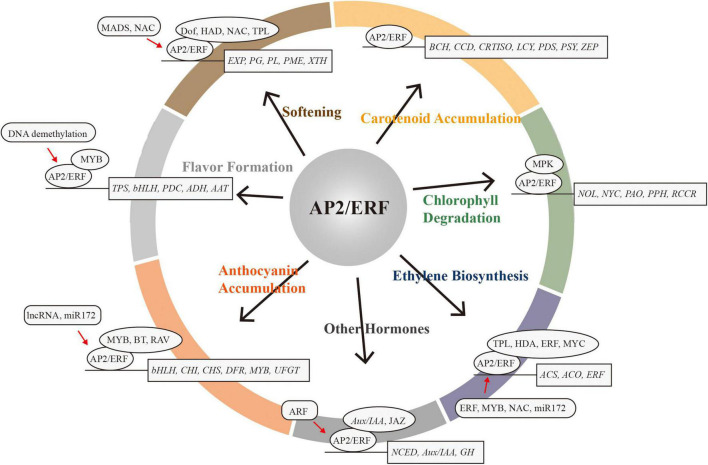
Insects and animals are attracted to, and feed on ripe fruit, thereby promoting seed dispersal. As a vital vitamin and nutrient source, fruit make up an indispensable and enjoyable component of the human diet. Fruit ripening involves a series of physiological and biochemical changes in, among others, pigmentation, chlorophyll (Chl) degradation, texture, sugar accumulation, and flavor. Growing evidence indicates that the coordinated and ordered trait changes during fruit ripening depend on a complex regulatory network consisting of transcription factors, co-regulators, hormonal signals, and epigenetic modifications. As one of the predominant transcription factor families in plants and a downstream component of ethylene signaling, more and more studies are showing that APETALA2/ethylene responsive factor (AP2/ERF) family transcription factors act as critical regulators in fruit ripening. In this review, we focus on the regulatory mechanisms of AP2/ERFs in fruit ripening, and in particular the recent results on their target genes and co-regulators. We summarize and discuss the role of AP2/ERFs in the formation of key fruit-ripening attributes, the enactment of their regulatory mechanisms by interaction with other proteins, their role in the orchestration of phytohormone-signaling networks, and the epigenetic modifications associated with their gene expression. Our aim is to provide a multidimensional perspective on the regulatory mechanisms of AP2/ERFs in fruit ripening, and a reference for understanding and furthering research on the roles of AP2/ERF in fruit ripening.
昆虫和动物会被成熟果实吸引并以其为食,从而促进种子传播。作为重要的维生素和营养来源,水果是人类饮食中不可或缺且令人喜爱的组成部分。果实成熟涉及一系列生理和生化变化,包括色素沉着、叶绿素(Chl)降解、质地、糖分积累和风味等。越来越多的证据表明,果实成熟过程中协调有序的性状变化取决于一个由转录因子、共调节因子、激素信号和表观遗传修饰组成的复杂调控网络。作为植物中主要的转录因子家族之一以及乙烯信号传导的下游组分,越来越多的研究表明APETALA2/乙烯响应因子(AP2/ERF)家族转录因子在果实成熟中起着关键调控作用。在本综述中,我们聚焦于AP2/ERF在果实成熟中的调控机制,尤其是其靶基因和共调节因子的最新研究结果。我们总结并讨论了AP2/ERF在关键果实成熟特性形成中的作用、通过与其他蛋白质相互作用发挥调控机制的过程、它们在植物激素信号网络协调中的作用以及与其基因表达相关的表观遗传修饰。我们的目的是提供一个关于AP2/ERF在果实成熟中调控机制的多维度视角,并为理解和进一步研究AP2/ERF在果实成熟中的作用提供参考。