Kellis Eleftherios, Blazevich Anthony J
Laboratory of Neuromechanics, Department of Physical Education and Sport Sciences at Serres, Aristotle University of Thessaloniki, TEFAA Serres, 62100, Serres, Greece.
Centre for Human Performance, School of Medical and Health Sciences, Edith Cowan University, Joondalup, 6027, Australia.
BMC Sports Sci Med Rehabil. 2022 Sep 5;14(1):166. doi: 10.1186/s13102-022-00555-6.
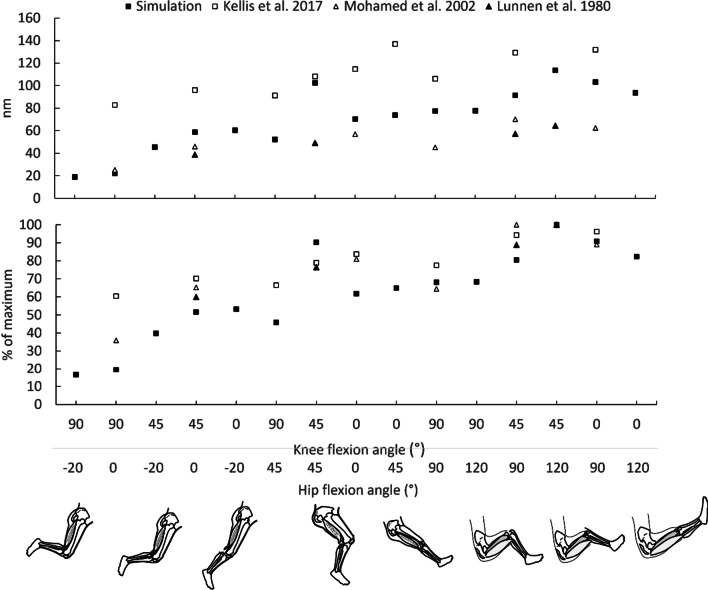
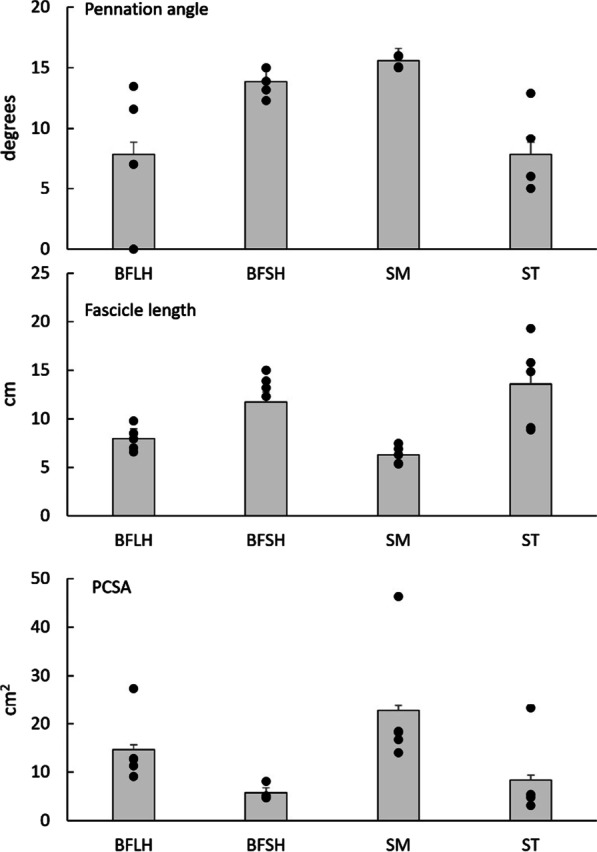
Temporal biomechanical and physiological responses to physical activity vary between individual hamstrings components as well as between exercises, suggesting that hamstring muscles operate differently, and over different lengths, between tasks. Nevertheless, the force-length properties of these muscles have not been thoroughly investigated. The present review examines the factors influencing the hamstrings' force-length properties and relates them to in vivo function. A search in four databases was performed for studies that examined relations between muscle length and force, torque, activation, or moment arm of hamstring muscles. Evidence was collated in relation to force-length relationships at a sarcomere/fiber level and then moment arm-length, activation-length, and torque-joint angle relations. Five forward simulation models were also used to predict force-length and torque-length relations of hamstring muscles. The results show that, due to architectural differences alone, semitendinosus (ST) produces less peak force and has a flatter active (contractile) fiber force-length relation than both biceps femoris long head (BFlh) and semimembranosus (SM), however BFlh and SM contribute greater forces through much of the hip and knee joint ranges of motion. The hamstrings' maximum moment arms are greater at the hip than knee, so the muscles tend to act more as force producers at the hip but generate greater joint rotation and angular velocity at the knee for a given muscle shortening length and speed. However, SM moment arm is longer than SM and BFlh, partially alleviating its reduced force capacity but also reducing its otherwise substantial excursion potential. The current evidence, bound by the limitations of electromyography techniques, suggests that joint angle-dependent activation variations have minimal impact on force-length or torque-angle relations. During daily activities such as walking or sitting down, the hamstrings appear to operate on the ascending limbs of their force-length relations while knee flexion exercises performed with hip angles 45-90° promote more optimal force generation. Exercises requiring hip flexion at 45-120° and knee extension 45-0° (e.g. sprint running) may therefore evoke greater muscle forces and, speculatively, provide a more optimum adaptive stimulus. Finally, increases in resistance to stretch during hip flexion beyond 45° result mainly from SM and BFlh muscles.
个体腘绳肌各部分以及不同运动之间,对身体活动的时间性生物力学和生理反应存在差异,这表明腘绳肌在不同任务中运作方式不同,且作用长度也不同。然而,这些肌肉的力-长度特性尚未得到充分研究。本综述探讨了影响腘绳肌力-长度特性的因素,并将其与体内功能联系起来。我们在四个数据库中进行了搜索,以查找研究腘绳肌肌肉长度与力、扭矩、激活或力臂之间关系的研究。我们整理了关于肌小节/纤维水平的力-长度关系,以及力臂-长度、激活-长度和扭矩-关节角度关系的证据。还使用了五个正向模拟模型来预测腘绳肌的力-长度和扭矩-长度关系。结果表明,仅由于结构差异,半腱肌(ST)产生的峰值力较小,且其主动(收缩)纤维力-长度关系比股二头肌长头(BFlh)和半膜肌(SM)更平缓,然而,在髋关节和膝关节的大部分运动范围内,BFlh和SM产生的力更大。腘绳肌在髋关节处的最大力臂大于膝关节处,因此,在给定的肌肉缩短长度和速度下,这些肌肉在髋关节处倾向于更多地作为力的产生者,但在膝关节处会产生更大的关节旋转和角速度。然而,SM的力臂比ST和BFlh长,这部分缓解了其力量产生能力的降低,但也降低了其原本较大的伸展潜力。受肌电图技术局限性的限制,目前的证据表明,与关节角度相关的激活变化对力-长度或扭矩-角度关系的影响最小。在诸如行走或坐下等日常活动中,腘绳肌似乎在其力-长度关系的上升段运作,而在髋关节角度为45-90°时进行的膝关节屈曲运动能促进更优化的力的产生。因此,需要髋关节屈曲45-120°和膝关节伸展45-0°的运动(如短跑)可能会引发更大的肌肉力量,并推测能提供更优化的适应性刺激。最后,髋关节屈曲超过45°时拉伸阻力的增加主要源于SM和BFlh肌肉。