National Clinical Research Center for Ophthalmic Diseases, Shanghai, China.
Department of Ophthalmology, Shanghai General Hospital (Shanghai First People's Hospital), Shanghai Jiao Tong University, School of Medicine, 100 Haining Road, Shanghai, 200080, China.
Stem Cell Res Ther. 2022 Sep 5;13(1):454. doi: 10.1186/s13287-022-03141-2.
Human embryonic stem cell-derived retinal pigment epithelial cells (hESC-derived RPE) are a promising source for cell-replacement therapy to treat retinal degenerative diseases, but research on RPE cryopreservation is limited. This study aimed to determine the best phase for RPE cryopreservation to preserve the post-thaw function and uncover the mechanism underlying RPE freezing tolerance.
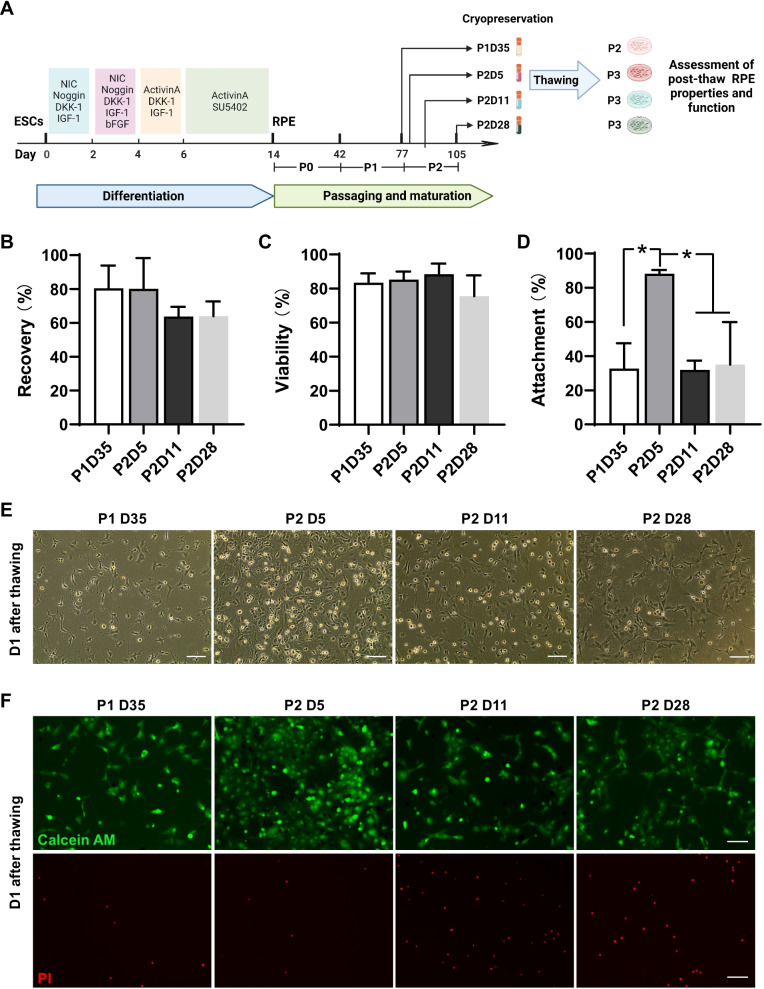
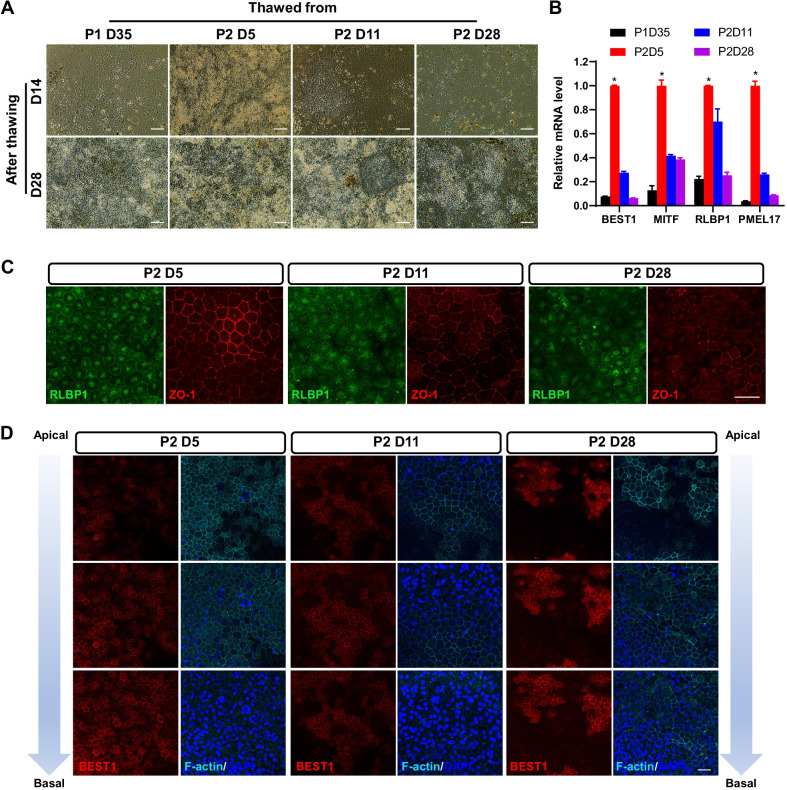
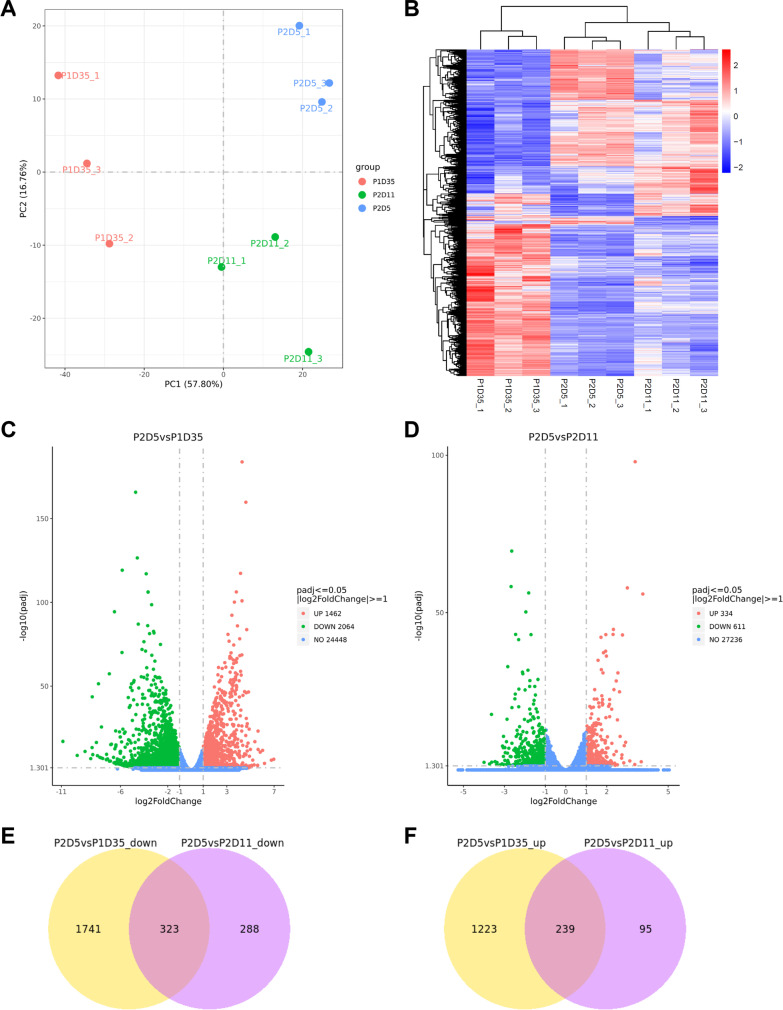
hESC-derived RPE cells were cryopreserved at various time points after seeding. After thawing, the survival and attachment rates, RPE marker gene expression, apical-basal polarity, PEDF secretion, transepithelial resistance, and phagocytotic ability of post-thaw RPE cells were evaluated. RNA sequencing was performed on RPE cells at three-time points, differentially expressed genes were identified, and gene ontology, Kyoto encyclopedia of genes and genomes, and protein-protein interaction analyses were used to investigate the key pathways or molecules associated with RPE cell freezing tolerance.
RPE frozen at passage 2 day 5 (P2D5) had the highest cell viability and attachment after thawing. They also retained properly localized expression of RPE marker genes and biological functions such as PEDF secretion, high transepithelial resistance, and phagocytic ability. The RNA-sequencing analysis revealed that RPE cells at P2D5 expressed high levels of cell cycle/DNA replication and ECM binding associated genes, as well as THBS1, which may serve as a possible hub gene involved in freezing tolerance. We also confirmed that the RPE cells at P2D5 were in the exponential stage with active DNA replication.
We propose that freezing hESC-derived RPE cells during their exponential phase results in the best post-thawing outcome in terms of cell viability and preservation of RPE cell properties and functions. The high expression levels of the cell cycle and ECM binding associated genes, particularly THBS1, may contribute to better cell recovery at this stage.
人胚胎干细胞来源的视网膜色素上皮细胞(hESC 衍生的 RPE)是治疗视网膜退行性疾病细胞替代治疗的有前途的来源,但 RPE 冷冻保存的研究有限。本研究旨在确定 RPE 冷冻保存的最佳阶段,以保持解冻后的功能,并揭示 RPE 抗冻性的机制。
在接种后不同时间点将 hESC 衍生的 RPE 细胞冷冻保存。解冻后,评估解冻后 RPE 细胞的存活率和附着率、RPE 标记基因表达、顶底极性、PEDF 分泌、跨上皮电阻和吞噬能力。在三个时间点对 RPE 细胞进行 RNA 测序,鉴定差异表达基因,并进行基因本体、京都基因与基因组百科全书和蛋白质-蛋白质相互作用分析,以研究与 RPE 细胞抗冻性相关的关键途径或分子。
在解冻后,冷冻保存在第 2 天 5 代(P2D5)的 RPE 具有最高的细胞活力和附着率。它们还保留了适当定位的 RPE 标记基因表达和生物功能,如 PEDF 分泌、高跨上皮电阻和吞噬能力。RNA 测序分析表明,在 P2D5 时,RPE 细胞表达高水平的细胞周期/DNA 复制和 ECM 结合相关基因,以及 THBS1,这可能是与抗冻性相关的可能枢纽基因。我们还证实,在 P2D5 时,RPE 细胞处于指数期,具有活跃的 DNA 复制。
我们提出,在指数期冷冻 hESC 衍生的 RPE 细胞可获得最佳的解冻后细胞活力和 RPE 细胞特性和功能保存结果。与细胞周期和 ECM 结合相关基因,特别是 THBS1 的高表达水平可能有助于在该阶段更好地恢复细胞。