Psychology, Faculty of Natural Sciences, University of Stirling, Stirling, FK9 4LA, UK.
Anti-Persoonsmijnen Ontmijnende Product Ontwikkeling (APOPO), Sokoine University of Agriculture, PO Box 3078, Morogoro, Tanzania.
Anim Cogn. 2023 Mar;26(2):435-450. doi: 10.1007/s10071-022-01654-0. Epub 2022 Sep 5.
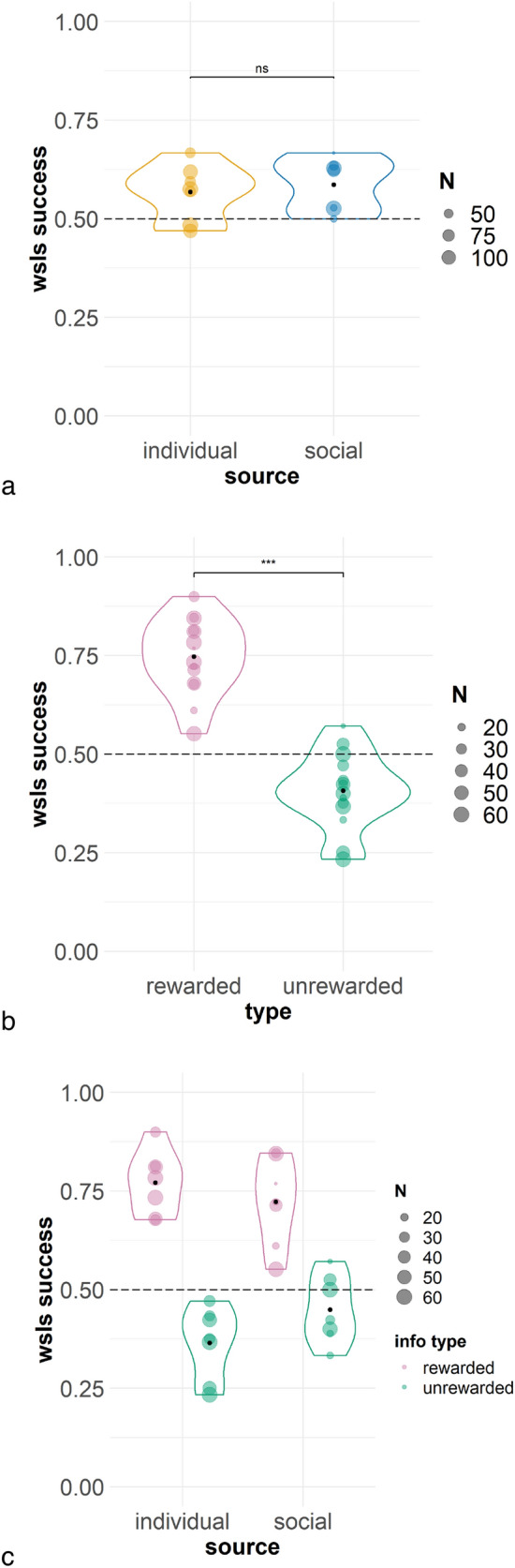
The limited evidence of complex culture in non-human primates contrasts strikingly with human behaviour. This may be because non-human primates fail to use information acquired socially as effectively as they use information acquired individually. Here, monkeys were trained on a stimulus discrimination task with a win-stay, lose-shift (WSLS) reward structure. In a social learning condition, the experimenter performed an information trial by choosing between the available stimuli; in an individual condition, monkeys made this choice themselves. The monkeys' subsequent test trials displayed the same stimulus array. They were rewarded for repetition of rewarded ('win-stay') and avoidance of unrewarded ('lose-shift') information trial selections. Nine monkeys reached our pre-determined performance criterion on the initial two-stimulus stage. Their ability to generalise the WSLS strategy was then evaluated by transfer to a three-stimulus stage. Minimal differences were found in information use between the social and individual conditions on two-stimuli. However, a bias was found towards repetition of the information trial, regardless of information source condition or whether the information trial selection was rewarded. Proficient subjects were found to generalise the strategy to three-stimuli following rewarded information trials, but performed at chance on unrewarded. Again, this was not found to vary by source condition. Overall, results suggest no fundamental barrier to non-human primates' use of information from a social source. However, the apparent struggle to learn from the absence of rewards hints at a difficulty with using information acquired from unsuccessful attempts; this could be linked to the limited evidence for cumulative culture in non-human primates.
非人类灵长类动物的复杂文化的有限证据与人类行为形成鲜明对比。这可能是因为非人类灵长类动物不能像个体获取信息那样有效地利用社会获取的信息。在这里,猴子们接受了一项带有赢留输变(WSLS)奖励结构的刺激辨别任务的训练。在社会学习条件下,实验者通过在可用刺激之间进行选择来进行信息试验;在个体条件下,猴子自己做出了选择。猴子们随后的测试试验显示了相同的刺激数组。它们因重复奖励(“赢留”)和避免未奖励(“输变”)信息试验选择而获得奖励。9 只猴子在最初的两刺激阶段达到了我们预先确定的表现标准。然后,通过转移到三刺激阶段来评估它们对 WSLS 策略的概括能力。在两刺激条件下,社会和个体条件之间在信息使用方面几乎没有差异。然而,无论信息试验选择是否得到奖励,都会发现有一种偏向于重复信息试验的趋势。熟练的受试者在经过奖励信息试验后发现能够将策略推广到三刺激,但在未奖励的情况下表现出机会。同样,这似乎也不受信息源条件的影响。总的来说,结果表明,非人类灵长类动物使用来自社会来源的信息没有根本障碍。然而,从缺乏奖励中学习的明显困难暗示了从不成功的尝试中获取信息的困难;这可能与非人类灵长类动物在累积文化方面的有限证据有关。