MRC London Institute of Medical Sciences (LMS), UK.
Faculty of Medicine, Institute of Clinical Sciences (ICS), Imperial College London, UK.
Mol Oncol. 2022 Nov;16(21):3855-3880. doi: 10.1002/1878-0261.13312. Epub 2022 Sep 23.
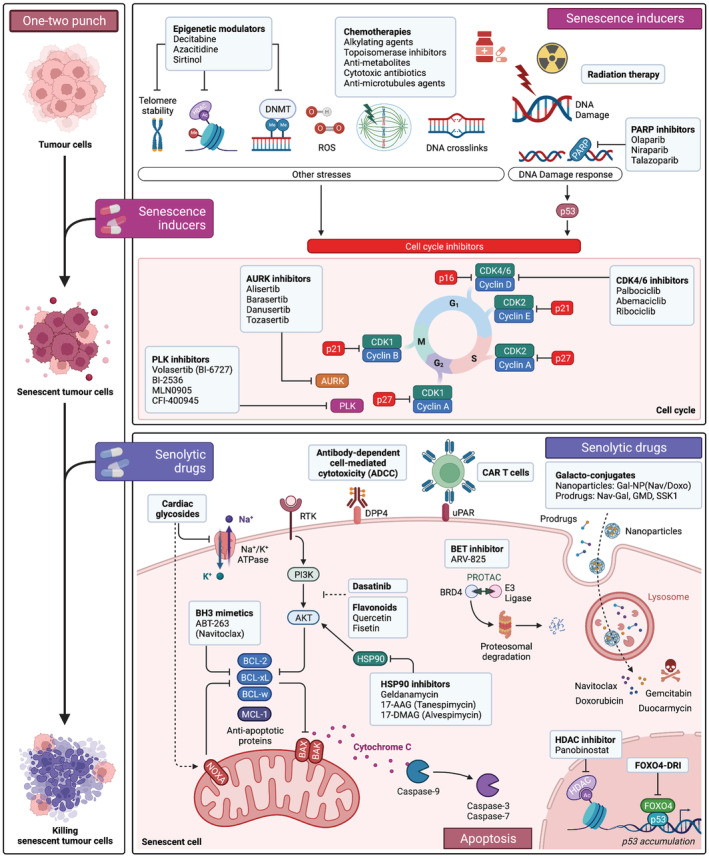
Cellular senescence is a stress response elicited by different molecular insults. Senescence results in cell cycle exit and is characterised by multiple phenotypic changes such as the production of a bioactive secretome. Senescent cells accumulate during ageing and are present in cancerous and fibrotic lesions. Drugs that selectively kill senescent cells (senolytics) have shown great promise for the treatment of age-related diseases. Senescence plays paradoxical roles in cancer. Induction of senescence limits cancer progression and contributes to therapy success, but lingering senescent cells fuel progression, recurrence, and metastasis. In this review, we describe the intricate relation between senescence and cancer. Moreover, we enumerate how current anticancer therapies induce senescence in tumour cells and how senolytic agents could be deployed to complement anticancer therapies. "One-two punch" therapies aim to first induce senescence in the tumour followed by senolytic treatment to target newly exposed vulnerabilities in senescent tumour cells. "One-two punch" represents an emerging and promising new strategy in cancer treatment. Future challenges of "one-two punch" approaches include how to best monitor senescence in cancer patients to effectively survey their efficacy.
细胞衰老(Cellular senescence)是由不同分子损伤引发的应激反应。衰老会导致细胞周期退出,并具有多种表型变化特征,例如产生具有生物活性的分泌组。衰老细胞在衰老过程中积累,并存在于癌症和纤维化病变中。选择性杀死衰老细胞的药物(Senolytics)在治疗与年龄相关的疾病方面显示出巨大的前景。衰老在癌症中起着矛盾的作用。衰老的诱导限制了癌症的进展并有助于治疗成功,但持续存在的衰老细胞会促进进展、复发和转移。在这篇综述中,我们描述了衰老和癌症之间复杂的关系。此外,我们还列举了当前的抗癌疗法如何诱导肿瘤细胞衰老,以及如何利用 Senolytic 药物来补充抗癌疗法。“双拳出击”疗法旨在首先在肿瘤中诱导衰老,然后进行 Senolytic 治疗以靶向衰老肿瘤细胞中新出现的脆弱性。“双拳出击”是癌症治疗中一种新兴且有前途的新策略。“双拳出击”方法的未来挑战包括如何最好地监测癌症患者的衰老情况,以有效评估其疗效。