Shanxi Key Laboratory of Stem Cells for Immunological Dermatosis, Institute of Dermatology, Taiyuan Central Hospital of Shanxi Medical University, Taiyuan, Shanxi, China.
No. 1 English Department, School of Fundamental Sciences, China Medical University, Shenyang, China.
J Cell Mol Med. 2022 Oct;26(20):5202-5212. doi: 10.1111/jcmm.17544. Epub 2022 Sep 6.
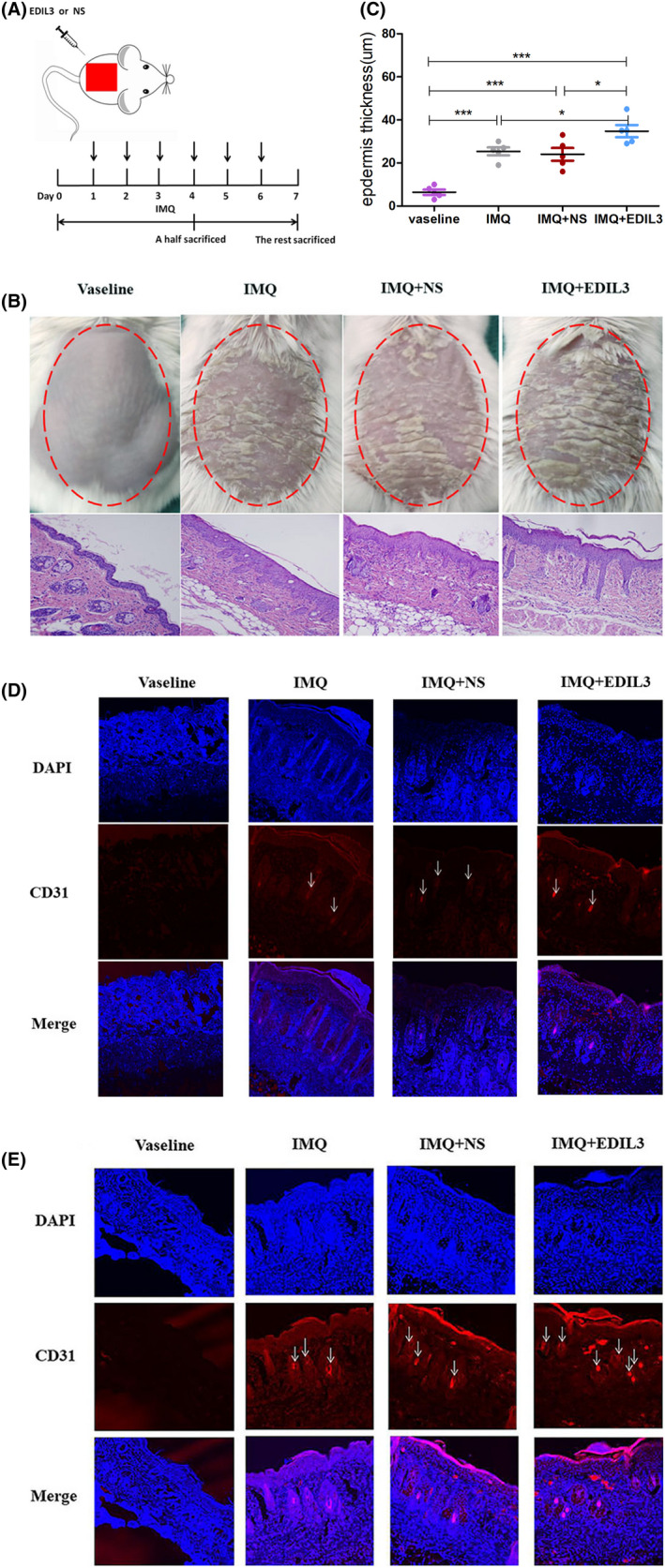
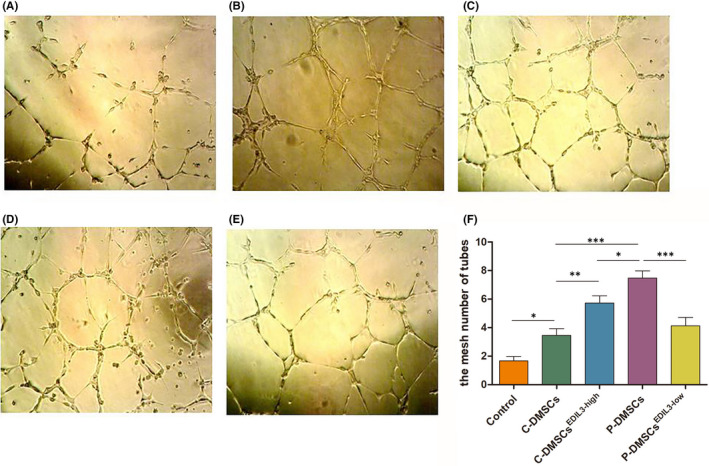
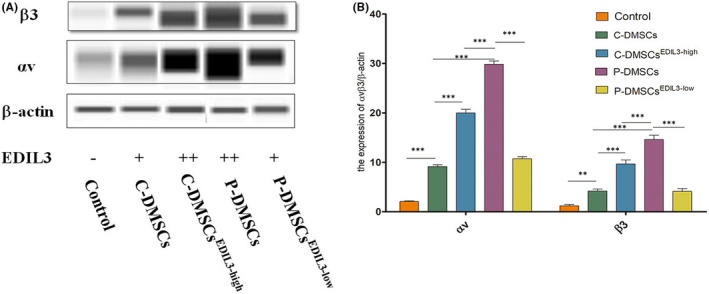
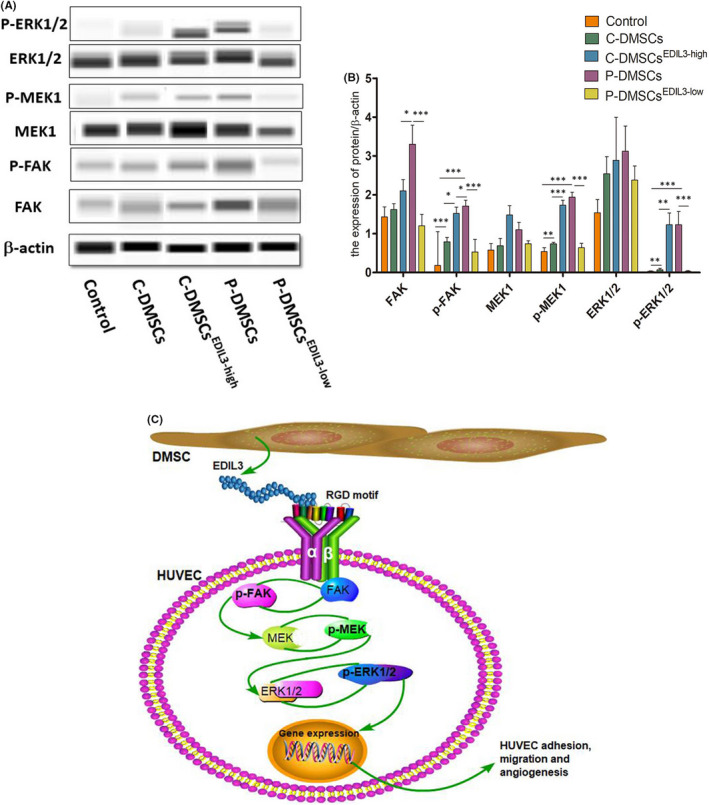
One of the earliest events in the development of psoriatic lesion is a vascular network expansion. The abnormal vascular network is associated with increased endothelial cells (ECs) survival, proliferation, adhesion, migration, angiogenesis and permeability in psoriatic lesion. Our previous study demonstrated that epidermal growth factor-like repeats and discoidin I-like domains 3 (EDIL3) derived from psoriatic dermal mesenchymal stem cells (DMSCs) promoted cell-cell adhesion, migration and angiogenesis of ECs, but the molecular mechanism of upstream or downstream has not been explored. So, this study aimed to explore the association between EDIL3 derived from DMSCs (DMSCs-derived EDIL3) and psoriasis-associated angiogenesis. We injected recombinant EDIL3 protein to mouse model of psoriasis to confirm the roles of EDIL3 in psoriasis. Besides, we employed both short-interference RNA (si-RNA) and lentiviral vectors to explore the molecular mechanism of EDIL3 promoting angiogenesis in psoriasis. In vivo, this research found that after injected recombination EDIL3 protein, the epidermis thickness and microvessel density were both elevated. EDIL3 accelerated the process of psoriasis in the IMQ-induced psoriasis-like mouse model. Additionally, we confirmed that in vitro DMSCs-derived EDIL3 is involved in the tube formation of ECs via αvβ3-FAK/MEK/ERK signal pathway. This suggested that DMSCs-derived EDIL3 and αvβ3-FAK/MEK/ERK signal pathway in ECs play an important role in the pathogenesis of psoriasis. And the modification of DMSCs, EDIL3 and αvβ3-FAK/MEK/ERK signal pathway will provide a valuable therapeutic target to control the angiogenesis in psoriasis.
银屑病皮损发展过程中的最早事件之一是血管网络扩张。异常的血管网络与银屑病皮损中内皮细胞 (ECs) 的存活、增殖、黏附、迁移、血管生成和通透性增加有关。我们之前的研究表明,来自银屑病真皮间充质干细胞 (DMSCs) 的表皮生长因子样重复和盘状结构域 I 样结构域 3 (EDIL3) 促进了 ECs 的细胞间黏附、迁移和血管生成,但上游或下游的分子机制尚未被探索。因此,本研究旨在探讨源自 DMSCs 的 EDIL3 (DMSCs 衍生的 EDIL3) 与银屑病相关血管生成之间的关联。我们向银屑病小鼠模型注射重组 EDIL3 蛋白,以验证 EDIL3 在银屑病中的作用。此外,我们还采用短发夹 RNA (si-RNA) 和慢病毒载体来探索 EDIL3 促进银屑病血管生成的分子机制。在体内,这项研究发现,在注射重组 EDIL3 蛋白后,表皮厚度和微血管密度均升高。EDIL3 加速了 IMQ 诱导的银屑病样小鼠模型中银屑病的发生过程。此外,我们证实,在体外,DMSCs 衍生的 EDIL3 通过 αvβ3-FAK/MEK/ERK 信号通路参与 ECs 的管状形成。这表明 DMSCs 衍生的 EDIL3 和 ECs 中的 αvβ3-FAK/MEK/ERK 信号通路在银屑病发病机制中发挥着重要作用。DMSCs、EDIL3 和 αvβ3-FAK/MEK/ERK 信号通路的修饰将为控制银屑病中的血管生成提供有价值的治疗靶点。