Department of Sports Science and Clinical Biomechanics, Centre for Active and Healthy Ageing, University of Southern Denmark, Odense, Denmark.
Charles Perkins Centre, Faculty of Medicine and Health, School of Health Sciences, The University of Sydney, Camperdown, New South Wales, Australia.
JAMA Neurol. 2022 Oct 1;79(10):1059-1063. doi: 10.1001/jamaneurol.2022.2672.
Step-based recommendations may be appropriate for dementia-prevention guidelines. However, the association of step count and intensity with dementia incidence is unknown.
To examine the dose-response association between daily step count and intensity and incidence of all-cause dementia among adults in the UK.
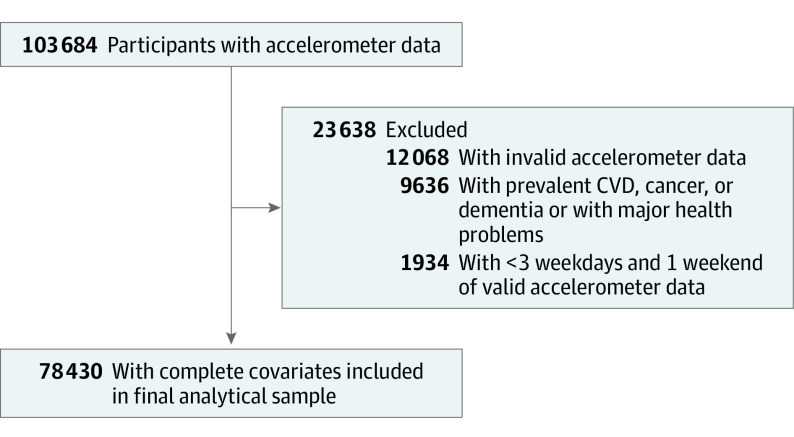
DESIGN, SETTING, AND PARTICIPANTS: UK Biobank prospective population-based cohort study (February 2013 to December 2015) with 6.9 years of follow-up (data analysis conducted May 2022). A total of 78 430 of 103 684 eligible adults aged 40 to 79 years with valid wrist accelerometer data were included. Registry-based dementia was ascertained through October 2021.
Accelerometer-derived daily step count, incidental steps (less than 40 steps per minute), purposeful steps (40 steps per minute or more), and peak 30-minute cadence (ie, mean steps per minute recorded for the 30 highest, not necessarily consecutive, minutes in a day).
Incident dementia (fatal and nonfatal), obtained through linkage with inpatient hospitalization or primary care records or recorded as the underlying or contributory cause of death in death registers. Spline Cox regressions were used to assess dose-response associations.
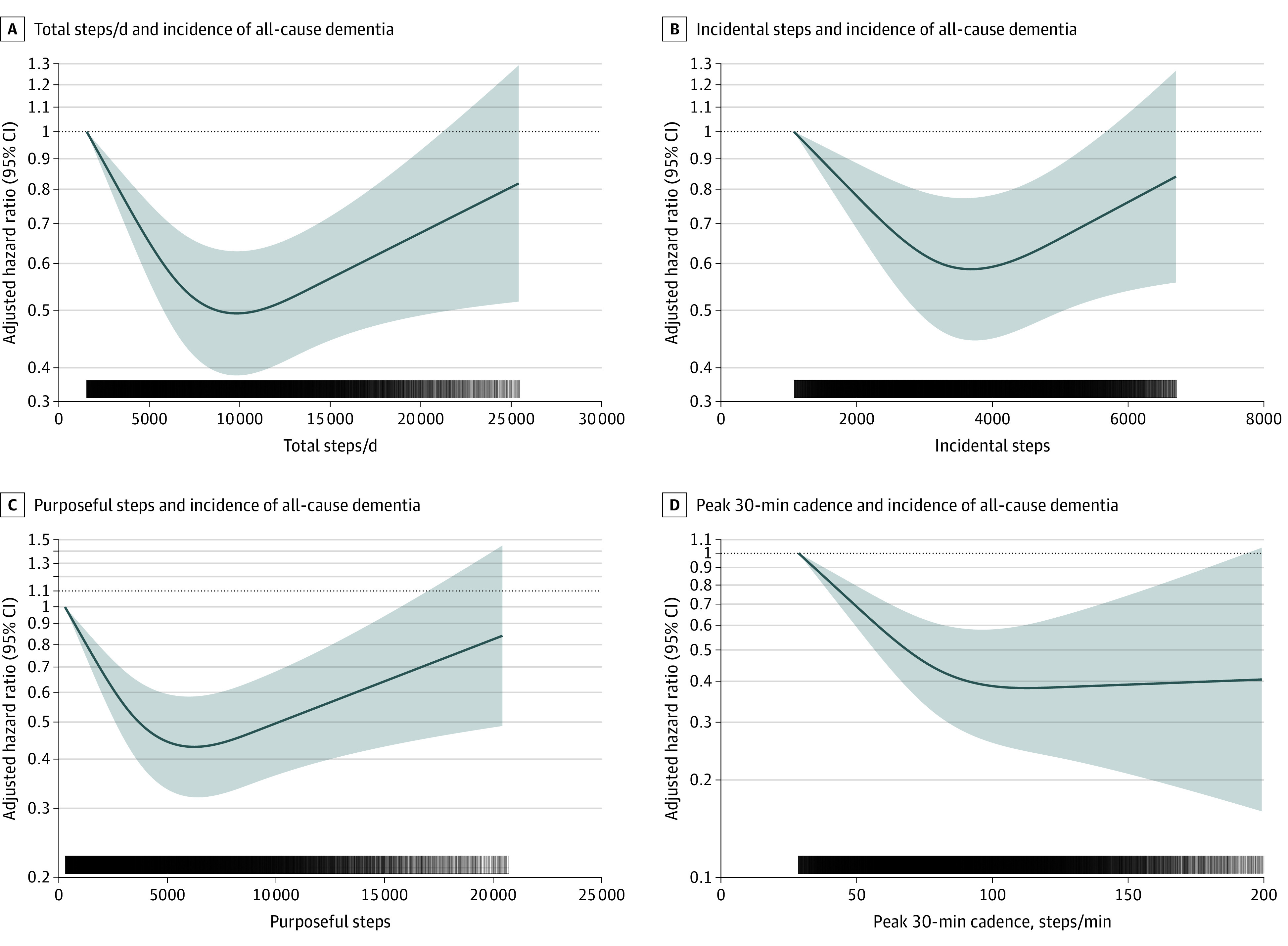
The study monitored 78 430 adults (mean [SD] age, 61.1 [7.9] years; 35 040 [44.7%] male and 43 390 [55.3%] female; 881 [1.1%] were Asian, 641 [0.8%] were Black, 427 [0.5%] were of mixed race, 75 852 [96.7%] were White, and 629 [0.8%] were of another, unspecified race) over a median (IQR) follow-up of 6.9 (6.4-7.5) years, 866 of whom developed dementia (mean [SD] age, 68.3 [5.6] years; 480 [55.4%] male and 386 [54.6%] female; 5 [0.6%] Asian, 6 [0.7%] Black, 4 [0.4%] mixed race, 821 [97.6%] White, and 6 [0.7%] other). Analyses revealed nonlinear associations between daily steps. The optimal dose (ie, exposure value at which the maximum risk reduction was observed) was 9826 steps (hazard ratio [HR], 0.49; 95% CI, 0.39-0.62) and the minimal dose (ie, exposure value at which the risk reduction was 50% of the observed maximum risk reduction) was 3826 steps (HR, 0.75; 95% CI, 0.67-0.83). The incidental cadence optimal dose was 3677 steps (HR, 0.58; 95% CI, 0.44-0.72); purposeful cadence optimal dose was 6315 steps (HR, 0.43; 95% CI, 0.32-0.58); and peak 30-minute cadence optimal dose was 112 steps per minute (HR, 0.38; 95% CI, 0.24-0.60).
In this cohort study, a higher number of steps was associated with lower risk of all-cause dementia. The findings suggest that a dose of just under 10 000 steps per day may be optimally associated with a lower risk of dementia. Steps performed at higher intensity resulted in stronger associations.
分步推荐可能适合预防痴呆症的指南。然而,计步和强度与痴呆症发病率之间的关系尚不清楚。
研究英国成年人日常计步和强度与全因痴呆症发病率之间的剂量-反应关系。
设计、地点和参与者:英国生物银行前瞻性基于人群的队列研究(2013 年 2 月至 2015 年 12 月),随访 6.9 年(数据分析于 2022 年 5 月进行)。共纳入了 78430 名符合条件的年龄在 40 至 79 岁、有有效腕部加速度计数据的成年人中的 103684 名。通过 2021 年 10 月的注册表确定痴呆症。
加速度计测量的每日计步数、偶然计步(每分钟少于 40 步)、有目的计步(每分钟 40 步或更多)和 30 分钟峰值步速(即一天中记录的最高 30 分钟内的平均每分钟步数,不一定是连续的)。
发生的痴呆症(致命和非致命),通过与住院或初级保健记录的联系或在死亡登记中记录为死亡的根本或促成原因来确定。使用样条 Cox 回归评估剂量-反应关系。
该研究监测了 78430 名成年人(平均[标准差]年龄 61.1[7.9]岁;35040[44.7%]名男性和 43390[55.3%]名女性;881[1.1%]名亚洲人,641[0.8%]名黑人,427[0.5%]名混血,75852[96.7%]名白人,629[0.8%]名其他种族),中位(IQR)随访时间为 6.9(6.4-7.5)年,其中 866 人患有痴呆症(平均[标准差]年龄 68.3[5.6]岁;480[55.4%]名男性和 386[54.6%]名女性;5[0.6%]名亚洲人,6[0.7%]名黑人,4[0.4%]名混血,821[97.6%]名白人,6[0.7%]名其他种族)。分析显示每日步数之间存在非线性关联。最佳剂量(即观察到最大风险降低的暴露值)为 9826 步(危险比[HR],0.49;95%CI,0.39-0.62),最小剂量(即风险降低 50%的暴露值观察到的最大风险降低)为 3826 步(HR,0.75;95%CI,0.67-0.83)。偶然步速的最佳剂量为 3677 步(HR,0.58;95%CI,0.44-0.72);有目的步速的最佳剂量为 6315 步(HR,0.43;95%CI,0.32-0.58);30 分钟峰值步速的最佳剂量为 112 步/分钟(HR,0.38;95%CI,0.24-0.60)。
在这项队列研究中,较高的步数与全因痴呆症风险降低相关。研究结果表明,每天接近 10000 步可能与痴呆症风险降低最佳相关。更高强度的步速会产生更强的关联。