Department of Mechanical Engineering, Massachusetts Institute of Technology, Cambridge, Massachusetts, United States of America.
Department of Bioengineering, Stanford University, Stanford, California, United States of America.
PLoS Biol. 2022 Sep 6;20(9):e3001727. doi: 10.1371/journal.pbio.3001727. eCollection 2022 Sep.
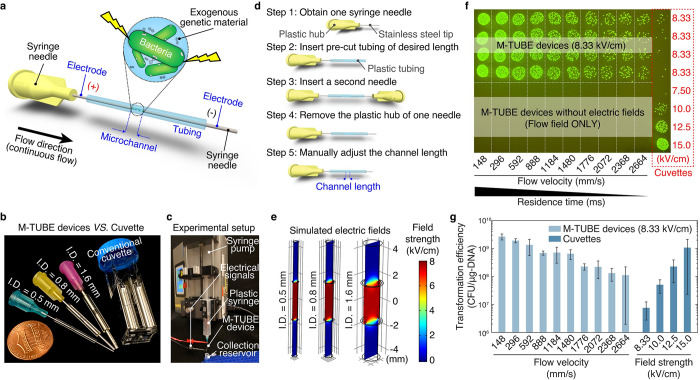
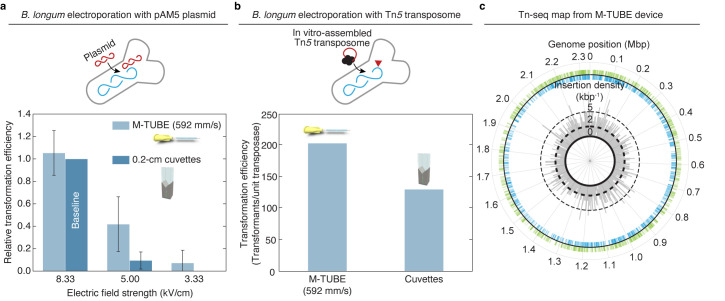
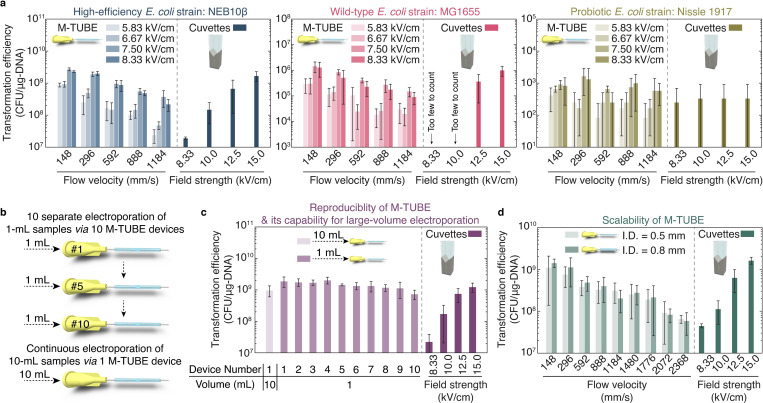
Conventional cuvette-based and microfluidics-based electroporation approaches for bacterial gene delivery have distinct advantages, but they are typically limited to relatively small sample volumes, reducing their utility for applications requiring high throughput such as the generation of mutant libraries. Here, we present a scalable, large-scale bacterial gene delivery approach enabled by a disposable, user-friendly microfluidic electroporation device requiring minimal device fabrication and straightforward operation. We demonstrate that the proposed device can outperform conventional cuvettes in a range of situations, including across Escherichia coli strains with a range of electroporation efficiencies, and we use its large-volume bacterial electroporation capability to generate a library of transposon mutants in the anaerobic gut commensal Bifidobacterium longum.
传统的比色皿和微流控电穿孔方法在细菌基因传递方面具有明显的优势,但它们通常仅限于相对较小的样本量,这限制了它们在需要高通量的应用中的实用性,例如突变文库的生成。在这里,我们提出了一种可扩展的、大规模的细菌基因传递方法,该方法由一种一次性的、用户友好的微流控电穿孔装置实现,该装置需要最小的设备制造和简单的操作。我们证明了该设备在各种情况下都能优于传统的比色皿,包括具有不同电穿孔效率的一系列大肠杆菌菌株,我们还利用其大容量的细菌电穿孔能力,在厌氧肠道共生菌长双歧杆菌中生成了转座子突变体文库。