The University of Texas MD Anderson Cancer Center, Houston, TX.
Alliance Statistics and Data Management Center, Mayo Clinic, Rochester, MN.
J Clin Oncol. 2023 Jan 20;41(3):472-478. doi: 10.1200/JCO.22.00365. Epub 2022 Sep 6.
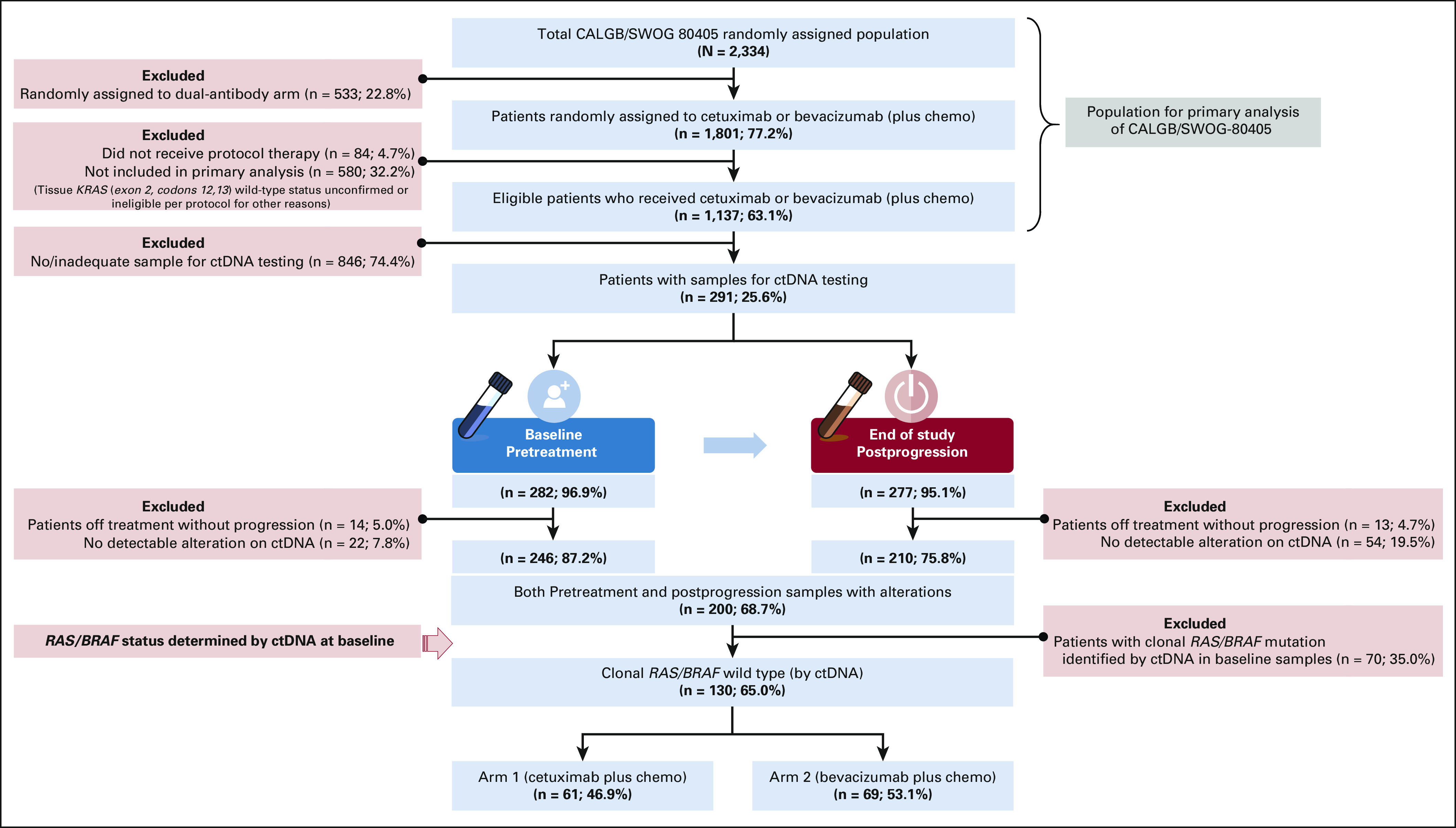
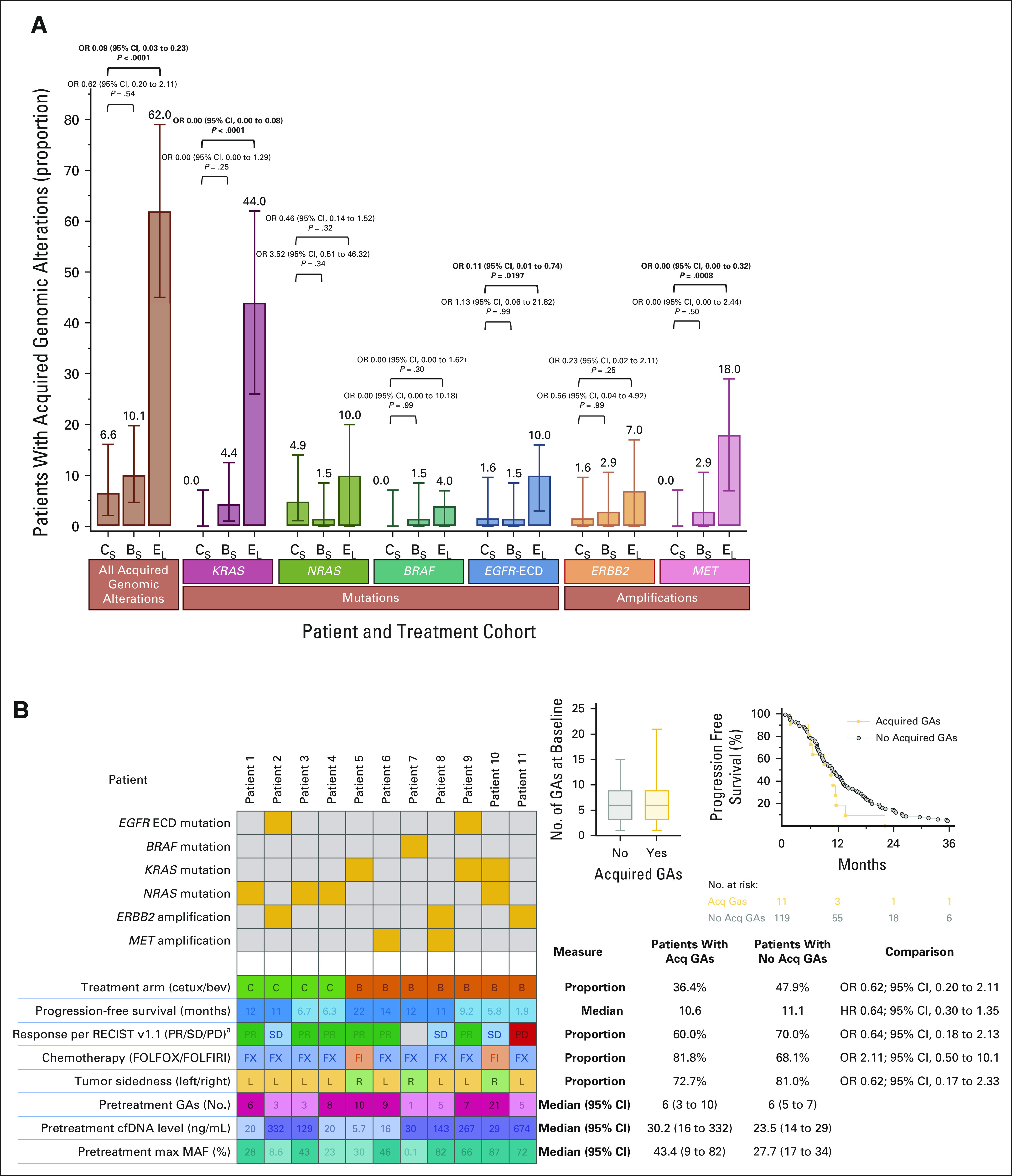
JCO Acquired genomic alterations (Acq-GAs), specifically , , and -ectodomain mutations and and amplifications, are recognized as major mechanisms of resistance to later-line anti-EGFR-antibody therapy in metastatic colorectal cancer (mCRC). However, data regarding emergence of these Acq-GAs under the selective pressure of first-line anti-EGFR-chemotherapy are lacking. We performed next-generation sequencing (Guardant360) on circulating tumor DNA obtained from paired plasma samples (pretreatment and postprogression) from the CALGB/SWOG-80405 trial, which randomly assigned patients with mCRC between first-line chemotherapy with cetuximab (anti-EGFR-chemotherapy) or bevacizumab (anti-VEGF-chemotherapy). The primary objective was to determine the prevalence of Acq-GAs on anti-EGFR-chemotherapy and compare this to the prevalence with anti-VEGF-chemotherapy on trial and pooled estimates (N = 292) seen with later-line anti-EGFR-antibody therapy as reported in the literature. Among the 61 patients on anti-EGFR-chemotherapy, only four (6.6%) developed ≥ 1 Acq-GAs of interest compared with 10.1% (7) on anti-VEGF-chemotherapy (odds ratio, 0.62; 95% CI, 0.20 to 2.11) and 62.0% on anti-EGFR-antibody therapy in later lines (odds ratio, 0.09; 95% CI, 0.03 to 0.23). Acq-GAs, classically associated with anti-EGFR-antibody resistance in later lines (, , and -ectodomain mutations; and amplifications), were rare with up-front use of anti-EGFR-chemotherapy indicating divergent resistance mechanisms. These findings have critical translational relevance to timing and value of circulating tumor DNA-guided anti-EGFR rechallenge in patients with mCRC, especially those treated with anti-EGFR therapy upfront.
JCO 获得性基因组改变(Acq-GAs),特别是 、 、 和外显子突变以及 和 扩增,被认为是转移性结直肠癌(mCRC)后线抗 EGFR 抗体治疗耐药的主要机制。然而,关于这些 Acq-GAs 在一线抗 EGFR 化疗选择压力下出现的数据尚缺乏。我们对 CALGB/SWOG-80405 试验中配对血浆样本(治疗前和进展后)中的循环肿瘤 DNA 进行了下一代测序(Guardant360),该试验随机分配 mCRC 患者接受一线化疗联合西妥昔单抗(抗 EGFR 化疗)或贝伐珠单抗(抗 VEGF 化疗)。主要目的是确定在抗 EGFR 化疗中 Acq-GAs 的发生率,并将其与试验中抗 VEGF 化疗的发生率以及文献中报告的后线抗 EGFR 抗体治疗的汇总估计值(N=292)进行比较。在接受抗 EGFR 化疗的 61 例患者中,只有 4 例(6.6%)发生了≥1 种感兴趣的 Acq-GAs,而接受抗 VEGF 化疗的患者为 10.1%(7 例)(比值比,0.62;95%CI,0.20 至 2.11),后线抗 EGFR 抗体治疗的患者为 62.0%(比值比,0.09;95%CI,0.03 至 0.23)。Acq-GAs 与后线抗 EGFR 抗体耐药相关( 、 、 和外显子突变; 和 扩增),在一线使用抗 EGFR 化疗时很少见,表明存在不同的耐药机制。这些发现对 mCRC 患者循环肿瘤 DNA 指导的抗 EGFR 再次挑战的时机和价值具有重要的转化相关性,特别是那些一线接受抗 EGFR 治疗的患者。