Gyamfi Joyce, Cooper Claire, Barber Aigna, Onakomaiya Deborah, Lee Wen-Yu, Zanowiak Jennifer, Mansu Moses, Diaz Laura, Thompson Linda, Abrams Roger, Schoenthaler Antoinette, Islam Nadia, Ogedegbe Gbenga
New York University School of Global Public Health, 708 Broadway, New York, NY, 10003, USA.
Department of Population Health, New York University School of Medicine, New York, NY, USA.
Implement Sci Commun. 2022 Sep 6;3(1):96. doi: 10.1186/s43058-022-00340-z.
Hypertension (HTN) control among Blacks in the USA has become a major public health challenge. Barriers to HTN control exist at multiple levels including patient, physician, and the health system. Patients also encounter significant community-level barriers, such as poor linkage to social services that impact health (unstable housing, food access, transportation). We describe a multi-component needs assessment to inform the development, implementation, and evaluation of a program to improve HTN management within a large healthcare system in New York City (NYC).
Guided by the Community-Based Participatory Research (CBPR) and Consolidated Framework for Implementation Research (CFIR) frameworks, data will be collected from four main sources: (1) quantitative surveys with health systems leadership, providers, and staff and with community-based organizations (CBOs) and faith-based organizations (FBOs); (2) qualitative interviews and focus groups with health systems leadership, providers, and staff and with CBOs and FBOs; (3) NYC Community Health Survey (CHS); and (4) New York University (NYU) Health system Epic Electronic Health Record (EHR) system. The data sources will allow for triangulation and synthesis of findings.
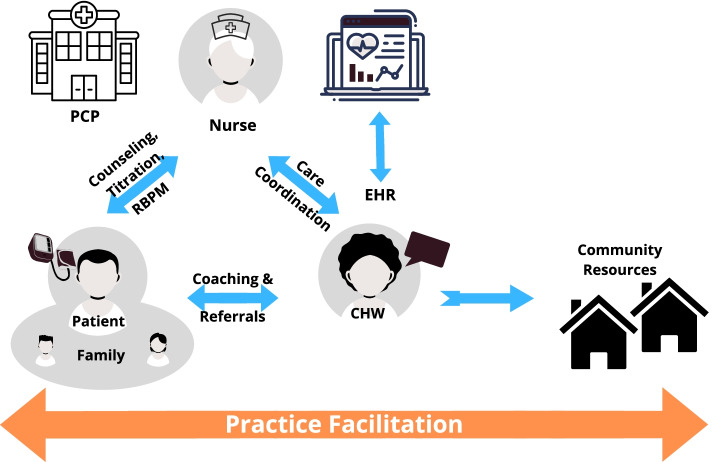
Findings from this comprehensive needs assessment will inform the development of a clinic-community-based practice facilitation program utilizing three multi-level evidence-based interventions (nurse case management, remote blood pressure (BP) monitoring, and social determinants of health (SDoH) support) integrated as a community-clinic linkage model for improved HTN control in Black patients. Integration of stakeholders' priorities, perspectives, and practices into the development of the program will improve adoption, sustainability, and the potential for scale-up.
NCT05208450; registered on January 26, 2022.
美国黑人的高血压(HTN)控制已成为一项重大的公共卫生挑战。HTN控制存在多个层面的障碍,包括患者、医生和卫生系统。患者还面临重大的社区层面障碍,例如与影响健康的社会服务联系不佳(住房不稳定、食物获取、交通)。我们描述了一项多方面的需求评估,以为纽约市(NYC)一个大型医疗系统内改善HTN管理项目的开发、实施和评估提供信息。
在基于社区的参与性研究(CBPR)和实施研究综合框架(CFIR)框架的指导下,将从四个主要来源收集数据:(1)对卫生系统领导、提供者和工作人员以及社区组织(CBO)和基于信仰的组织(FBO)进行定量调查;(2)对卫生系统领导、提供者和工作人员以及CBO和FBO进行定性访谈和焦点小组讨论;(3)纽约市社区健康调查(CHS);以及(4)纽约大学(NYU)卫生系统Epic电子健康记录(EHR)系统。这些数据源将有助于对研究结果进行三角测量和综合。
这项全面需求评估的结果将为一个基于诊所 - 社区的实践促进项目的开发提供信息,该项目利用三种基于多层次证据的干预措施(护士病例管理、远程血压(BP)监测以及健康的社会决定因素(SDoH)支持),作为一种社区 - 诊所联系模型进行整合,以改善黑人患者的HTN控制。将利益相关者的优先事项、观点和实践纳入项目开发将提高采用率、可持续性以及扩大规模的潜力。
NCT05208450;于2022年1月26日注册。