Department of Gastrointestinal Surgery, Institute of Digestive and Metabolic Diseases, Hospital Clinic, C. de Villarroel, 170, 08036, Barcelona, Spain.
Universitat Internacional de Catalunya, Barcelona, Spain.
Langenbecks Arch Surg. 2022 Dec;407(8):3701-3710. doi: 10.1007/s00423-022-02671-w. Epub 2022 Sep 7.
To describe the transition process from open repair (OR) to laparoscopic repair (LR) of bilateral inguinal hernia in a small basic general hospital METHODS: We describe the technical details and training strategy used to facilitate the transition to systematic LR of bilateral inguinal hernia. We conducted a retrospective analysis of prospectively collected data from all patients undergoing bilateral inguinal hernia repair between January 2017 and December 2020. We analysed the evolution of LR and compared the surgical outcomes: complications, acute pain (24 h), chronic pain (> 3 months), and recurrence (1 year) of the patients operated on by OR and LR.
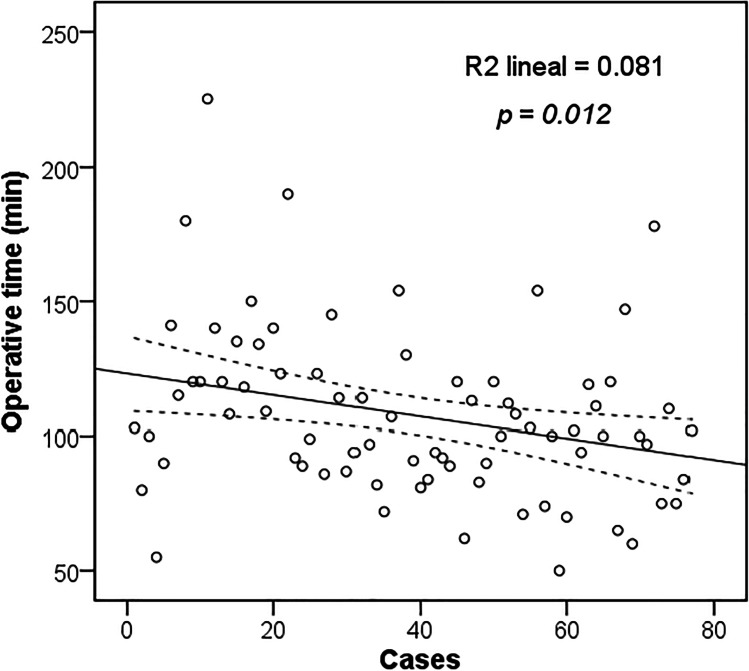
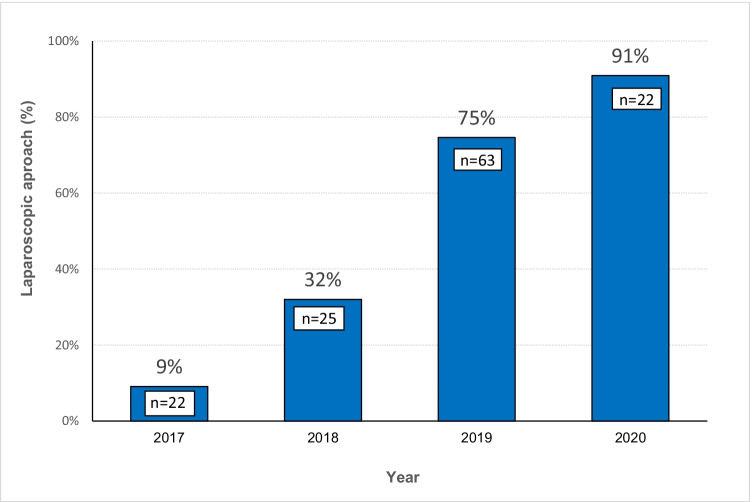
We performed 132 bilateral inguinal hernia repairs, 55 (41.7%) ORs, and 77 (58.3%) LRs. A significant difference was observed in the choice of LR over time (2017: 9%, 2018: 32%, 2019: 75%, 2020: 91%, p < 0.001). The mean operative time was shorter in the OR group than in the LR group (56 min vs. 108 min, p < 0.001). However, the operative time of the LR decreased over the years. No significant differences were observed in complications or recurrence. LR was associated with lower acute postoperative pain at 24 h (2.2 vs. 3.1 points, p = 0.021) and lower chronic groin pain than OR (1.3% vs. 12.7%, p = 0.009).
A structured and systematized training process made the transition from OR to LR of bilateral inguinal hernias feasible and safe in a small basic general hospital. This transition did not increase complications or recurrence. Additionally, LR was associated with a decrease in postoperative pain and chronic groin pain.
描述小综合医院从开放式修复(OR)到腹腔镜修复(LR)双侧腹股沟疝的过渡过程。
我们描述了用于促进系统 LR 双侧腹股沟疝修复的技术细节和培训策略。我们对 2017 年 1 月至 2020 年 12 月期间所有接受双侧腹股沟疝修复的患者前瞻性收集的数据进行了回顾性分析。我们分析了 LR 的演变,并比较了 OR 和 LR 手术患者的手术结果:并发症、急性疼痛(24 小时)、慢性疼痛(>3 个月)和复发(1 年)。
我们进行了 132 例双侧腹股沟疝修复术,其中 55 例(41.7%)采用 OR,77 例(58.3%)采用 LR。随着时间的推移,LR 的选择有显著差异(2017 年:9%,2018 年:32%,2019 年:75%,2020 年:91%,p<0.001)。OR 组的平均手术时间短于 LR 组(56 分钟比 108 分钟,p<0.001)。然而,LR 的手术时间在过去几年中有所下降。并发症或复发无显著差异。LR 与术后 24 小时较低的急性疼痛(2.2 分比 3.1 分,p=0.021)和较低的慢性腹股沟疼痛有关,而 OR 则无差异(1.3%比 12.7%,p=0.009)。
在小综合医院,结构化和系统化的培训过程使从 OR 到 LR 双侧腹股沟疝的过渡成为可能且安全。这种过渡并未增加并发症或复发的风险。此外,LR 与术后疼痛和慢性腹股沟疼痛的减轻有关。