Tzarouchis Dimitrios C, Mencagli Mario Junior, Edwards Brian, Engheta Nader
University of Pennsylvania, Department of Electrical and Systems Engineering, Philadelphia, PA, 19104, USA.
University of North Carolina at Charlotte, Department of Electrical and Computer Engineering, Charlotte, NC, 28223, USA.
Light Sci Appl. 2022 Sep 7;11(1):263. doi: 10.1038/s41377-022-00950-1.
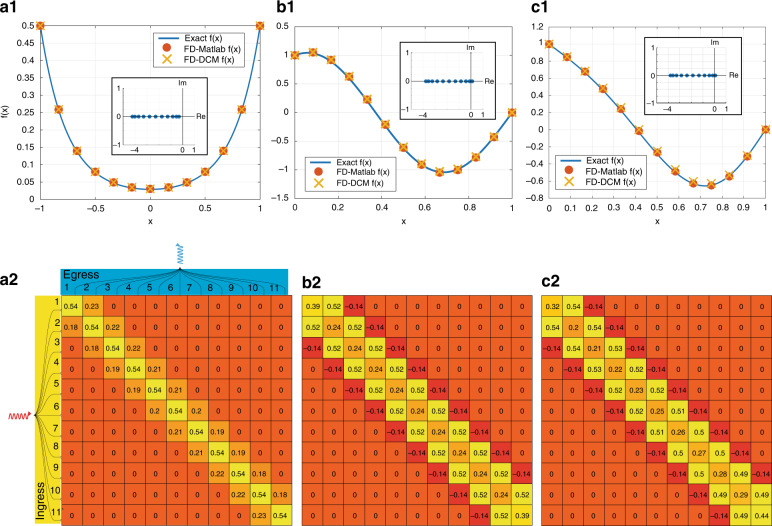
Performing analog computations with metastructures is an emerging wave-based paradigm for solving mathematical problems. For such devices, one major challenge is their reconfigurability, especially without the need for a priori mathematical computations or computationally-intensive optimization. Their equation-solving capabilities are applied only to matrices with special spectral (eigenvalue) distribution. Here we report the theory and design of wave-based metastructures using tunable elements capable of solving integral/differential equations in a fully-reconfigurable fashion. We consider two architectures: the Miller architecture, which requires the singular-value decomposition, and an alternative intuitive direct-complex-matrix (DCM) architecture introduced here, which does not require a priori mathematical decomposition. As examples, we demonstrate, using system-level simulation tools, the solutions of integral and differential equations. We then expand the matrix inverting capabilities of both architectures toward evaluating the generalized Moore-Penrose matrix inversion. Therefore, we provide evidence that metadevices can implement generalized matrix inversions and act as the basis for the gradient descent method for solutions to a wide variety of problems. Finally, a general upper bound of the solution convergence time reveals the rich potential that such metadevices can offer for stationary iterative schemes.
利用亚结构进行模拟计算是一种新兴的基于波的解决数学问题的范式。对于此类器件,一个主要挑战是它们的可重构性,特别是无需先验数学计算或计算密集型优化。它们的方程求解能力仅适用于具有特殊谱(特征值)分布的矩阵。在此,我们报告了基于波的亚结构的理论和设计,该亚结构使用能够以完全可重构方式求解积分/微分方程的可调元件。我们考虑两种架构:需要奇异值分解的米勒架构,以及这里引入的一种替代的直观直接复矩阵(DCM)架构,它不需要先验数学分解。作为示例,我们使用系统级仿真工具演示了积分方程和微分方程的解。然后,我们将两种架构的矩阵求逆能力扩展到评估广义摩尔 - 彭罗斯矩阵求逆。因此,我们证明了元器件可以实现广义矩阵求逆,并作为解决各种问题的梯度下降方法的基础。最后,解收敛时间的一般上限揭示了此类元器件可为平稳迭代方案提供的丰富潜力。