Department of Neuroscience, Brown University, Providence, RI, 02912, USA.
Robert J. and Nancy D. Carney Institute for Brain Science, Brown University, Providence, RI, 02912, USA.
Nat Commun. 2022 Sep 7;13(1):5274. doi: 10.1038/s41467-022-33059-5.
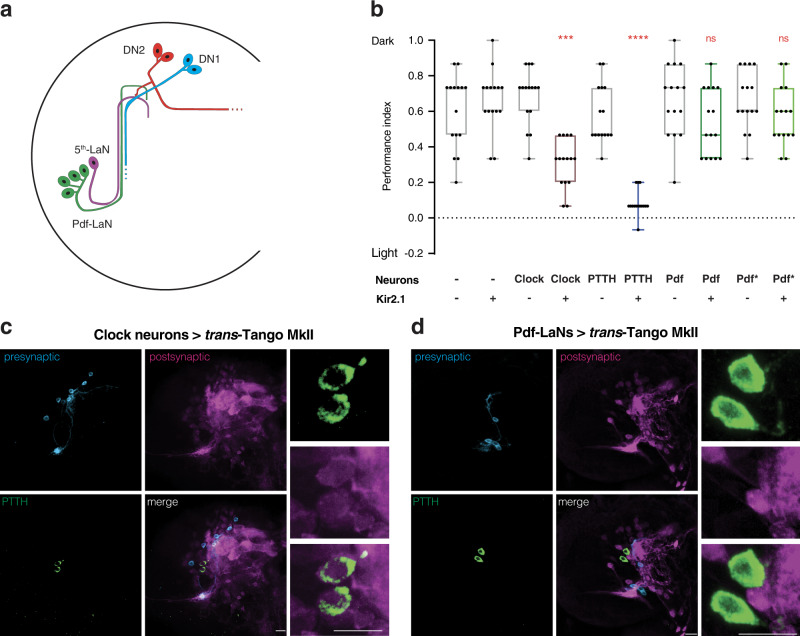
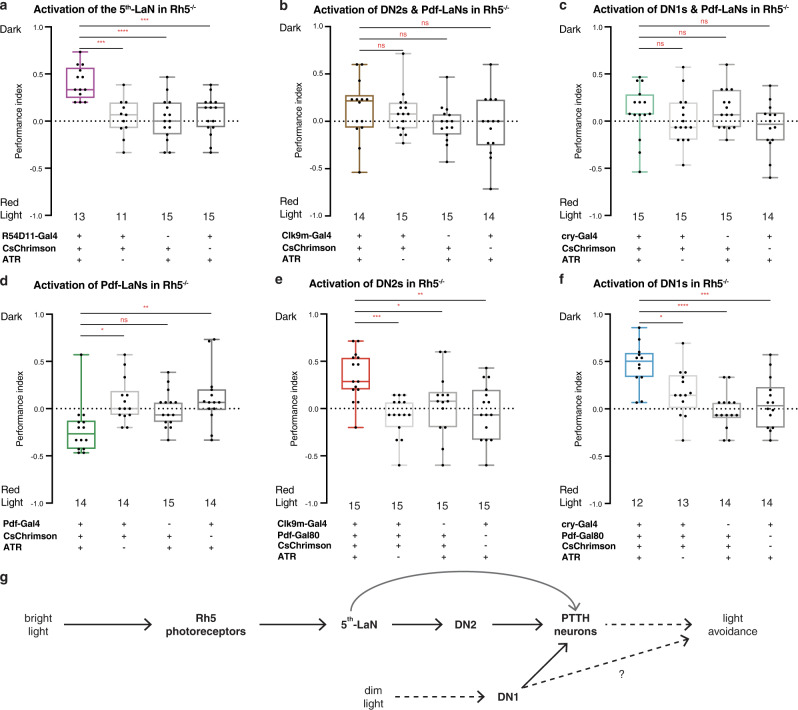
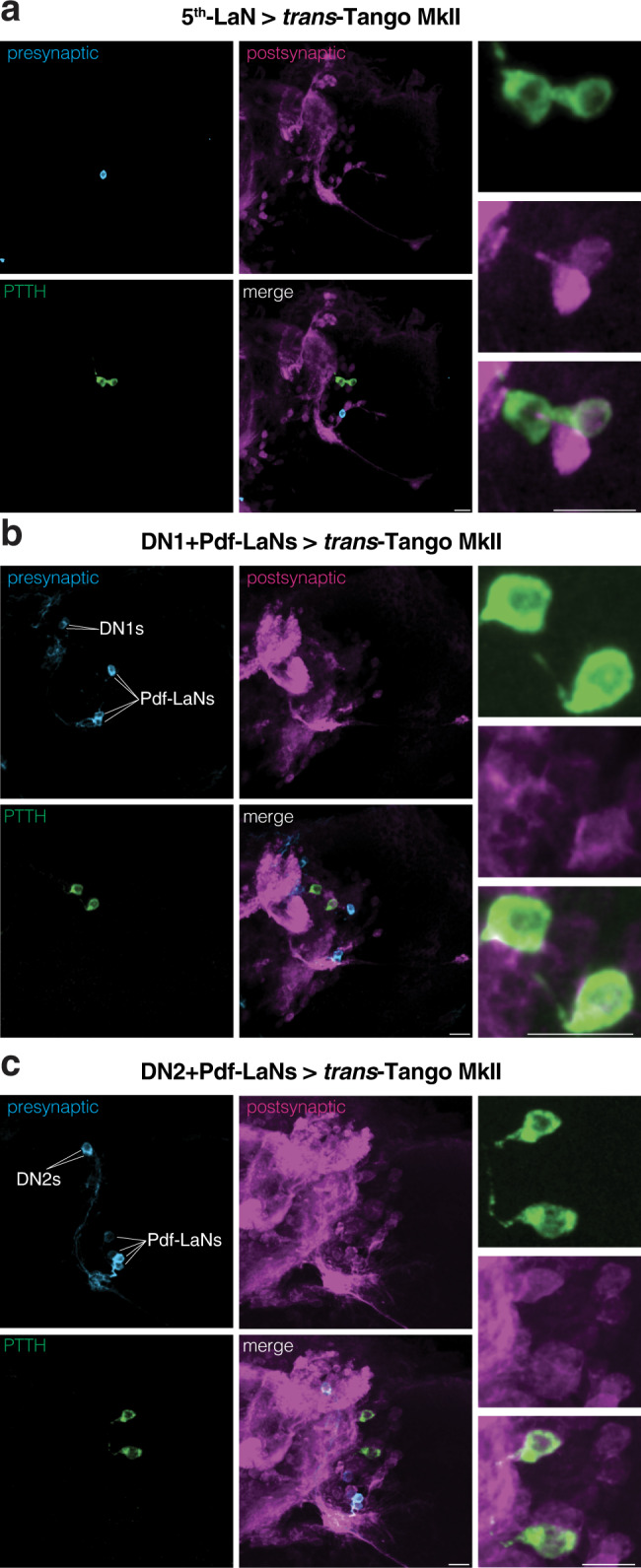
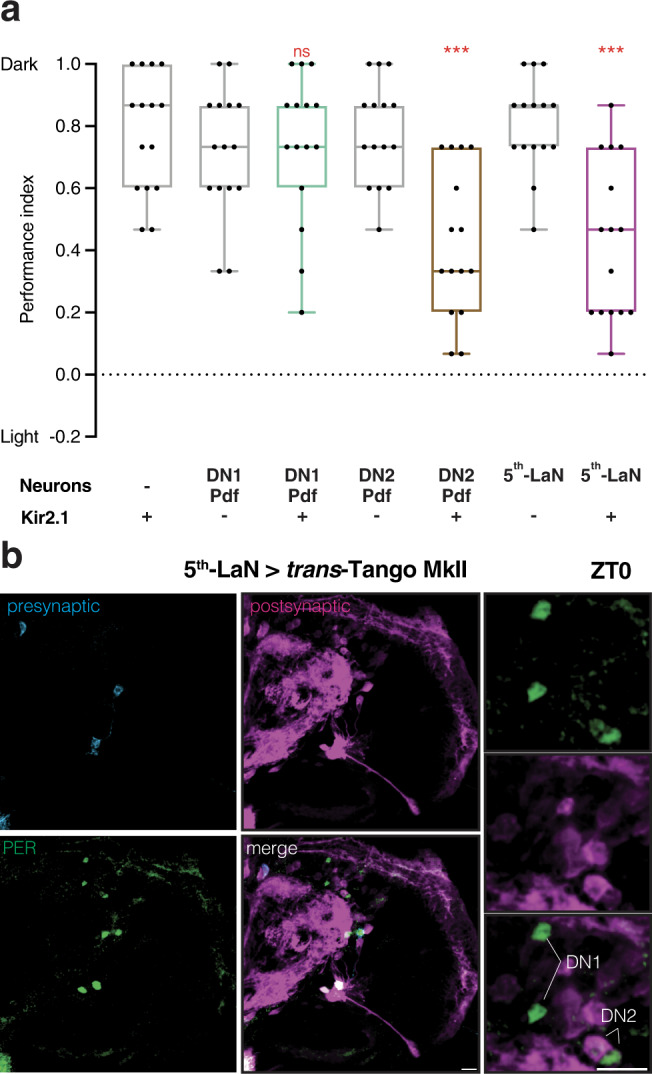
Understanding how neural circuits underlie behaviour is challenging even in the connectome era because it requires a combination of anatomical and functional analyses. This is exemplified in the circuit underlying the light avoidance behaviour displayed by Drosophila melanogaster larvae. While this behaviour is robust and the nervous system relatively simple, the circuit is only partially delineated with some contradictions among studies. Here, we devise trans-Tango MkII, an offshoot of the transsynaptic circuit tracing tool trans-Tango, and implement it in anatomical tracing together with functional analysis. We use neuronal inhibition to test necessity of particular neuronal types in light avoidance and selective neuronal activation to examine sufficiency in rescuing light avoidance deficiencies exhibited by photoreceptor mutants. Our studies reveal a four-order circuit for light avoidance connecting the light-detecting photoreceptors with a pair of neuroendocrine cells via two types of clock neurons. This approach can be readily expanded to studying other circuits.
理解神经回路如何支配行为,即使在连接组时代也是一项挑战,因为这需要结合解剖学和功能分析。这在黑腹果蝇幼虫表现出的光回避行为的回路中得到了例证。虽然这种行为很稳定,神经系统也相对简单,但该回路仅部分描绘出来,不同研究之间存在一些矛盾。在这里,我们设计了 trans-Tango MkII,这是 transsynaptic 回路追踪工具 trans-Tango 的一个分支,并在解剖学追踪中结合功能分析来实现它。我们使用神经元抑制来测试特定神经元类型在光回避中的必要性,以及选择性神经元激活来检查其在挽救光感受器突变体表现出的光回避缺陷中的充分性。我们的研究揭示了一个用于光回避的四级回路,它通过两种类型的时钟神经元将光探测光感受器与一对神经内分泌细胞连接起来。这种方法可以很容易地扩展到研究其他回路。