Syed Sofia Ali, Qureshi Muhammad Asif, Khan Saeed, Kumar Rajesh, Shafique Yusra, Khan Bilal Ahmed, Safdar Jawad
Department of Oral Pathology, Dr. Ishrat-ul-Ibad Khan Institute of Oral Health Sciences, Dow University of Health Sciences, Karachi 74200, Pakistan.
Department of Pathology, Dow International Medical College, Dow University of Health Sciences, Karachi 74200, Pakistan.
Ecancermedicalscience. 2022 Jun 15;16:1413. doi: 10.3332/ecancer.2022.1413. eCollection 2022.
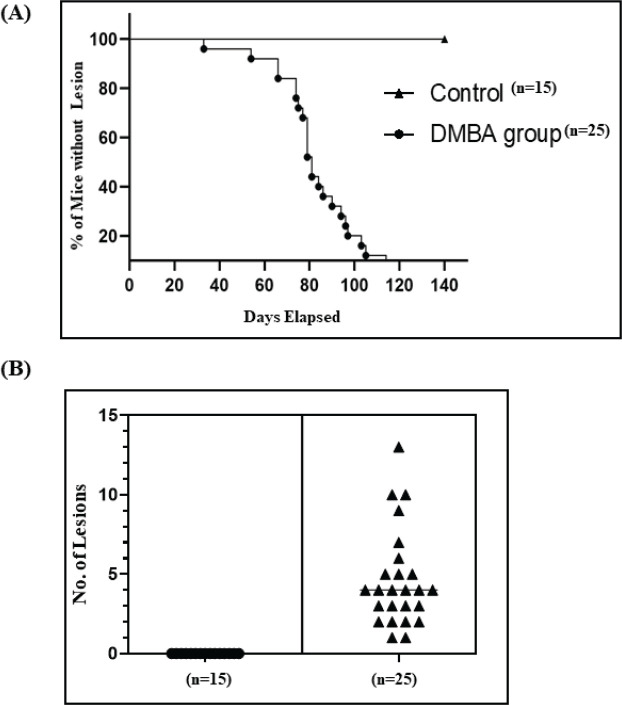
Oral squamous cell carcinoma (OSCC) is the most common cancer in Pakistani men and the second most common cancer in women. The objective of our study was to devise a novel accelerated murine model of oral carcinogenesis that can be exploited as a tool to investigate the cancer circuitry involved in OSCC and to identify molecules of diagnostic, therapeutic and prognostic significance. A total of 40 healthy male, 6-8 weeks old, 22 ± 2 gram, Naval Medical Research Institute (NMRI) outbred strain mice were recruited in the experiment. NMRI mice are commonly used for animal experiments in various fields of biology and for drug toxicity. Of these, 25 mice underwent the oral carcinogenesis regimen via topical application of 0.5% 9,10-dimethyl-1,2-benzanthracene (DMBA) on the lower left lip for a maximum of 20 weeks and 15 mice were used as controls (without the carcinogenic regimen). Exophytic tissue masses were harvested, fixed in 10% formalin and stained with haematoxylin and eosin (H&E) for microscopic diagnosis. Additionally, the expression levels of CK 5/6, p53 and Ki-67 were investigated using immunohistochemistry. Of the 25 mice which underwent the carcinogenic regimen, 21 developed moderately differentiated squamous cell carcinoma and 1 showed dysplastic features with foci of invasion. Three mice were found dead with lesion(s). CK 5/6 showed strong positivity (100%) and p53 and Ki-67 showed patchy (<30%) strong positivity in OSCC, suggesting the similarity of our model to human OSCC. We present an accelerated, close-to-human carcinogenesis, model of oral carcinogenesis using DMBA in NMRI mice that can be exploited to study the pathogenesis of oral squamous cell carcinoma and subsequently devise immunotherapy or targeted therapy.
口腔鳞状细胞癌(OSCC)是巴基斯坦男性中最常见的癌症,在女性中是第二常见的癌症。我们研究的目的是设计一种新型的加速口腔癌发生的小鼠模型,该模型可作为一种工具,用于研究OSCC中涉及的癌症通路,并识别具有诊断、治疗和预后意义的分子。实验共招募了40只健康的雄性小鼠,6 - 8周龄,体重22±2克,为海军医学研究所(NMRI)远交系小鼠。NMRI小鼠常用于生物学各个领域的动物实验以及药物毒性研究。其中,25只小鼠通过在左下唇局部涂抹0.5%的9,10 - 二甲基 - 1,2 - 苯并蒽(DMBA)进行口腔癌发生方案处理,最长持续20周,15只小鼠作为对照(未进行致癌方案处理)。采集外生性组织块,用10%福尔马林固定,并用苏木精和伊红(H&E)染色进行显微镜诊断。此外,使用免疫组织化学研究CK 5/6、p53和Ki - 67的表达水平。在接受致癌方案处理的25只小鼠中,21只发生了中分化鳞状细胞癌,1只表现出发育异常特征并伴有侵袭灶。发现3只小鼠因病变死亡。在OSCC中,CK 5/6显示强阳性(100%),p53和Ki - 67显示斑片状(<30%)强阳性,表明我们的模型与人类OSCC相似。我们展示了一种使用NMRI小鼠中的DMBA建立的加速、接近人类的口腔癌发生模型,该模型可用于研究口腔鳞状细胞癌的发病机制,并随后设计免疫疗法或靶向疗法。