Department of Ophthalmology, Guangdong Eye Institute, Guangdong Provincial People's Hospital, Guangdong Academy of Medical Sciences, Guangzhou, China.
Graduate School, Shantou University Medical College, Shantou, China.
Front Public Health. 2022 Aug 22;10:984199. doi: 10.3389/fpubh.2022.984199. eCollection 2022.
To examine the risk factors for falls in elderly patients with visual impairment (VI) and assess the predictive performance of these factors.
Between January 2019 and March 2021, a total of 251 elderly patients aged 65-92 years with VI were enrolled and then prospectively followed up for 12 months to evaluate outcomes of accidental falls telephone interviews. Information of demographics and lifestyle, gait and balance deficits, and ophthalmic and systemic conditions were collected during baseline visits. Forward stepwise multivariable logistic regression analysis was performed to identify independent risk factors of falls in elderly patients with VI, and a derived nomogram was constructed.
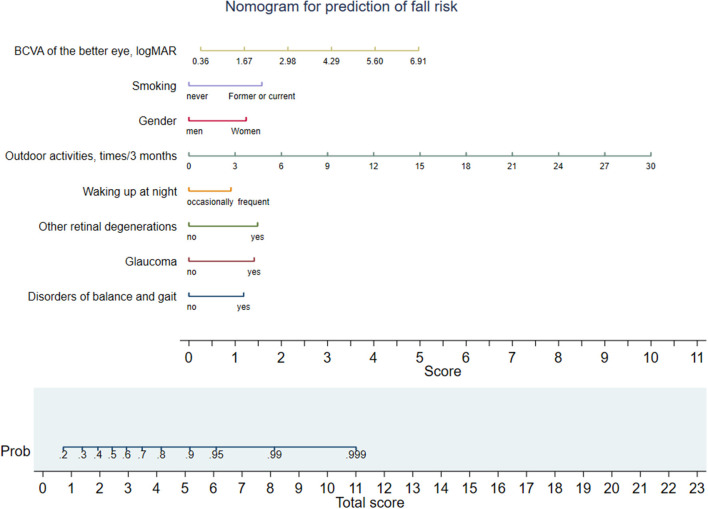
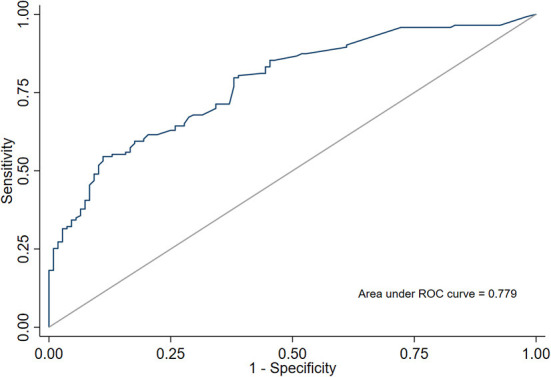
A total of 143 falls were reported in 251 elderly patients during follow-up, with an incidence of 56.97%. The risk factors for falls in elderly patients with VI identified by multivariable logistic regression were women [odds ratio (OR), 95% confidence interval (CI): 2.71, 1.40-5.27], smoking (3.57, 1.34-9.48), outdoor activities/3 months (1.31, 1.08-1.59), waking up frequently during the night (2.08, 1.15-3.79), disorders of balance and gait (2.60, 1.29-5.24), glaucoma (3.12, 1.15-8.44), other retinal degenerations (3.31, 1.16-9.43) and best-corrected visual acuity (BCVA) of the better eye (1.79, 1.10-2.91). A nomogram was developed based on the abovementioned multivariate analysis results. The area under receiver operating characteristic curve of the predictive model was 0.779.
Gender, smoking, outdoor activities, waking up at night, disorders of balance and gait, glaucoma, other retinal degeneration and BCVA of the better eye were independent risk factors for falls in elderly patients with VI. The predictive model and derived nomogram achieved a satisfying prediction of fall risk in these individuals.
探讨老年视力障碍(VI)患者跌倒的危险因素,并评估这些因素的预测性能。
2019 年 1 月至 2021 年 3 月,共纳入 251 名 65-92 岁的老年 VI 患者,并对其进行前瞻性随访 12 个月,以评估意外跌倒的结局。通过电话访谈进行评估。在基线就诊时收集人口统计学和生活方式、步态和平衡缺陷以及眼科和全身情况的信息。采用逐步向前多变量逻辑回归分析识别老年 VI 患者跌倒的独立危险因素,并构建一个推导的列线图。
在随访期间,251 名老年患者共报告了 143 次跌倒,发生率为 56.97%。多变量逻辑回归分析确定的老年 VI 患者跌倒的危险因素包括女性[比值比(OR),95%置信区间(CI):2.71,1.40-5.27]、吸烟(3.57,1.34-9.48)、户外活动/3 个月(1.31,1.08-1.59)、夜间频繁醒来(2.08,1.15-3.79)、平衡和步态障碍(2.60,1.29-5.24)、青光眼(3.12,1.15-8.44)、其他视网膜变性(3.31,1.16-9.43)和最佳矫正视力(BCVA)较好眼(1.79,1.10-2.91)。基于上述多变量分析结果,建立了一个列线图。预测模型的受试者工作特征曲线下面积为 0.779。
性别、吸烟、户外活动、夜间醒来、平衡和步态障碍、青光眼、其他视网膜变性和 BCVA 较好眼是老年 VI 患者跌倒的独立危险因素。预测模型和推导的列线图对这些个体的跌倒风险预测达到了令人满意的效果。