Department of Veterinary Epidemiology and Public Health, Faculty of Health and Medical Sciences, University of Surrey, Guildford.
Onderstepoort J Vet Res. 2022 Aug 4;89(1):2007. doi: 10.4102/ojvr.v89i1.2007.
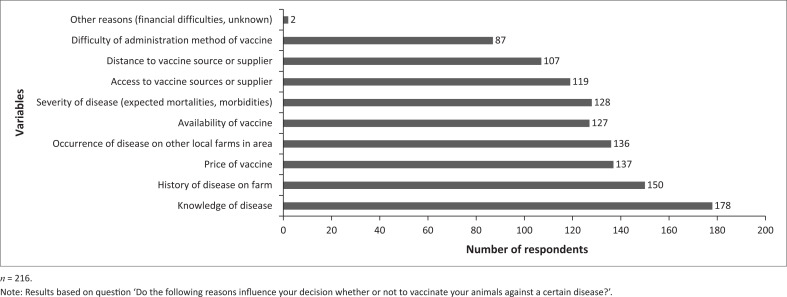
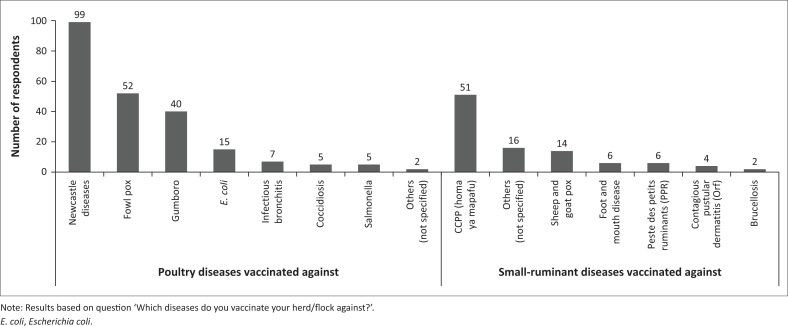
Vaccination is an important disease prevention and control measure; however, vaccine adoption by livestock farmers in Tanzania is still low. This cross-sectional study examined the challenges to vaccine use faced by livestock owners and animal health professionals (AHPs) in Tanzania. A questionnaire was administered to 216 households that kept small ruminants and poultry and 19 AHPs' data were collected electronically via the survey platform Qualtrics, and descriptive statistics were performed. Households with poultry reported vaccinating mostly against Newcastle disease (91.7%), fowl pox (48.1%) and Gumboro disease (37.0%), whilst households with small ruminants reported contagious caprine pleuropneumonia (62.2%), sheep and goat pox (17.1%), foot-and-mouth disease (7.3%) and peste des petits ruminants (7.3%). The households' decision to vaccinate was mostly influenced by knowledge of diseases (82.4%), disease history on the farm (69.4%) and vaccine price (63.4%). Most households (54.6%) experienced challenges when purchasing vaccines, including high vaccine cost (78.0%), long distance from vaccine source (61.0%) and vaccine unavailability (21.2%). The findings suggest that improving the knowledge of livestock owners regarding the priority diseases and the benefits of vaccination, establishing more vaccine suppliers, improving vaccine distribution and access and training AHPs and households on appropriate vaccine storage and handling are necessary to improve vaccine adoption and ensure vaccine quality and effectiveness.
疫苗接种是一种重要的疾病防控措施;然而,坦桑尼亚的牲畜饲养者对疫苗的接受程度仍然较低。本横断面研究调查了坦桑尼亚牲畜饲养者和动物卫生专业人员(AHPs)在使用疫苗方面面临的挑战。向 216 户饲养小反刍动物和家禽的家庭以及 19 名 AHP 发放了问卷,并通过调查平台 Qualtrics 以电子方式收集了数据,进行了描述性统计分析。报告称,饲养家禽的家庭主要针对新城疫(91.7%)、禽痘(48.1%)和 Gumboro 病(37.0%)进行疫苗接种,而饲养小反刍动物的家庭则报告称针对传染性山羊胸膜肺炎(62.2%)、绵羊和山羊痘(17.1%)、口蹄疫(7.3%)和小反刍动物瘟(7.3%)进行疫苗接种。家庭是否决定接种疫苗主要受到对疾病的了解程度(82.4%)、农场疾病史(69.4%)和疫苗价格(63.4%)的影响。大多数家庭(54.6%)在购买疫苗时遇到了挑战,包括疫苗成本高(78.0%)、距离疫苗来源远(61.0%)和疫苗供应不足(21.2%)。研究结果表明,有必要提高牲畜饲养者对优先疾病和疫苗接种益处的了解,建立更多的疫苗供应商,改善疫苗的分配和获取途径,并对动物卫生专业人员和家庭进行适当的疫苗储存和处理培训,以提高疫苗的接受程度,确保疫苗的质量和效果。