Ramsay Santé Institut Cardiovasculaire Paris Sud, Hôpital privé Jacques Cartier Massy France.
AP-HP, La Pitié Salpêtrière University Hospital, Cardiology Department Paris France.
J Am Heart Assoc. 2022 Sep 20;11(18):e026196. doi: 10.1161/JAHA.122.026196. Epub 2022 Sep 8.
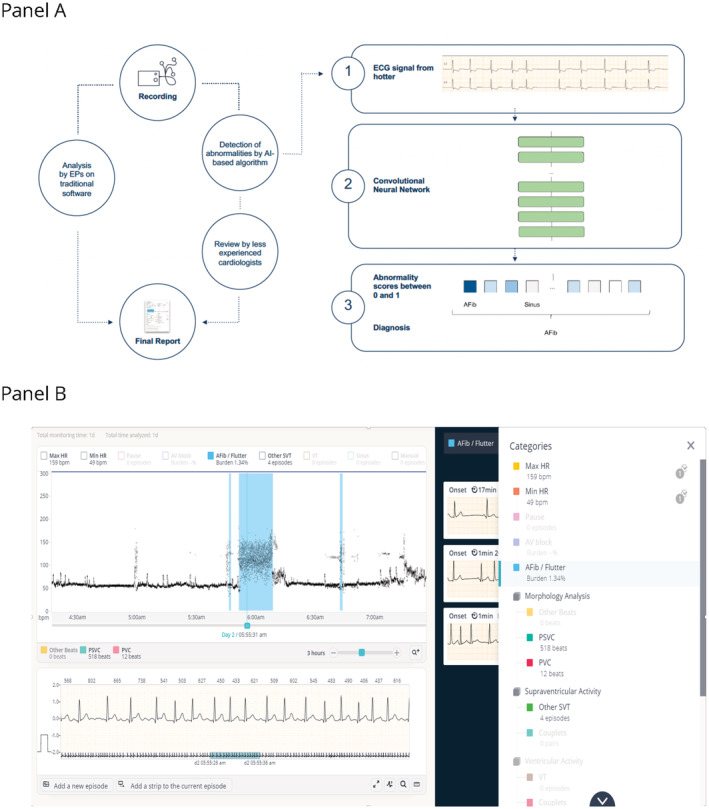
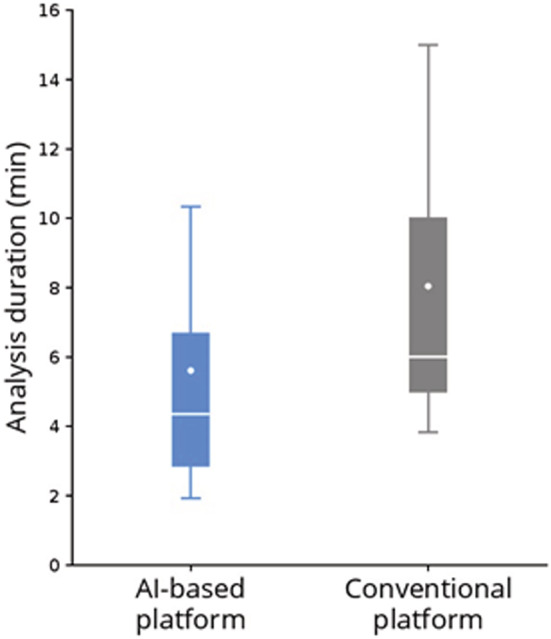
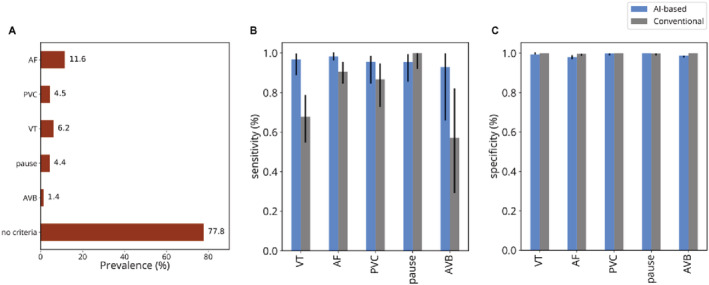
Background Holter analysis requires significant clinical resources to achieve a high-quality diagnosis. This study sought to assess whether an artificial intelligence (AI)-based Holter analysis platform using deep neural networks is noninferior to a conventional one used in clinical routine in detecting a major rhythm abnormality. Methods and Results A total of 1000 Holter (24-hour) recordings were collected from 3 tertiary hospitals. Recordings were independently analyzed by cardiologists for the AI-based platform and by electrophysiologists as part of clinical practice for the conventional platform. For each Holter, diagnostic performance was evaluated and compared through the analysis of the presence or absence of 5 predefined cardiac abnormalities: pauses, ventricular tachycardia, atrial fibrillation/flutter/tachycardia, high-grade atrioventricular block, and high burden of premature ventricular complex (>10%). Analysis duration was monitored. The deep neural network-based platform was noninferior to the conventional one in its ability to detect a major rhythm abnormality. There were no statistically significant differences between AI-based and classical platforms regarding the sensitivity and specificity to detect the predefined abnormalities except for atrial fibrillation and ventricular tachycardia (atrial fibrillation, 0.98 versus 0.91 and 0.98 versus 1.00; pause, 0.95 versus 1.00 and 1.00 versus 1. 00; premature ventricular contractions, 0.96 versus 0.87 and 1.00 versus 1.00; ventricular tachycardia, 0.97 versus 0.68 and 0.99 versus 1.00; atrioventricular block, 0.93 versus 0.57 and 0.99 versus 1.00). The AI-based analysis was >25% faster than the conventional one (4.4 versus 6.0 minutes; <0.001). Conclusions These preliminary findings suggest that an AI-based strategy for the analysis of Holter recordings is faster and at least as accurate as a conventional analysis by electrophysiologists.
动态心电图分析需要大量的临床资源才能实现高质量的诊断。本研究旨在评估基于人工智能(AI)的动态心电图分析平台是否使用深度神经网络在检测主要节律异常方面不劣于临床常规使用的传统平台。
共从 3 家三级医院收集了 1000 份动态心电图(24 小时)记录。由心脏病专家对基于 AI 的平台和电生理学家对传统平台进行独立分析,以检测 5 种预先定义的心脏异常的存在或缺失:停搏、室性心动过速、心房颤动/扑动/心动过速、高度房室传导阻滞和室性早搏负担过重(>10%)。监测分析持续时间。深度神经网络的平台在检测主要节律异常方面不劣于传统平台。除了心房颤动和室性心动过速,基于 AI 的平台和经典平台在检测预先定义的异常方面的敏感性和特异性没有统计学差异:心房颤动(0.98 与 0.91 和 0.98 与 1.00);停搏(0.95 与 1.00 和 1.00 与 1.00);室性早搏(0.96 与 0.87 和 1.00 与 1.00);室性心动过速(0.97 与 0.68 和 0.99 与 1.00);房室传导阻滞(0.93 与 0.57 和 0.99 与 1.00)。基于 AI 的分析比传统分析快>25%(4.4 与 6.0 分钟;<0.001)。
这些初步发现表明,基于 AI 的动态心电图分析策略比传统的电生理学家分析更快,至少同样准确。