Instituto de Biotecnología y Biología Molecular, CCT-La Plata-CONICET, Departamento de Ciencias Biológicas, Facultad de Ciencias Exactas, Universidad Nacional de La Plata, La Plata, Argentina.
Center for Biotechnology (CeBiTec), Bielefeld Universitygrid.7491.b, Genome Research of Industrial Microorganisms, Bielefeld, Germany.
mBio. 2022 Oct 26;13(5):e0194922. doi: 10.1128/mbio.01949-22. Epub 2022 Sep 8.
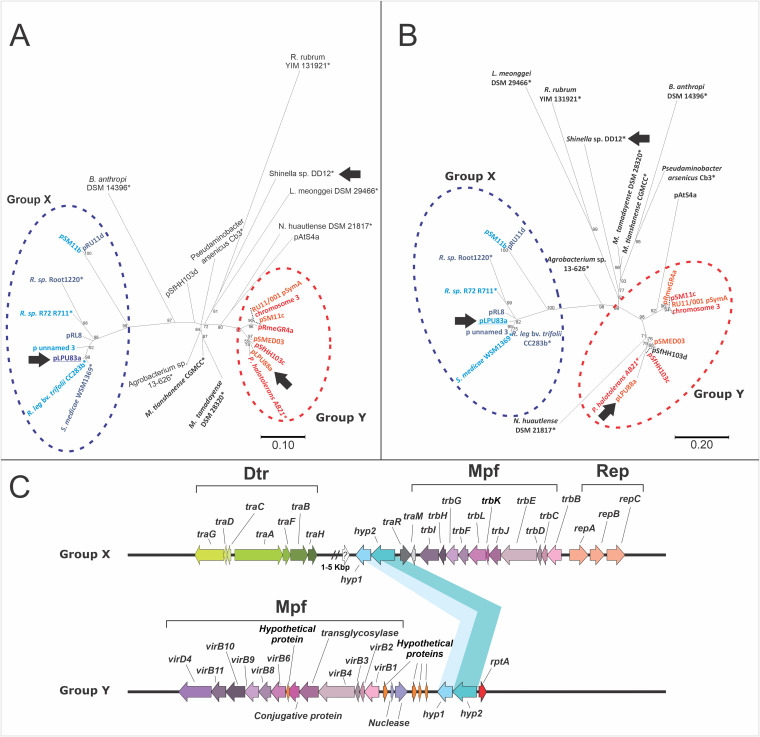
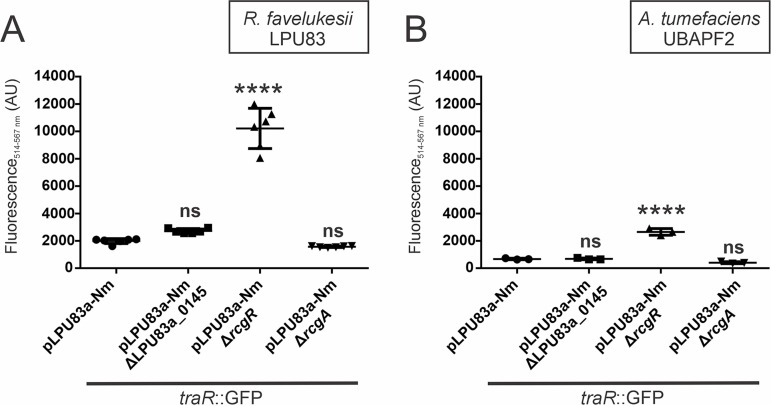
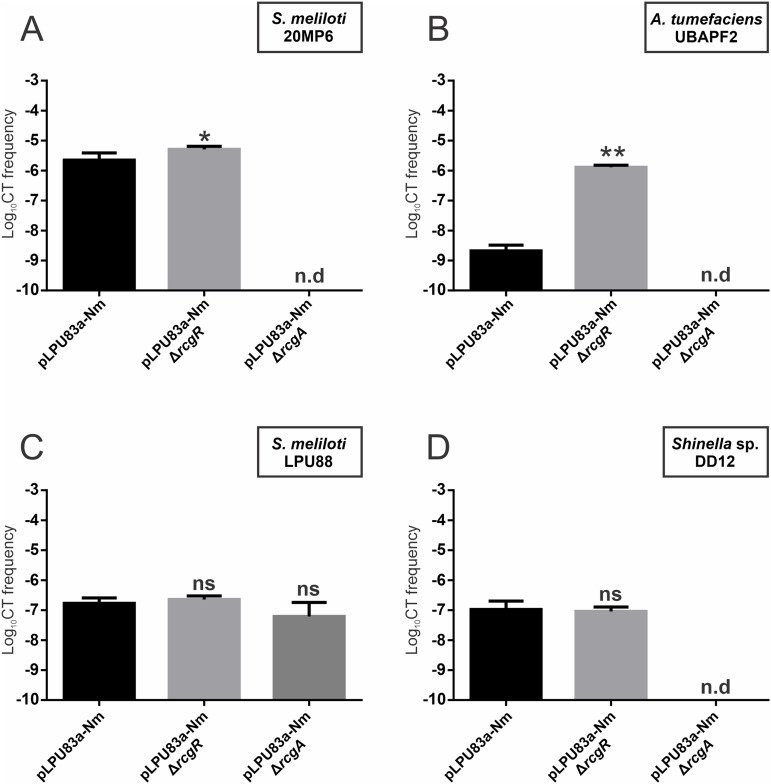
Rhizobia are Gram-negative bacteria that are able to establish a nitrogen-fixing symbiotic interaction with leguminous plants. Rhizobia genomes usually harbor several plasmids which can be transferred to other organisms by conjugation. Two main mechanisms of the regulation of rhizobial plasmid transfer have been described: quorum sensing (QS) and the / system. Nevertheless, new genes and molecules that modulate conjugative transfer have recently been described, demonstrating that new actors can tightly regulate the process. In this work, by means of bioinformatics tools and molecular biology approaches, two hypothetical genes are identified as playing key roles in conjugative transfer. These genes are located between conjugative genes of plasmid pRfaLPU83a from Rhizobium favelukesii LPU83, a plasmid that shows a conjugative transfer behavior depending on the genomic background. One of the two mentioned genes, , is essential for conjugation, while the other, , acts as an inhibitor of the process. In addition to introducing this new regulatory system, we show evidence of the functions of these genes in different genomic backgrounds and confirm that homologous proteins from non-closely related organisms have the same functions. These findings set up the basis for a new regulatory circuit of the conjugative transfer of plasmids. Extrachromosomal DNA elements, such as plasmids, allow for the adaptation of bacteria to new environments by conferring new determinants. Via conjugation, plasmids can be transferred between members of the same bacterial species, different species, or even to organisms belonging to a different kingdom. Knowledge about the regulatory systems of plasmid conjugative transfer is key in understanding the dynamics of their dissemination in the environment. As the increasing availability of genomes raises the number of predicted proteins with unknown functions, deeper experimental procedures help to elucidate the roles of these determinants. In this work, two uncharacterized proteins that constitute a new regulatory circuit with a key role in the conjugative transfer of rhizobial plasmids were discovered.
根瘤菌是能够与豆科植物建立固氮共生关系的革兰氏阴性细菌。根瘤菌基因组通常含有几个质粒,这些质粒可以通过接合转移到其他生物体中。已经描述了调节根瘤菌质粒转移的两种主要机制:群体感应(QS)和 / 系统。然而,最近已经描述了新的基因和分子来调节共轭转移,这表明新的因素可以紧密调节这个过程。在这项工作中,通过生物信息学工具和分子生物学方法,鉴定出两个假设基因在共轭转移中发挥关键作用。这些基因位于 Rhizobium favelukesii LPU83 的质粒 pRfaLPU83a 的共轭基因之间,该质粒的共轭转移行为取决于基因组背景。所提到的两个基因之一, ,对于共轭是必需的,而另一个, ,则作为该过程的抑制剂。除了引入这个新的调控系统外,我们还证明了这些基因在不同基因组背景下的功能,并证实了来自非密切相关生物的同源蛋白具有相同的功能。这些发现为质粒共轭转移的新调控回路奠定了基础。 质粒等染色体外 DNA 元件使细菌能够通过赋予新的决定因素来适应新的环境。通过接合,质粒可以在同种细菌、不同种细菌甚至不同生物界的生物之间进行转移。了解质粒共轭转移的调控系统是理解它们在环境中传播动态的关键。随着基因组的可用性增加,预测具有未知功能的蛋白质数量也在增加,更深入的实验程序有助于阐明这些决定因素的作用。在这项工作中,发现了两个未被表征的蛋白质,它们构成了一个新的调控回路,在根瘤菌质粒的共轭转移中起着关键作用。