Liu Xin, Chen Wenjie, Fang Zhixin, Yu Ying, Bi Jing, Wang Jing, Dong Qingli, Zhang Hongzhi
School of Health Science and Engineering, University of Shanghai for Science and Technology, Shanghai 200093, China.
Shanghai Municipal Center for Disease Control and Prevention, Shanghai 200336, China.
Foods. 2022 Aug 24;11(17):2561. doi: 10.3390/foods11172561.
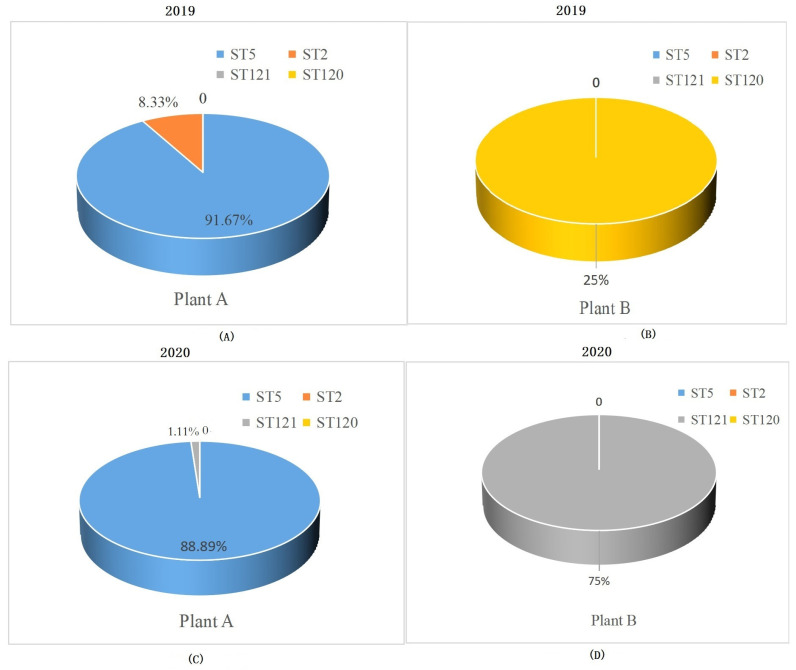
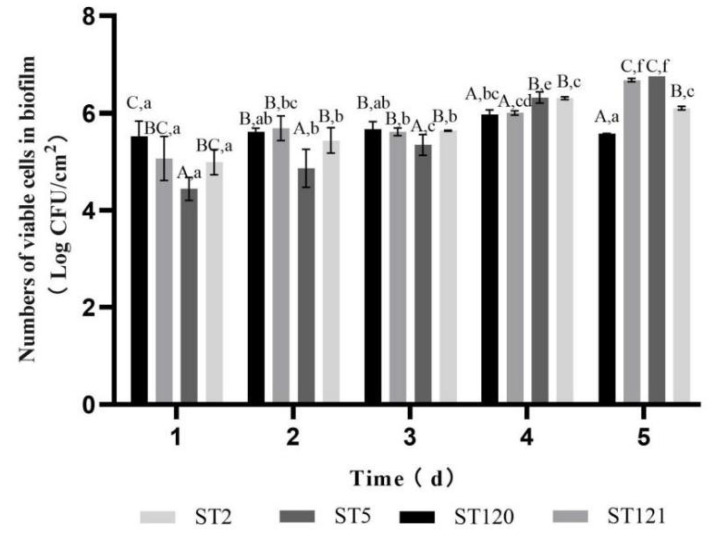
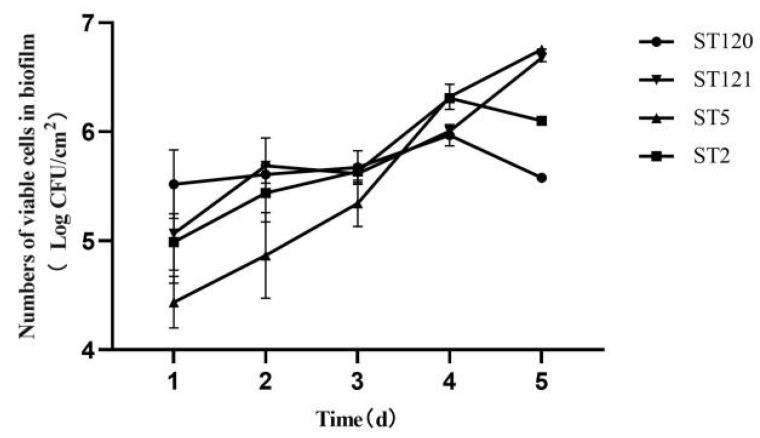
Most human listeriosis is foodborne, and ready-to-eat (RET) foods contaminated by during processing are found to be common vehicles. In this study, a total of four STs (ST5, ST121, ST120, and ST2) have been identified in two RTE food plants from 2019 to 2020 in Shanghai, China. The ST5 was predominant in one RTE food processing plant, and it persists in the RTE meat processing plant with continued clone transmission. The genetic features of the four STs isolates were different. ST5 and ST121 had the three genes , , and ; however, ST120 and ST2 had two genes except for . SSI-1was present in ST5, ST121, and ST120. Additionally, SSI-2 was present only in the ST121 isolates. ST120 had all six biofilm-forming associated genes (, , , , and ). The ST2 isolate had only three biofilm-forming associated genes, which were , , and . The four ST isolates had different biofilm formation abilities at different stages. The biofilm formation ability of ST120 was significantly higher when grown for one day. However, the biofilm formation ability of ST120 reduced significantly after growing for four days. In contrast, the biofilm formation ability of ST5 and ST121 increased significantly. These results suggested that ST5 and ST121 had stronger ability to adapt to stressful environments. Biofilms formed by all four STs grown over four days can be sanitized entirely by a disinfectant concentration of 500 mg/L. Additionally, only ST5 and ST121 biofilm cells survived in sub-lethal concentrations of chlorine-containing disinfectant. These results suggested that ST5 and ST121 were more resistant to chlorine-containing disinfectants. These results indicated that the biofilm formation ability of isolates changed at different stages. Additionally, the persistence in food processing environments might be verified by the biofilm formation, stress resistance, etc. Alternatively, these results underlined that disinfectants should be used at lethal concentrations. More attention should be paid to ST5 and ST121, and stronger surveillance should be taken to prevent and control the clonal spread of isolates in food processing plants in Shanghai.
大多数人类李斯特菌病是食源性的,在加工过程中被污染的即食(RET)食品是常见的传播媒介。在本研究中,2019年至2020年期间在中国上海的两家即食食品工厂中总共鉴定出四种序列型(ST5、ST121、ST120和ST2)。ST5在一家即食食品加工厂中占主导地位,并通过持续的克隆传播在即食肉类加工厂中持续存在。这四种序列型分离株的遗传特征各不相同。ST5和ST121具有三个基因、和;然而,ST120和ST2除了外有两个基因。SSI-1存在于ST5、ST121和ST120中。此外,SSI-2仅存在于ST121分离株中。ST120具有所有六个生物膜形成相关基因(、、、、和)。ST2分离株仅具有三个生物膜形成相关基因,即、和。这四种序列型分离株在不同阶段具有不同的生物膜形成能力。培养一天时ST120的生物膜形成能力显著更高。然而,培养四天后ST120的生物膜形成能力显著降低。相比之下,ST5和ST121的生物膜形成能力显著增加。这些结果表明ST5和ST121具有更强的适应应激环境的能力。培养四天的所有四种序列型形成的生物膜可以用500 mg/L的消毒剂浓度完全消毒。此外,只有ST5和ST121生物膜细胞在亚致死浓度的含氯消毒剂中存活。这些结果表明ST5和ST121对含氯消毒剂更具抗性。这些结果表明序列型分离株的生物膜形成能力在不同阶段发生变化。此外,在食品加工环境中的持久性可能通过生物膜形成、抗逆性等来验证。或者,这些结果强调应使用致死浓度的消毒剂。应更多关注ST5和ST121,并应加强监测以预防和控制上海食品加工厂中序列型分离株的克隆传播。