Division of Gastroenterology and Hepatology, Department of Medicine, Nihon University School of Medicine, 30-1 Oyaguchi-kamicho, Itabashi-ku, Tokyo 173-8610, Japan.
Departments of Internal Medicine, and Molecular Microbiology and Immunology, Saint Louis University, Saint Louis, MO 63104, USA.
Int J Mol Sci. 2022 Aug 26;23(17):9679. doi: 10.3390/ijms23179679.
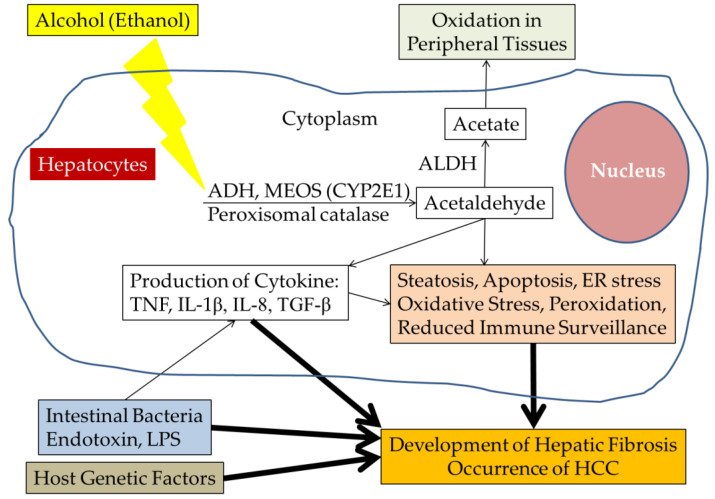
Alcohol is the one of the major causes of liver diseases and promotes liver cirrhosis and hepatocellular carcinoma (HCC). In hepatocytes, alcohol is converted to acetaldehyde, which causes hepatic steatosis, cellular apoptosis, endoplasmic reticulum stress, peroxidation, production of cytokines and reduces immune surveillance. Endotoxin and lipopolysaccharide produced from intestinal bacteria also enhance the production of cytokines. The development of hepatic fibrosis and the occurrence of HCC are induced by these alcohol metabolites. Several host genetic factors have recently been identified in this process. Here, we reviewed the molecular mechanism associated with HCC in alcoholic liver disease.
酒精是导致肝脏疾病的主要原因之一,可促进肝硬化和肝细胞癌(HCC)的发生。在肝细胞中,酒精转化为乙醛,导致肝脂肪变性、细胞凋亡、内质网应激、过氧化、细胞因子产生,并降低免疫监视。肠道细菌产生的内毒素和脂多糖也会增强细胞因子的产生。这些酒精代谢物诱导肝纤维化的发展和 HCC 的发生。在这个过程中,最近已经确定了几个宿主遗传因素。本文综述了酒精性肝病中与 HCC 相关的分子机制。