Department of Dermatology, Shinshu University School of Medicine, Matsumoto 390-8621, Japan.
Department of Molecular Immunology, Institute of Development, Aging and Cancer, Tohoku University, Sendai 980-8575, Japan.
Int J Mol Sci. 2022 Sep 2;23(17):10039. doi: 10.3390/ijms231710039.
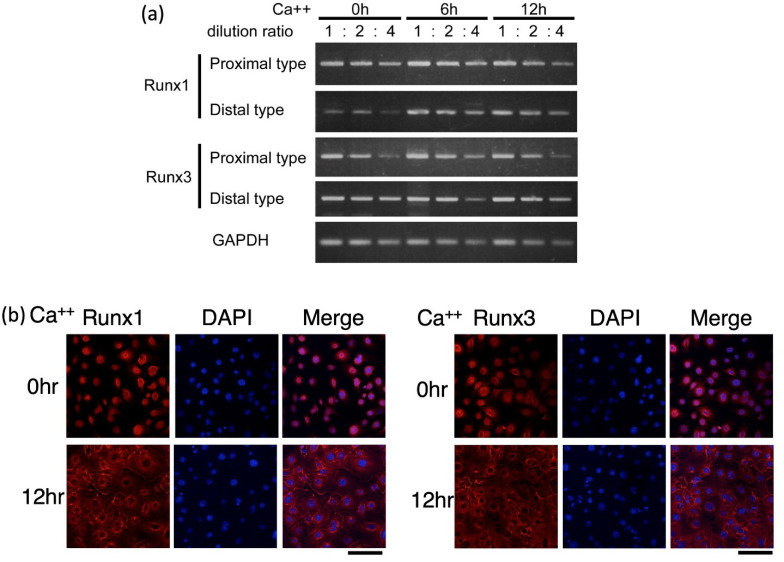
The Runt-related transcription factor (Runx) family has been suggested to play roles in stem cell regulation, tissue development, and oncogenesis in various tissues/organs. In this study, we investigated the possible functions of Runx1 and Runx3 in keratinocyte differentiation. Both Runx1 and Runx3 proteins were detected in primary cultures of mouse keratinocytes. Proteins were localized in the nuclei of undifferentiated keratinocytes but translocated to the cytoplasm of differentiated cells. The siRNA-mediated inhibition of and expression increased expression of keratin 1 and keratin 10, which are early differentiation markers of keratinocytes. In contrast, overexpression of Runx1 and Runx3 suppressed keratin 1 and keratin 10 expression. Endogenous Runx1 and Runx3 proteins were associated with the promoter sequences of and genes in undifferentiated but not differentiated keratinocytes. In mouse skin, the inhibition of and expression by keratinocyte-specific gene targeting increased the ratios of keratin 1- and keratin 10-positive cells in the basal layer of the epidermis. On the other hand, inhibition of and expression did not alter the proliferation capacity of cultured or epidermal keratinocytes. These results suggest that Runx1 and Runx3 likely function to directly inhibit differentiation-induced expression of and genes but are not involved in the regulation of keratinocyte proliferation.
Runt 相关转录因子(Runx)家族被认为在各种组织/器官中的干细胞调节、组织发育和肿瘤发生中发挥作用。在这项研究中,我们研究了 Runx1 和 Runx3 在角质形成细胞分化中的可能功能。在原代培养的小鼠角质形成细胞中检测到 Runx1 和 Runx3 蛋白。这些蛋白定位于未分化角质形成细胞的核内,但在分化细胞中转位到细胞质中。siRNA 介导的 和 表达抑制增加了角质蛋白 1 和 10 的表达,角质蛋白 1 和 10 是角质形成细胞早期分化的标志物。相比之下,Runx1 和 Runx3 的过表达抑制了角质蛋白 1 和角质蛋白 10 的表达。内源性 Runx1 和 Runx3 蛋白与未分化但不是分化的角质形成细胞中 和 基因的启动子序列相关联。在小鼠皮肤中,角质形成细胞特异性基因靶向抑制 和 表达增加了表皮基底层中角蛋白 1 和角蛋白 10 阳性细胞的比例。另一方面,抑制 和 表达并不改变培养或表皮角质形成细胞的增殖能力。这些结果表明,Runx1 和 Runx3 可能直接抑制分化诱导的 和 基因表达,但不参与角质形成细胞增殖的调节。