Park Seong-Sik, Kim Jong-In, Lee Chan-Hyeong, Bae Ju-Hyun, Park Ju-Mi, Choe Eun-Ji, Baek Moon-Chang
Department of Molecular Medicine, CMRI, Exosome Convergence Research Center (ECRC), School of Medicine, Kyungpook National University, Daegu 41944, Korea.
Cancers (Basel). 2022 Aug 23;14(17):4081. doi: 10.3390/cancers14174081.
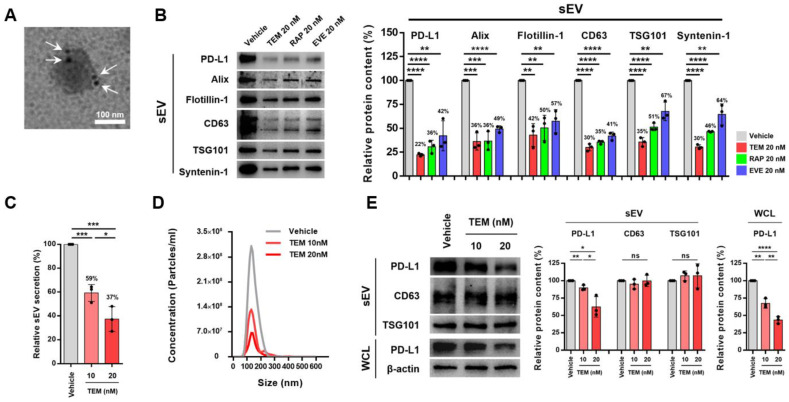
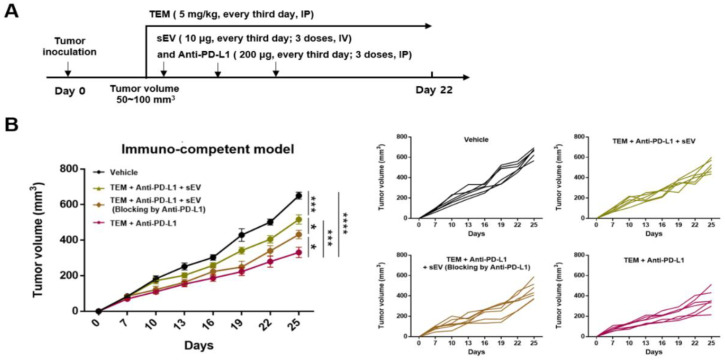
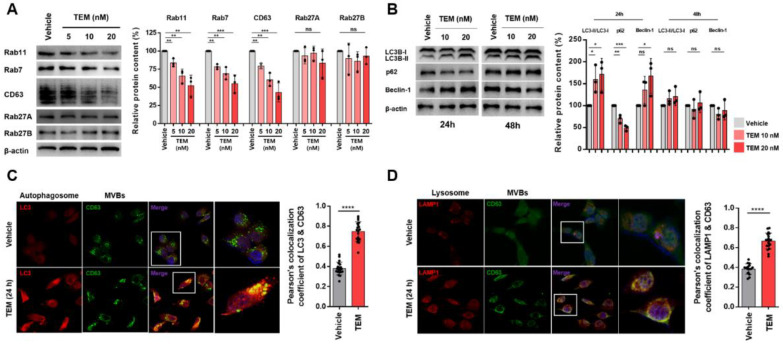
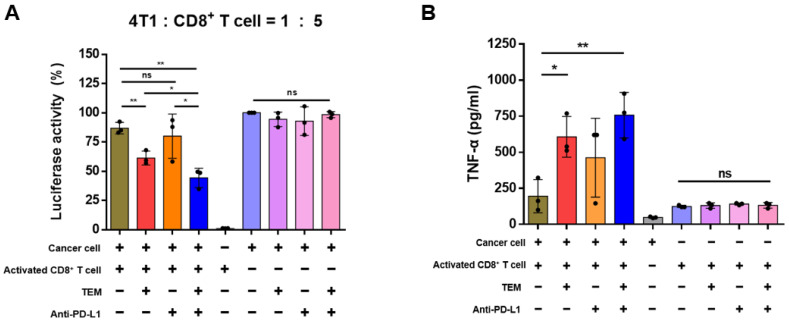
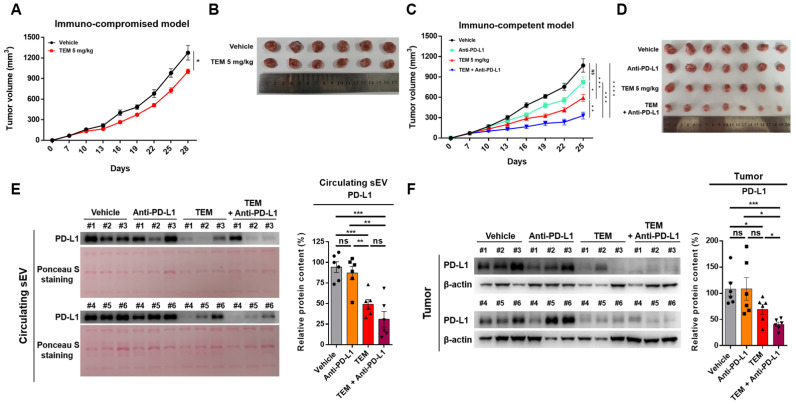
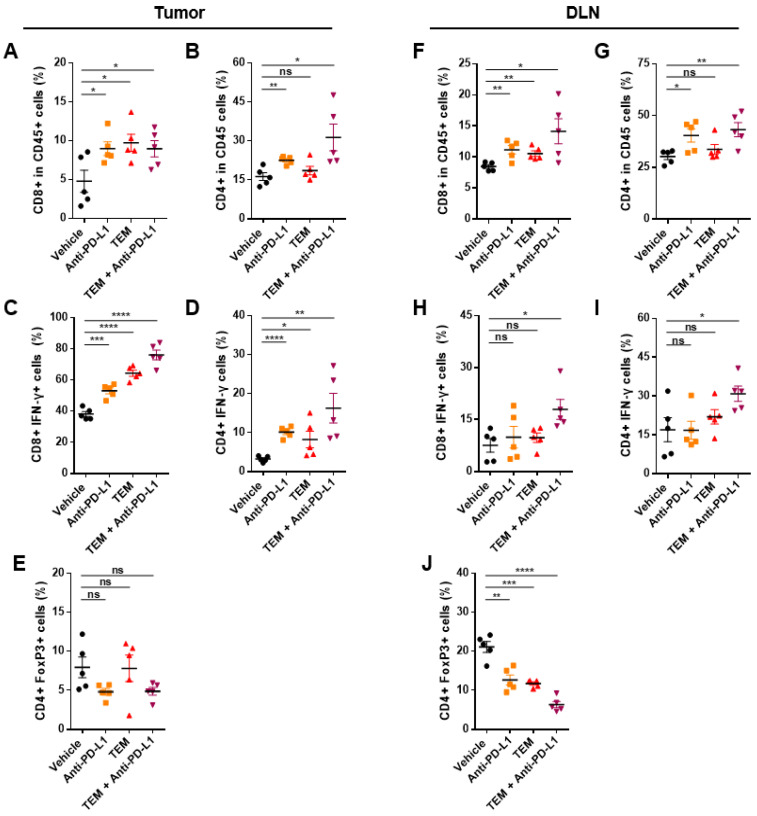
Tumor-derived small extracellular vesicle (sEV) programmed death-ligand 1 (PD-L1) contributes to the low reactivity of cells to immune checkpoint blockade therapy (ICBT), because sEV PD-L1 binds to programmed death 1 (PD-1) in immune cells. However, there are no commercially available anti-cancer drugs that activate immune cells by inhibiting tumor-derived sEV PD-L1 secretion and cellular PD-L1. Here, we aimed to investigate if temsirolimus (TEM) inhibits both sEV PD-L1 and cellular PD-L1 levels in MDA-MB-231 cells. In cancer cell autophagy activated by TEM, multivesicular bodies (MVBs) associated with the secretion of sEV are degraded through colocalization with autophagosomes or lysosomes. TEM promotes CD8 T cell-mediated anti-cancer immunity in co-cultures of CD8 T cells and tumor cells. Furthermore, the combination therapy of TEM and anti-PD-L1 antibodies enhanced anti-cancer immunity by increasing both the number and activity of CD4 and CD8 T cells in the tumor and draining lymph nodes (DLNs) of breast cancer-bearing immunocompetent mice. In contrast, the anti-cancer effect of the combination therapy with TEM and anti-PD-L1 antibodies was reversed by the injection of exogenous sEV PD-L1. These findings suggest that TEM, previously known as a targeted anti-cancer drug, can overcome the low reactivity of ICBT by inhibiting sEV PD-L1 and cellular PD-L1 levels.
肿瘤衍生的小细胞外囊泡(sEV)程序性死亡配体1(PD-L1)导致细胞对免疫检查点阻断疗法(ICBT)反应性较低,因为sEV PD-L1与免疫细胞中的程序性死亡1(PD-1)结合。然而,目前尚无通过抑制肿瘤衍生的sEV PD-L1分泌和细胞PD-L1来激活免疫细胞的抗癌药物。在这里,我们旨在研究西罗莫司(TEM)是否能抑制MDA-MB-231细胞中sEV PD-L1和细胞PD-L1的水平。在TEM激活的癌细胞自噬中,与sEV分泌相关的多囊泡体(MVBs)通过与自噬体或溶酶体共定位而降解。TEM在CD8 T细胞与肿瘤细胞的共培养中促进CD8 T细胞介导的抗癌免疫。此外,TEM与抗PD-L1抗体的联合治疗通过增加荷乳腺癌免疫活性小鼠肿瘤和引流淋巴结(DLN)中CD4和CD8 T细胞的数量和活性,增强了抗癌免疫。相反,注射外源性sEV PD-L1可逆转TEM与抗PD-L1抗体联合治疗的抗癌效果。这些发现表明,先前作为靶向抗癌药物的TEM可以通过抑制sEV PD-L1和细胞PD-L1水平来克服ICBT的低反应性。