Faculty of Physical Education and Physiotherapy, Opole University of Technology, 45-758 Opole, Poland.
Institute of Psychology, University of Opole, 45-040 Opole, Poland.
Int J Environ Res Public Health. 2022 Sep 2;19(17):10954. doi: 10.3390/ijerph191710954.
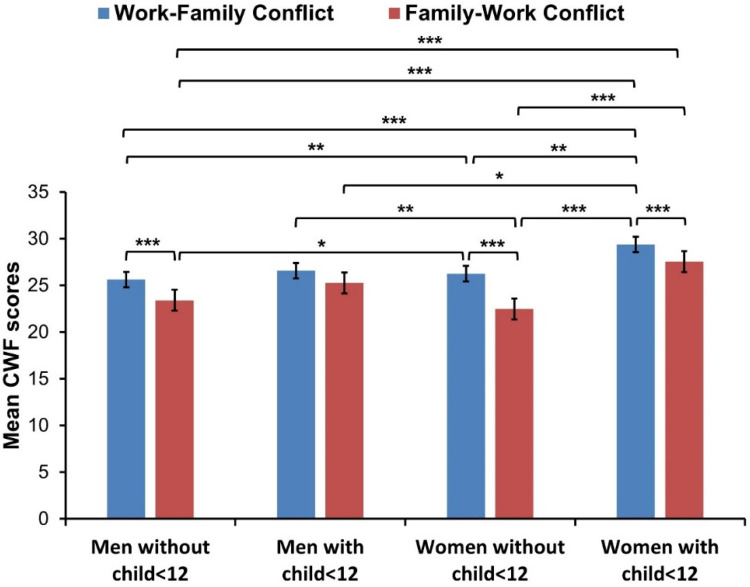
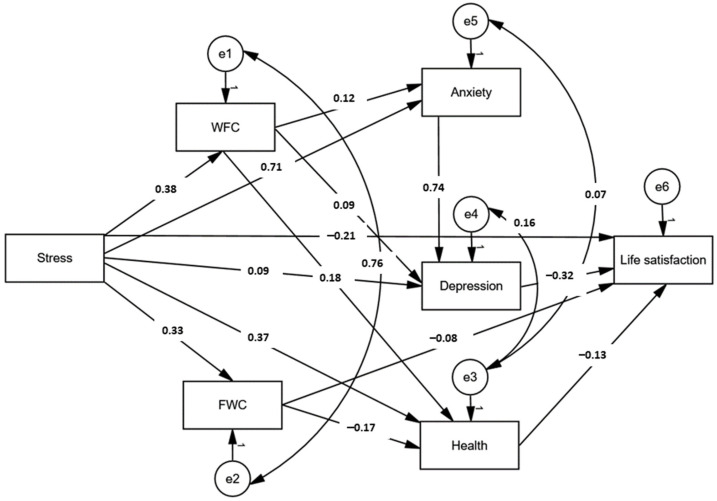
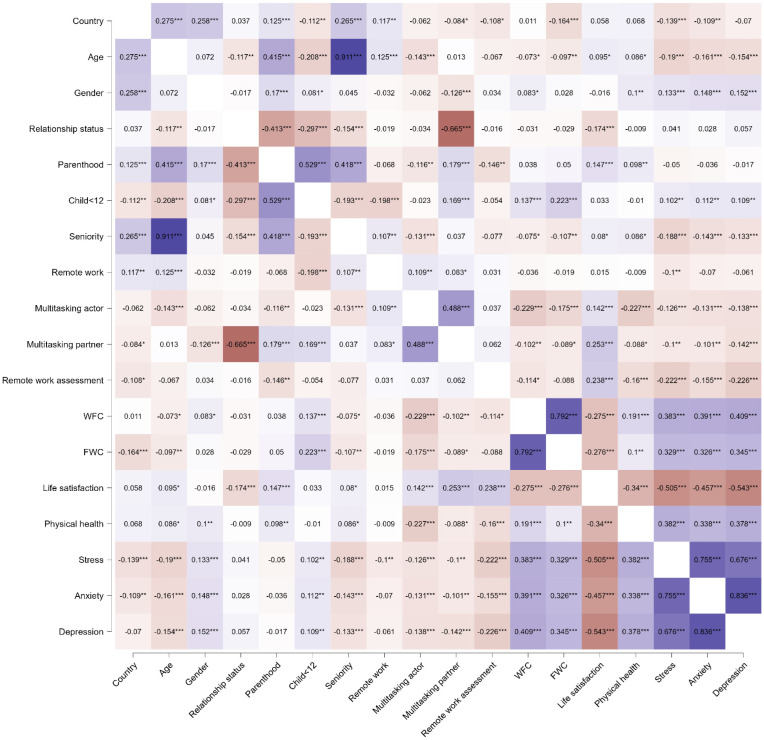
The conflict between work and family demands increased during the COVID-19 pandemic due to changes in lifestyle related to the lockdown. This study examines the associations between work-family conflict (WFC) and family-work conflict (FWC) with work-specific, family-specific, and well-being-related variables during the second wave of the COVID-19 pandemic. The results may be used in practice to improve the well-being of employees by adjusting home-based work and family areas of life to dynamic changes during the pandemic. The sample of 736 adults from Poland (53.26%) and Ukraine (46.74%), aged between 19 and 72 ( = 39.40; = 10.80), participated in the study. The cross-sectional study was performed using an online survey, including sociodemographic variables, measures of WFC, time pressure, remote work assessment (RWAS), physical health (GSRH), life satisfaction (SWLS), perceived stress (PSS-10), anxiety (GAD-7), and depression (PHQ-9). This study showed numerous inter-group differences in all variables across the country, gender, relationship status, parenthood, caring for children under 12, and remote working status. A high WFC is more likely among Polish workers (than Ukrainian workers), people with a low level of self-perceived time pressure, and high symptoms of stress. Caring for children under 12, low self-perceived time pressure, and high stress can predict FWC. Various paths lead from perceived stress via WFC and FWC, physical health, anxiety, and depression to life satisfaction, as suggested by the structural equation modeling analysis. Parents of children under 12 and women are the most vulnerable groups for increased WFC, FWC, and worse mental health and well-being. Prevention programs should focus on reducing stress, anxiety, and work demands in these adult populations. A unique contribution to the existing knowledge revealed patterns of associations between WFC and FWC in relation to well-being dimensions in a cross-cultural context during the pandemic.
由于与封锁相关的生活方式的改变,在 COVID-19 大流行期间,工作和家庭需求之间的冲突加剧。本研究考察了在 COVID-19 大流行的第二波期间,工作家庭冲突(WFC)和家庭工作冲突(FWC)与工作特定、家庭特定和与幸福感相关的变量之间的关联。研究结果可用于通过调整家庭工作和家庭生活领域以适应大流行期间的动态变化,从而提高员工的幸福感。该研究的样本来自波兰(53.26%)和乌克兰(46.74%)的 736 名成年人,年龄在 19 至 72 岁之间( = 39.40; = 10.80)。这项横断面研究使用在线调查进行,包括社会人口统计学变量、WFC 测量、时间压力、远程工作评估(RWAS)、身体健康(GSRH)、生活满意度(SWLS)、感知压力(PSS-10)、焦虑(GAD-7)和抑郁(PHQ-9)。本研究表明,在所有变量方面,全国范围内、不同国家、性别、婚姻状况、是否有子女、是否照顾 12 岁以下儿童以及是否远程工作的群体之间存在诸多差异。与乌克兰工人相比,波兰工人(更)可能感到工作家庭冲突程度高,自我感知时间压力低,压力症状高。照顾 12 岁以下儿童、自我感知时间压力低和压力大,这些因素可以预测家庭工作冲突。结构方程模型分析表明,感知压力通过工作家庭冲突和家庭工作冲突、身体健康、焦虑和抑郁对生活满意度产生影响,存在各种路径。有 12 岁以下儿童的父母和女性是工作家庭冲突、家庭工作冲突以及心理健康和幸福感恶化的最脆弱群体。预防计划应侧重于减轻这些成年人群体的压力、焦虑和工作需求。本研究在跨文化背景下,在大流行期间,揭示了工作家庭冲突和家庭工作冲突与幸福感维度之间的关联模式,这是对现有知识的独特贡献。