Glut4Science, Physiology, Nutrition and Sport, 01004 Vitoria-Gasteiz, Spain.
Institute of Biomedicine (IBIOMED), University of Leon, 24071 Leon, Spain.
Nutrients. 2022 Aug 24;14(17):3479. doi: 10.3390/nu14173479.
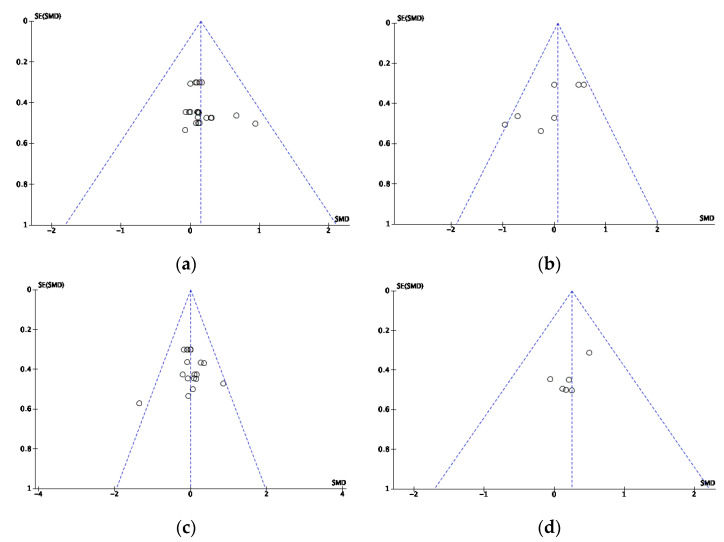
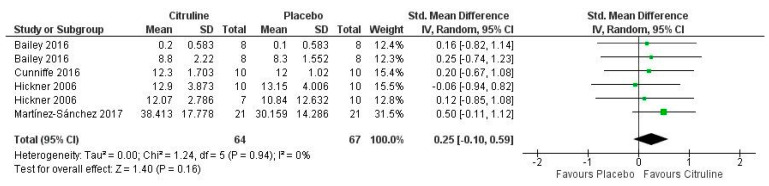
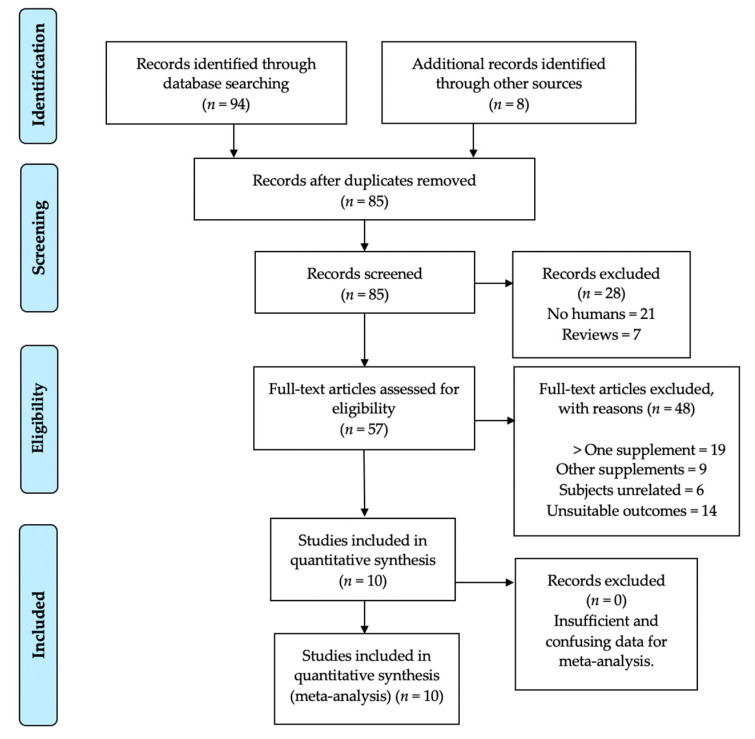
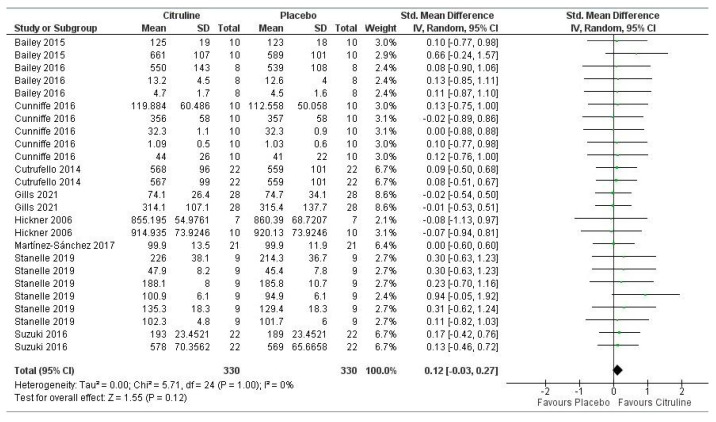
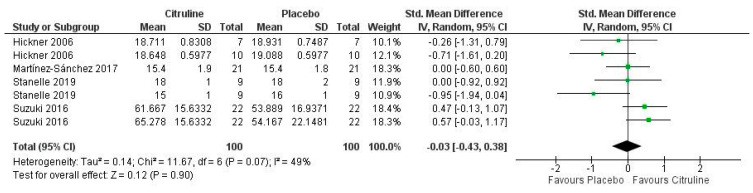
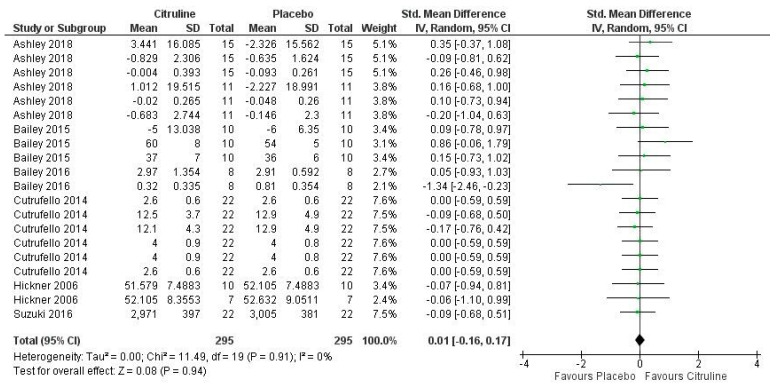
Supplementation with Citrulline (Cit) has been shown to have a positive impact on aerobic exercise performance and related outcomes such as lactate, oxygen uptake (VO) kinetics, and the rate of perceived exertion (RPE), probably due to its relationship to endogenous nitric oxide production. However, current research has shown this to be controversial. The main objective of this systematic review and meta-analysis was to analyze and assess the effects of Cit supplementation on aerobic exercise performance and related outcomes, as well as to show the most suitable doses and timing of ingestion. A structured literature search was carried out by the PRISMA (Preferred Reporting Items for Systematic Reviews and Meta-Analyses) and PICOS guidelines in the following databases: Pubmed/Medline, Scopus, and Web of Science (WOS). A total of 10 studies were included in the analysis, all of which exclusively compared the effects of Cit supplementation with those of a placebo group on aerobic performance, lactate, VO, and the RPE. Those articles that used other supplements and measured other outcomes were excluded. The meta-analysis was carried out using Hedges' g random effects model and pooled standardized mean differences (SMD). The results showed no positive effects of Cit supplementation on aerobic performance (pooled SMD = 0.15; 95% CI (-0.02 to 0.32); , 0%; = 0.08), the RPE (pooled SMD = -0.03; 95% CI (-0.43 to 0.38); , 49%; = 0.9), VO kinetics (pooled SMD = 0.01; 95% CI (-0.16 to 0.17); , 0%; = 0.94), and lactate (pooled SMD = 0.25; 95% CI (-0.10 to 0.59); , 0%; = 0.16). In conclusion, Cit supplementation did not prove to have any benefits for aerobic exercise performance and related outcomes. Where chronic protocols seemed to show a positive tendency, more studies in the field are needed to better understand the effects.
补充瓜氨酸(Cit)已被证明对有氧运动表现和相关结果有积极影响,例如乳酸、摄氧量(VO)动力学和感知用力程度(RPE),这可能与其内源性一氧化氮生成有关。然而,目前的研究表明这存在争议。本系统评价和荟萃分析的主要目的是分析和评估 Cit 补充剂对有氧运动表现和相关结果的影响,并展示最适合的摄入剂量和时间。通过 PRISMA(系统评价和荟萃分析的首选报告项目)和 PICOS 指南,在以下数据库中进行了结构化文献检索:Pubmed/Medline、Scopus 和 Web of Science(WOS)。共有 10 项研究被纳入分析,所有研究都专门比较了 Cit 补充剂与安慰剂组对有氧运动表现、乳酸、VO 和 RPE 的影响。那些使用其他补充剂和测量其他结果的文章被排除在外。荟萃分析使用 Hedges'g 随机效应模型和汇总标准化均数差(SMD)进行。结果表明,Cit 补充剂对有氧运动表现(汇总 SMD=0.15;95%CI(-0.02 至 0.32); ,0%; = 0.08)、RPE(汇总 SMD=-0.03;95%CI(-0.43 至 0.38); ,49%; = 0.9)、VO 动力学(汇总 SMD=0.01;95%CI(-0.16 至 0.17); ,0%; = 0.94)和乳酸(汇总 SMD=0.25;95%CI(-0.10 至 0.59); ,0%; = 0.16)没有积极影响。总之,Cit 补充剂对有氧运动表现和相关结果没有任何益处。在慢性方案中似乎显示出积极的趋势,但需要更多的研究来更好地理解其效果。