Faculdade de Medicina, Universidade de Brasília, UnB, Campus Universitário Darcy Ribeiro, Asa Norte, Brasilia 70910-900, DF, Brazil.
Instituto de Estudos em Saúde Coletiva, Universidade Federal do Rio de Janeiro, Avenida Horacio Macedo, S/N-Próxima à Prefeitura Universitária da UFRJ, Ilha do Fundão-Cidade Universitária, Rio de Janeiro 21941-598, RJ, Brazil.
Nutrients. 2022 Aug 24;14(17):3487. doi: 10.3390/nu14173487.
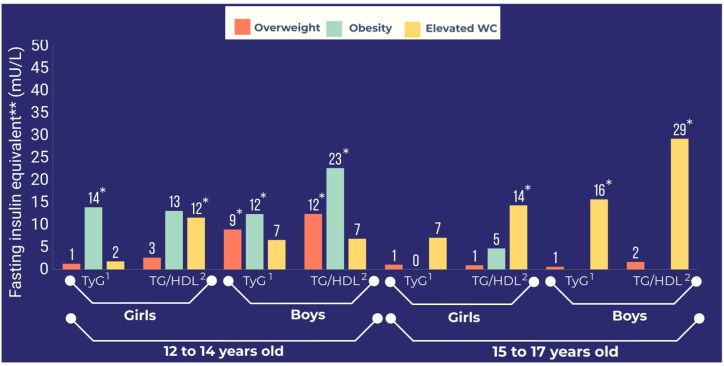
(1) Background: There is still controversy concerning the most effective and efficient strategy to identify insulin resistance in adolescents. We estimated the level of fasting insulin (fasting insulin equivalent, FIeq) that would replicate the strength of the associations of obesity, overweight, and waist circumference with two insulin resistance markers: triglyceride/high-density lipoprotein (TG/HDL) and triglyceride/glucose (TyG); (2) Methods: We studied approximately 38,000 adolescents aged 12 to 17 years, sampled from a multicenter Brazilian school-based survey, The Study of Cardiovascular Risk Factors in Adolescents (Portuguese acronym, ERICA), conducted in 2013-2014. Fasting insulin equivalents for adiposity variables were calculated by dividing the beta coefficient of each adiposity measure by the fasting insulin beta coefficient from linear regression analysis according to age (12-14, 15-17 years old) and sex, and adjusted by smoking, alcohol consumption, physical inactivity, sedentary behavior, socioeconomic status, and Tanner stage; (3) Results: The FIeqs for obesity were greater than those for overweight and elevated waist circumference for both TG/HDL and TyG in early adolescence. The FIeqs for elevated WC were greater than those for obesity and overweight in adolescents aged 15 to 17 years; (4) Conclusions: Our study suggests that WC measurements might be useful to identify adolescents with insulin resistance, particularly in late adolescence.
(1)背景:目前,在识别青少年胰岛素抵抗方面,哪种策略最有效、最具效率仍存在争议。我们旨在评估空腹胰岛素(空腹胰岛素当量,FIeq)水平,该水平应能复制肥胖、超重和腰围与两种胰岛素抵抗标志物的关联强度:甘油三酯/高密度脂蛋白(TG/HDL)和甘油三酯/葡萄糖(TyG);(2)方法:我们研究了大约 38000 名 12 至 17 岁的青少年,这些青少年是来自巴西多中心基于学校的调查,即青少年心血管风险因素研究(葡萄牙语缩写为 ERICA)的样本,该调查于 2013-2014 年进行。根据年龄(12-14 岁、15-17 岁)和性别,将肥胖变量的β系数除以线性回归分析中空腹胰岛素的β系数,计算出与肥胖变量对应的空腹胰岛素当量,同时还对吸烟、饮酒、缺乏运动、久坐行为、社会经济地位和性成熟度进行了调整;(3)结果:在青少年早期,与 TG/HDL 和 TyG 相比,肥胖的 FIeq 大于超重和腰围升高,而在 15 至 17 岁的青少年中,腰围升高的 FIeq 大于肥胖和超重;(4)结论:我们的研究表明,WC 测量可能有助于识别胰岛素抵抗的青少年,特别是在青少年晚期。