
膳食脂肪与合并心血管代谢疾病患者全因死亡率和心血管疾病死亡率的相关性。
Associations of Dietary Fats with All-Cause Mortality and Cardiovascular Disease Mortality among Patients with Cardiometabolic Disease.
机构信息
School of Public Health, Tongji Medical College, Huazhong University of Science and Technology, Wuhan 430030, China.
出版信息
Nutrients. 2022 Aug 31;14(17):3608. doi: 10.3390/nu14173608.
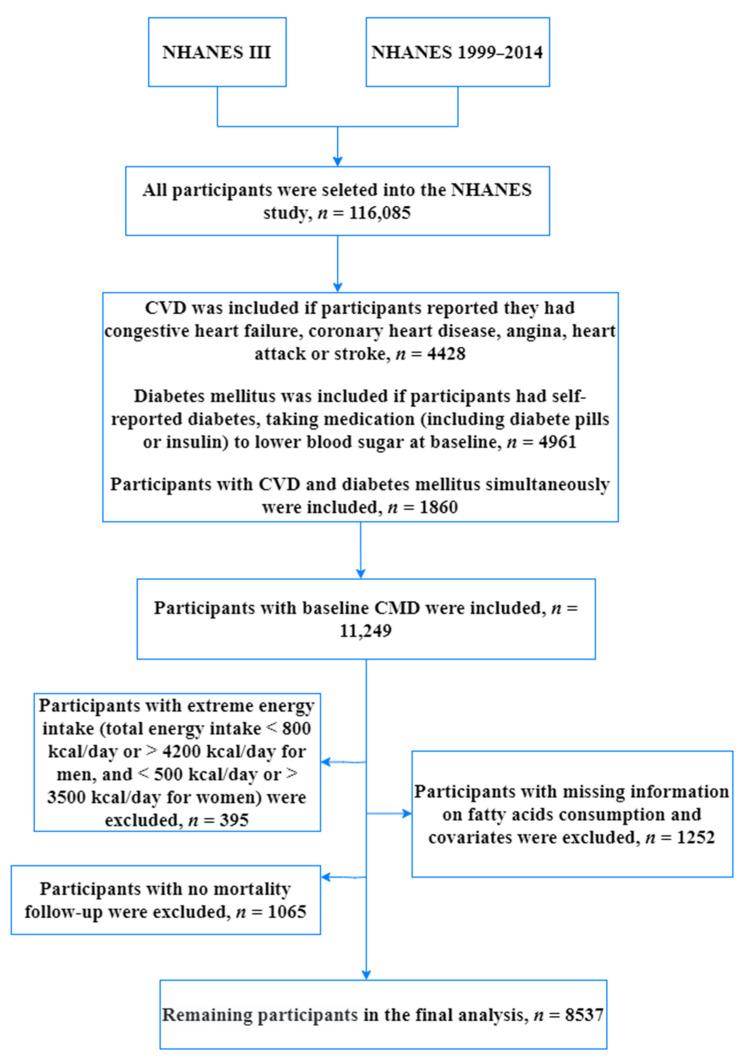
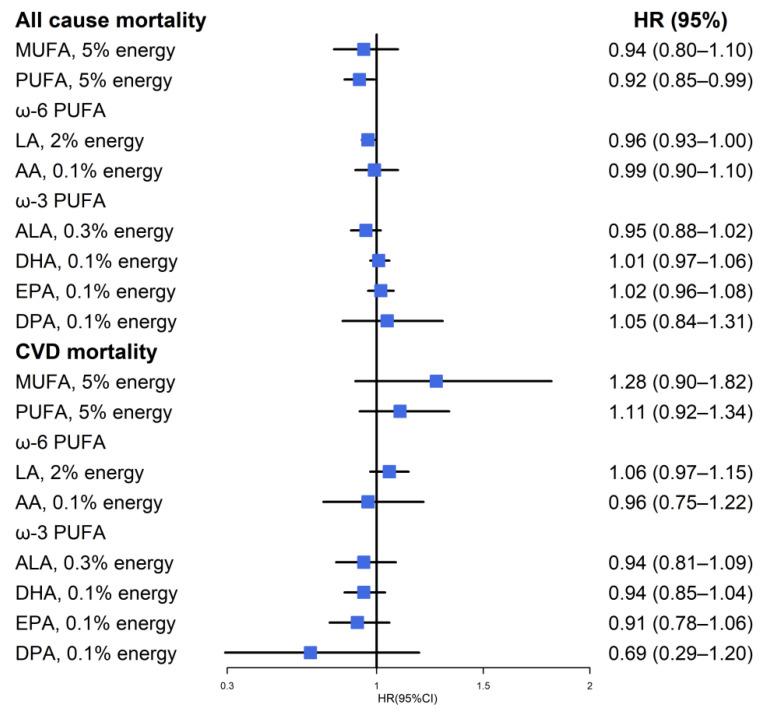
Previous studies have shown distinct associations between specific dietary fats and mortality. However, evidence on specific dietary fats and mortality among patients with cardiometabolic disease (CMD) remains unclear. The aim of this study was to estimate the association between consumption of specific fatty acids and survival of patients with CMD and examine whether cardiometabolic biomarkers can mediate the above effects. The study included 8537 participants with CMD, from the Third National Health and Nutrition Examination Survey (NHANES III) and NHANES 1999-2014. Cox proportional hazards regression, restricted cubic spline regression, and isocaloric substitution models were used to estimate the associations of dietary fats with all-cause mortality and cardiovascular disease (CVD) mortality among participants with CMD. Mediation analysis was performed to assess the potential mediating roles of cardiometabolic biomarkers. During a median follow-up of 10.3 years (0-27.1 years), 3506 all-cause deaths and 882 CVD deaths occurred. The hazard ratios (HRs) of all-cause mortality among patients with CMD were 0.85 (95% confidence interval (CI), 95% CI, 0.73-0.99; trend = 0.03) for ω-6 polyunsaturated fatty acids (ω-6 PUFA), 0.86 (95% CI, 0.75-1.00; trend = 0.05) for linoleic acid (LA), and 0.86 (95% CI, 0.75-0.98; trend = 0.03) for docosapentaenoic acid (DPA). Isocalorically replacing energy from SFA with PUFA and LA were associated with 8% and 4% lower all-cause mortality respectively. The HRs of CVD mortality among CMD patients comparing extreme tertiles of specific dietary fats were 0.60 (95% CI, 0.48-0.75; trend = 0.002) for eicosapentaenoic acid (EPA), and 0.64 (95% CI, 0.48-0.85; trend = 0.002) for DPA and above effects were mediated by levels of total cholesterol (TC), triglycerides (TG), low density lipoprotein cholesterol (LDL), and high density lipoprotein cholesterol (HDL). Restricted cubic splines showed significant negative nonlinear associations between above specific dietary fats and mortality. These results suggest that intakes of ω-6 PUFA, LA, and DPA or replacing SFA with PUFA or LA might be associated with lower all-cause mortality for patients with CMD. Consumption of EPA and DPA could potentially reduce cardiovascular death for patients with CMD, and their effects might be regulated by cardiometabolic biomarkers indirectly. More precise and representative studies are further needed to validate our findings.
先前的研究表明,特定的膳食脂肪与死亡率之间存在明显的关联。然而,关于代谢性心血管疾病(CMD)患者特定膳食脂肪与死亡率之间的证据尚不清楚。本研究旨在估计特定脂肪酸的摄入与 CMD 患者生存之间的关系,并检验代谢性心血管生物标志物是否可以介导上述影响。研究纳入了来自第三次全国健康和营养调查(NHANES III)和 NHANES 1999-2014 年的 8537 名 CMD 患者。使用 Cox 比例风险回归、限制立方样条回归和等热量替代模型来估计膳食脂肪与 CMD 患者全因死亡率和心血管疾病(CVD)死亡率之间的关系。进行中介分析以评估代谢性心血管生物标志物的潜在中介作用。在中位随访 10.3 年(0-27.1 年)期间,发生了 3506 例全因死亡和 882 例 CVD 死亡。CMD 患者的全因死亡率的危险比(HR)为 0.85(95%置信区间(CI),0.73-0.99;趋势=0.03),ω-6 多不饱和脂肪酸(ω-6PUFA)为 0.86(95%CI,0.75-1.00;趋势=0.05),亚油酸(LA)为 0.86(95%CI,0.75-0.98;趋势=0.03),二十二碳五烯酸(DPA)为 0.86(95%CI,0.75-0.98;趋势=0.03)。用 PUFA 和 LA 等量替代 SFA 所产生的能量与全因死亡率分别降低 8%和 4%相关。CMD 患者比较特定膳食脂肪极端三分位数的 CVD 死亡率的 HR 为 0.60(95%CI,0.48-0.75;趋势=0.002),二十碳五烯酸(EPA)为 0.64(95%CI,0.48-0.85;趋势=0.002),DPA 以上效应由总胆固醇(TC)、甘油三酯(TG)、低密度脂蛋白胆固醇(LDL)和高密度脂蛋白胆固醇(HDL)水平介导。限制立方样条显示上述特定膳食脂肪与死亡率之间存在显著的负非线性关系。这些结果表明,ω-6PUFA、LA 和 DPA 的摄入或用 PUFA 或 LA 替代 SFA 可能与 CMD 患者的全因死亡率降低有关。EPA 和 DPA 的消耗可能会降低 CMD 患者的心血管死亡风险,其效果可能间接由代谢性心血管生物标志物调节。需要进一步进行更精确和更具代表性的研究来验证我们的发现。

 Zotero 插件