College of Chemistry and Chemical Engineering, Xi'an Shiyou University, Xi'an 710065, China.
Molecules. 2022 Aug 25;27(17):5457. doi: 10.3390/molecules27175457.
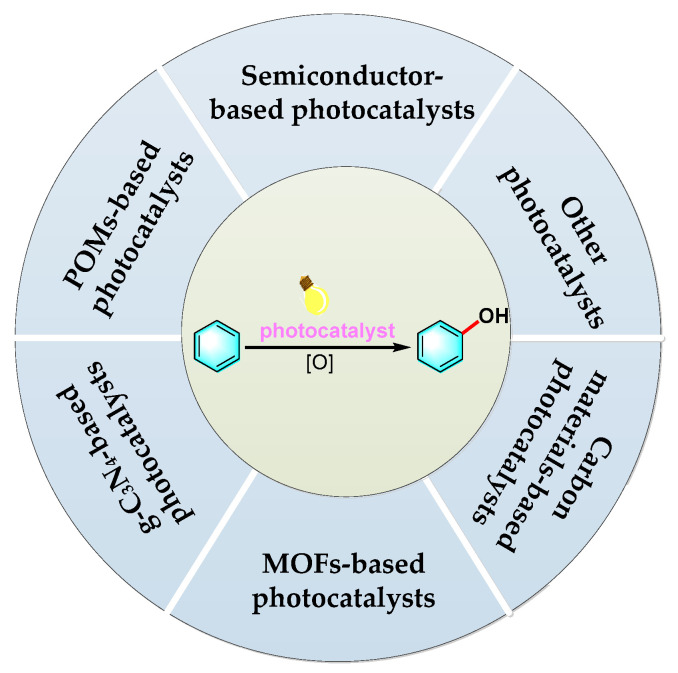
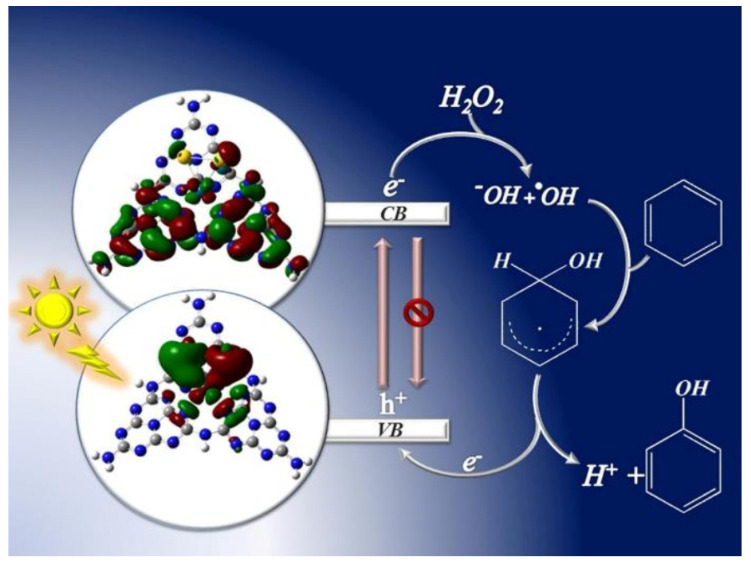
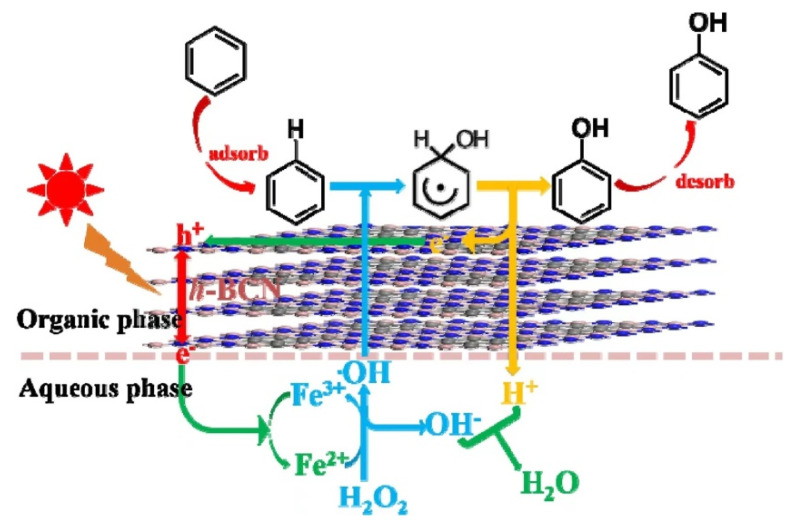
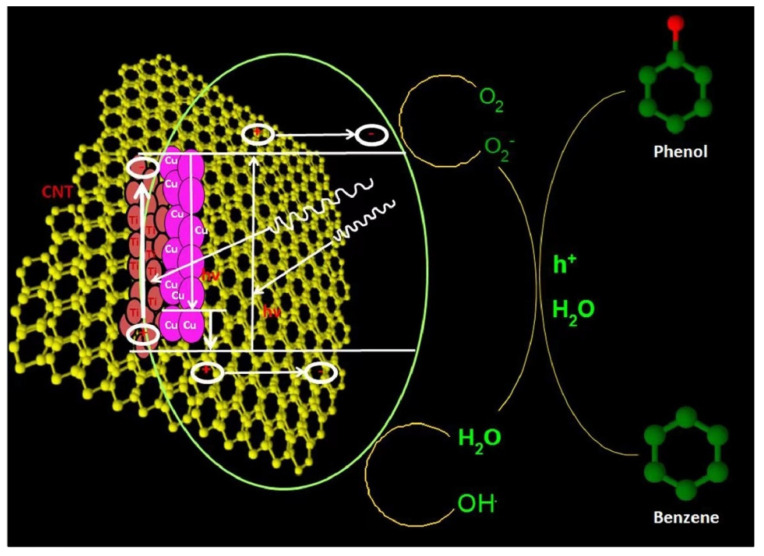
Phenol is an important chemical material that is widely used in industry. Currently, phenol is dominantly produced by the well-known three-step cumene process, which suffers from severe drawbacks. Therefore, developing a green, sustainable, and economical strategy for the production of phenol directly from benzene is urgently needed. In recent years, the photocatalytic hydroxylation of benzene to phenol, which is economically feasible and could be performed under mild conditions, has attracted more attention, and development of highly efficient photocatalyst would be a key issue in this field. In this review, we systematically introduce the recent achievements of photocatalytic hydroxylation of benzene to phenol from 2015 to mid-2022, and various heterogeneous photocatalysts are comprehensively reviewed, including semiconductors, polyoxometalates (POMs), graphitic carbon nitride (g-CN), metal-organic frameworks (MOFs), carbon materials, and some other types of photocatalysts. Much effort is focused on the physical and chemical approaches for modification of these photocatalysts. The challenges and future promising directions for further enhancing the catalytic performances in photocatalytic hydroxylation of benzene are discussed in the end.
苯酚是一种重要的化工原料,广泛应用于工业领域。目前,苯酚主要通过著名的异丙苯三步法生产,但该方法存在严重的缺陷。因此,开发一种绿色、可持续、经济的苯直接生产苯酚的策略迫在眉睫。近年来,苯的光催化羟基化反应生成苯酚具有经济可行性,且可以在温和条件下进行,引起了更多关注,开发高效的光催化剂将是该领域的关键问题。本综述系统地介绍了 2015 年至 2022 年年中期间,苯光催化羟基化生成苯酚的最新研究成果,全面综述了各种多相光催化剂,包括半导体、多金属氧酸盐(POMs)、石墨相氮化碳(g-CN)、金属-有机骨架(MOFs)、碳材料以及其他类型的光催化剂。重点介绍了这些光催化剂的物理化学改性方法。最后,讨论了进一步提高苯光催化羟基化反应催化性能的挑战和未来有前景的方向。