Department of Agricultural Sciences, University of Naples "Federico II", 80055 Portici, Italy.
ARWA Foodtech AB, 22363 Lund, Sweden.
Molecules. 2022 Aug 29;27(17):5563. doi: 10.3390/molecules27175563.
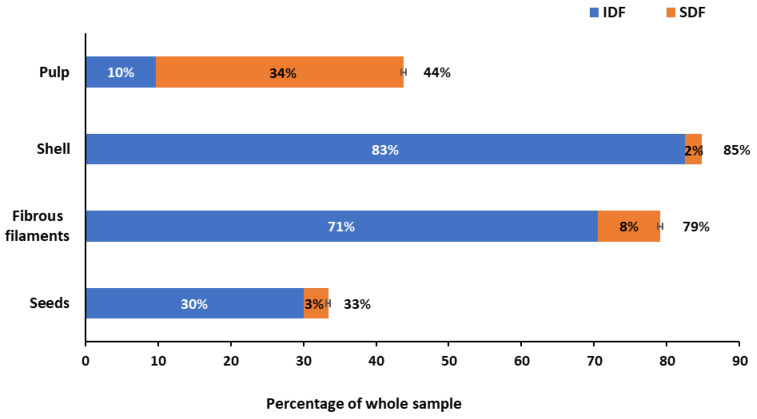
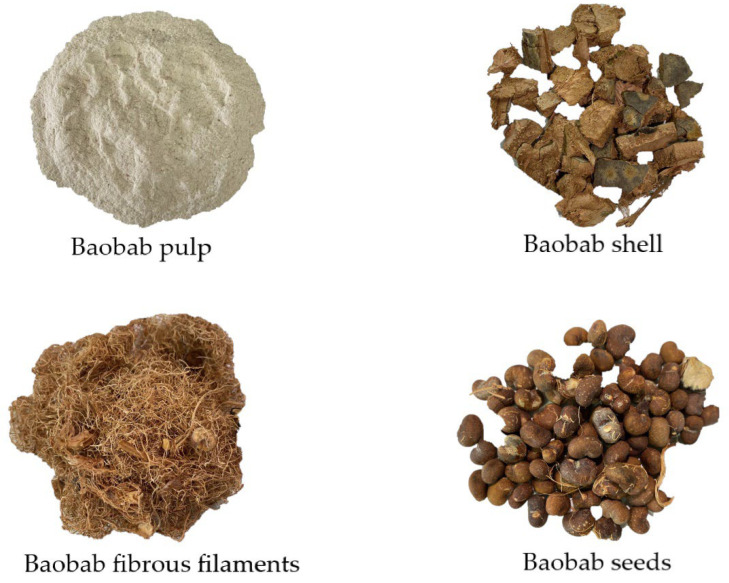
Since 2008, baobab-fruit dried pulp is listed as an ingredient on the European Union's Novel Food Catalogue. By pulp production, 80% of the baobab fruit is discarded, forming side streams, namely, shell, fibrous filaments, and seeds. This study explored pulp and side-stream functional properties, including total dietary fiber (TDF), total antioxidant capacity (TAC), polyphenols, and water- (WHC) and oil-holding capacities (OHC), along with endocannabinoids (ECs) and N-acylethanolamines (NAEs) in pulp, seeds, and seed oil. Shell excelled in TDF (85%), followed by fibrous filaments (79%), and showed the highest soluble and direct TAC (72 ± 0.7 and 525 ± 1.0 µmol eq. Trolox/g, respectively). Pulp was the richest in polyphenols, followed by shell, fibrous filaments, and seeds. Quercetin predominated in shell (438.7 ± 2.5 µg/g); whereas epicatechin predominated in pulp (514 ± 5.7 µg/g), fibrous filaments (197.2 ± 0.1 µg/g), and seeds (120.1 ± 0.6 µg/g); followed by procyanidin B2 that accounted for 26-40% of total polyphenols in all the products. WHC and OHC ranged between 2-7 g HO-Oil/g, with fibrous filaments showing the highest values. ECs were not found, whereas NAEs were abundant in seed oil (2408.7 ± 11.1 ng/g). Baobab shell and fibrous filaments are sources of polyphenols and antioxidant dietary fibers, which support their use as functional food ingredients.
自 2008 年以来,巴旦木果干浆已被列入欧盟新型食品目录的成分之一。通过果肉加工,80%的巴旦木果实被丢弃,形成副产物,即果壳、纤维丝和种子。本研究探索了果肉和副产物的功能特性,包括总膳食纤维(TDF)、总抗氧化能力(TAC)、多酚、水(WHC)和油(OHC)保持能力,以及果肉、种子和种籽油中的内源性大麻素(ECs)和 N-酰基乙醇胺(NAEs)。果壳的 TDF(85%)含量最高,其次是纤维丝(79%),并显示出最高的可溶性和直接 TAC(分别为 72±0.7 和 525±1.0µmol eq. Trolox/g)。果肉中的多酚含量最丰富,其次是果壳、纤维丝和种子。壳中以槲皮素为主(438.7±2.5µg/g);而表儿茶素在果肉中含量最高(514±5.7µg/g),纤维丝(197.2±0.1µg/g)和种子(120.1±0.6µg/g)次之;其次是原花青素 B2,占所有产品中总多酚的 26-40%。WHC 和 OHC 范围在 2-7g HO-Oil/g 之间,纤维丝的数值最高。未发现 ECs,但种籽油中含有丰富的 NAEs(2408.7±11.1ng/g)。巴旦木果壳和纤维丝是多酚和抗氧化膳食纤维的来源,支持将其用作功能性食品成分。