Korycki Adrian, Garnier Christian, Irusta Silvia, Chabert France
Laboratoire Génie de Production, Ecole Nationale d'Ingénieurs de Tarbes, Institut Polytechnique de Toulouse, Université de Toulouse, 47 Avenue d'Azereix, 65016 Tarbes, France.
Department of Chemical and Environmental Engineering, Institute of Nanoscience of Aragon, University of Zaragoza, Mariano Esquillor s/n, 50018 Zaragoza, Spain.
Polymers (Basel). 2022 Aug 25;14(17):3466. doi: 10.3390/polym14173466.
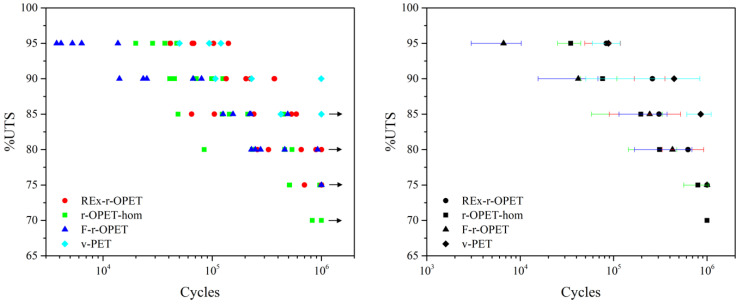
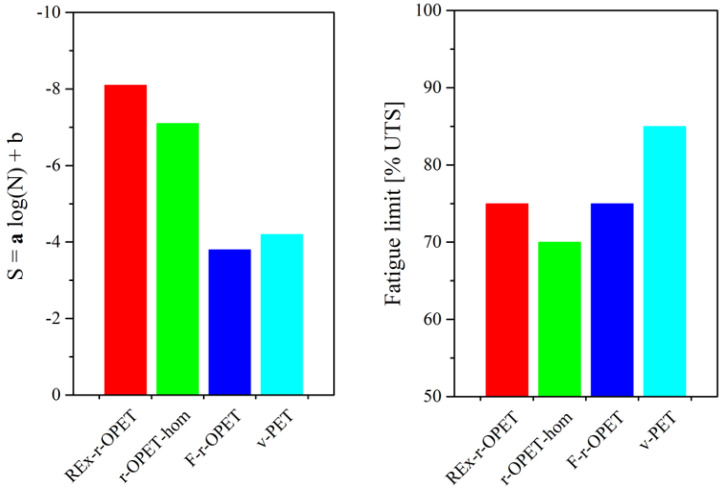
Polyethylene terephthalate (PET) is among the most used thermoplastic polymers in large scale manufacturing. Opaque PET is increasingly used in milk bottles to save weight and to bring a glossy white aspect due to TiO nanoparticles. The recyclability of opaque PET is an issue: whereas the recycling channels are well established for transparent PET, the presence of opaque PET in household wastes weakens those channels: opaque bottles cannot be mixed with transparent ones because the resulting blend is not transparent anymore. Many research efforts focus on the possibility to turn opaque PET into resources, as one key to a more circular economy. A recent study has demonstrated the improvement of the mechanical properties of recycled PET through reactive extrusion. In the present work, the lifespan of recycled opaque PET has been evaluated throughout tensile-tensile fatigue loading cycles at various steps of the recycling process: The specimens are obtained from flakes after grinding PET wastes (F-r-OPET), from a subsequent homogenization step (r-OPET-hom) and after reactive extrusion (Rex-r-OPET). Virgin PET is also considered as a comparison. First, tensile tests monitored by digital image correlation have been carried out to obtain the elastic modulus and ultimate tensile stress of each type of PET. The fatigue properties of reactive REx-r-OPET increase, probably associated with the rise of cross-linking and branching rates. The fatigue lifespan increases with the macromolecular weight. The fracture surface analysis of specimens brings new insight regarding the factors governing the fatigue behavior and the damaging mode of recycled PET. TiO nanoparticles act as stress concentrators, contributing to void formation at multiple sites and thus promoting the fracture process. Finally, the fatigue life of REx-r-OPET is comparable to those of virgin PET. Upcycling opaque PET by reactive extrusion may be a relevant new route to absorb some of the growing amounts of PET worldwide.
聚对苯二甲酸乙二酯(PET)是大规模制造业中使用最广泛的热塑性聚合物之一。不透明PET越来越多地用于奶瓶,以减轻重量,并由于TiO纳米颗粒而呈现出光泽的白色外观。不透明PET的可回收性是一个问题:虽然透明PET的回收渠道已经很成熟,但家庭垃圾中不透明PET的存在削弱了这些渠道:不透明瓶子不能与透明瓶子混合,因为混合后的混合物不再透明。许多研究工作都集中在将不透明PET转化为资源的可能性上,这是实现更循环经济的关键之一。最近的一项研究表明,通过反应挤出可以改善回收PET的机械性能。在本工作中,在回收过程的各个步骤中,通过拉伸-拉伸疲劳加载循环评估了回收不透明PET的寿命:试样取自研磨PET废料后的薄片(F-r-OPET)、随后的均质化步骤(r-OPET-hom)以及反应挤出后(Rex-r-OPET)。纯PET也作为对照。首先,通过数字图像相关监测进行拉伸试验,以获得每种类型PET的弹性模量和极限拉伸应力。反应性REx-r-OPET的疲劳性能提高,可能与交联和支化速率的增加有关。疲劳寿命随大分子重量的增加而增加。试样的断口表面分析为控制回收PET疲劳行为和损伤模式的因素带来了新的见解。TiO纳米颗粒起到应力集中器的作用,导致多个部位形成空隙,从而促进断裂过程。最后,REx-r-OPET的疲劳寿命与纯PET相当。通过反应挤出对不透明PET进行升级回收可能是吸收全球不断增长的PET数量的一条相关新途径。