Institute for Automation and Applied Informatics, Karlsruhe Institute of Technology, 76344 Eggenstein-Leopoldshafen, Germany.
Karlsruhe Nano Micro Facility, Karlsruhe Institute of Technology, 76344 Eggenstein-Leopoldshafen, Germany.
Sensors (Basel). 2022 Sep 1;22(17):6625. doi: 10.3390/s22176625.
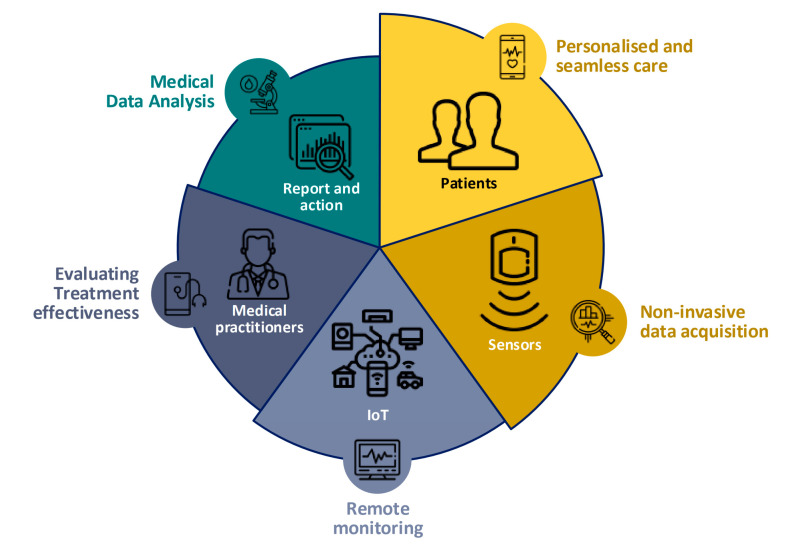
The rapid development of technology has brought about a revolution in healthcare stimulating a wide range of smart and autonomous applications in homes, clinics, surgeries and hospitals. Smart healthcare opens the opportunity for a qualitative advance in the relations between healthcare providers and end-users for the provision of healthcare such as enabling doctors to diagnose remotely while optimizing the accuracy of the diagnosis and maximizing the benefits of treatment by enabling close patient monitoring. This paper presents a comprehensive review of non-invasive vital data acquisition and the Internet of Things in healthcare informatics and thus reports the challenges in healthcare informatics and suggests future work that would lead to solutions to address the open challenges in IoT and non-invasive vital data acquisition. In particular, the conducted review has revealed that there has been a daunting challenge in the development of multi-frequency vital IoT systems, and addressing this issue will help enable the vital IoT node to be reachable by the broker in multiple area ranges. Furthermore, the utilization of multi-camera systems has proven its high potential to increase the accuracy of vital data acquisition, but the implementation of such systems has not been fully developed with unfilled gaps to be bridged. Moreover, the application of deep learning to the real-time analysis of vital data on the node/edge side will enable optimal, instant offline decision making. Finally, the synergistic integration of reliable power management and energy harvesting systems into non-invasive data acquisition has been omitted so far, and the successful implementation of such systems will lead to a smart, robust, sustainable and self-powered healthcare system.
技术的飞速发展在医疗保健领域引发了一场革命,刺激了家庭、诊所、手术室和医院中各种智能和自主应用的发展。智能医疗为医疗保健服务提供者和最终用户之间的关系提供了定性的进步机会,例如使医生能够远程诊断,同时通过密切监测患者来优化诊断的准确性并最大限度地提高治疗效果。本文对非侵入性生命数据采集和医疗保健信息学中的物联网进行了全面回顾,从而报告了医疗保健信息学中的挑战,并提出了未来的工作,这些工作将有助于解决物联网和非侵入性生命数据采集方面的开放挑战。特别是,所进行的审查表明,在多频生命物联网系统的开发方面面临着艰巨的挑战,解决这个问题将有助于使生命物联网节点能够在多个区域范围内被代理访问。此外,多摄像机系统的利用已被证明具有提高生命数据采集准确性的巨大潜力,但此类系统的实施尚未完全开发,存在未填补的空白需要加以弥合。此外,将深度学习应用于节点/边缘侧的生命数据实时分析将能够实现最佳的即时离线决策。最后,可靠的电源管理和能量收集系统与非侵入性数据采集的协同集成到目前为止还被忽略了,如果成功实施这些系统,将能够构建出智能、强大、可持续和自供电的医疗保健系统。