López-Gil José Francisco, Smith Lee, López-Bueno Rubén, Tárraga-López Pedro Juan
Health and Social Research Center, Universidad de Castilla-La Mancha, Cuenca, Spain.
Centre for Health, Performance and Wellbeing, Anglia Ruskin University, Cambridge, United Kingdom.
Front Nutr. 2022 Aug 23;9:871238. doi: 10.3389/fnut.2022.871238. eCollection 2022.
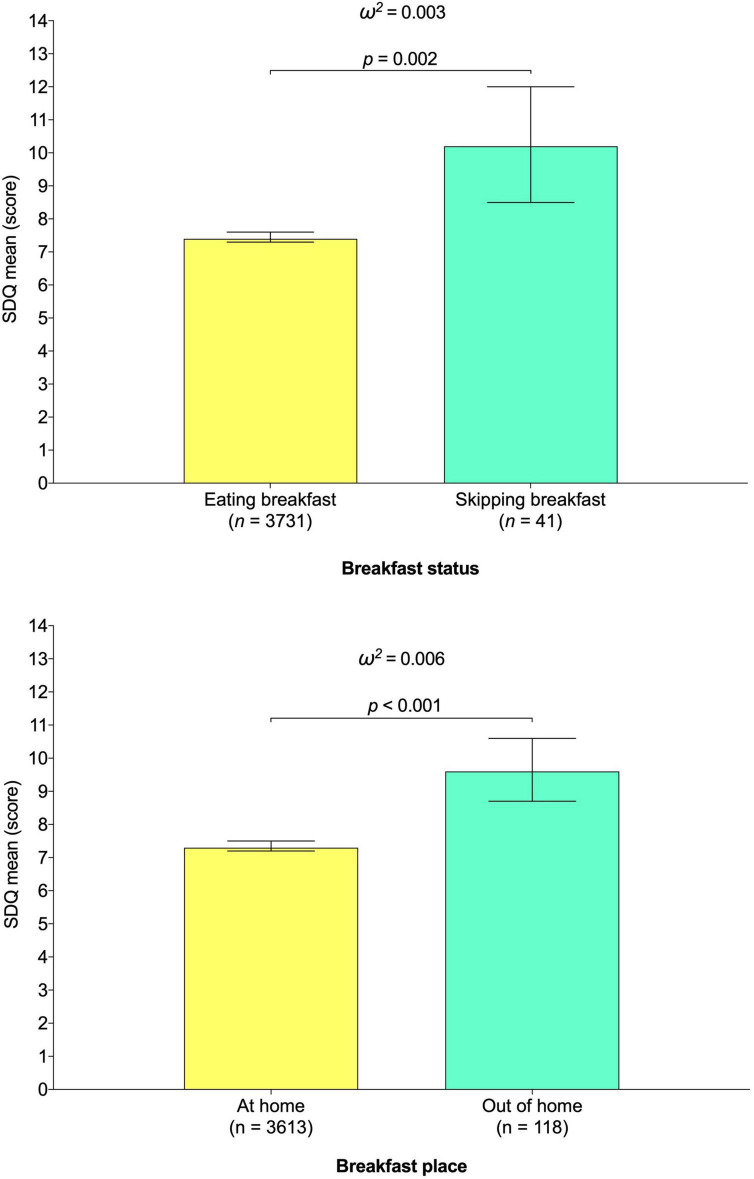
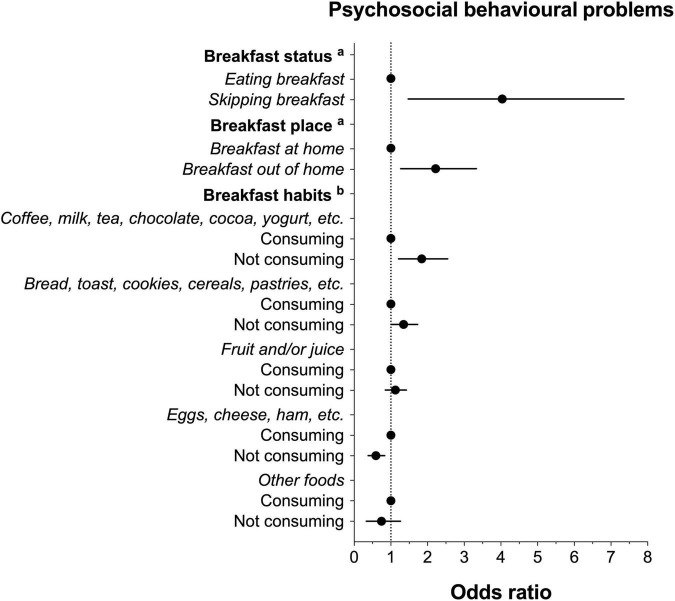
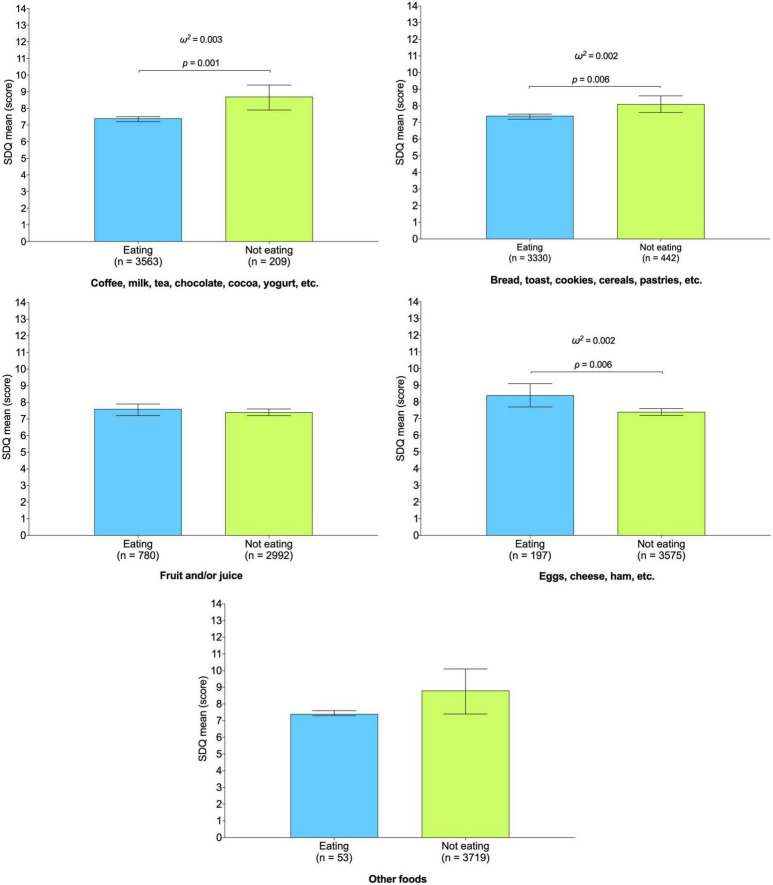
The aim of this study was to examine whether breakfast status, place and habits are associated with psychosocial behavioural problems in a nationally representative sample of young people aged 4-14 years residing in Spain. This study analysed secondary data from the Spanish National Health Survey (2017), including 3,772 Spanish children and adolescents. Breakfast status, place, and habits were assessed by questions answered by parents/guardians. The Strengths and Difficulties Questionnaire (SDQ) parents' version form was applied to evaluate the psychosocial health of their children. Skipping breakfast and eating breakfast out of home were linked to greater odds of psychosocial behavioural problems (skipping breakfast: OR = 3.29; CI 95%, 1.47-7.35; breakfast out of home: OR = 2.06; CI 95%, 1.27-3.33) than eating breakfast at home. Similarly, not consuming coffee, milk, tea, chocolate, cocoa, yogurt, etc., for breakfast was related to greater odds of psychosocial behavioural problems (OR = 1.76; CI 95%, 1.21-2.55). This association was also found for those who did not eat bread, toast, cereals, pastries, etc., for breakfast (OR = 1.31; CI 95%, 1.01-1.73). Conversely, not consuming eggs, cheese, ham, etc., was associated with lower odds of psychosocial behavioural problems (OR = 0.56; CI 95%, 0.38-0.83). Our results show that eating breakfast (specifically at home) and breakfast habits related to the intake of certain food/beverages groups were associated with higher or lower odds of psychosocial behavioural problems.
本研究旨在调查在西班牙全国具有代表性的4至14岁年轻人样本中,早餐状况、地点和习惯是否与心理社会行为问题相关。本研究分析了西班牙国家健康调查(2017年)的二手数据,其中包括3772名西班牙儿童和青少年。早餐状况、地点和习惯通过父母/监护人回答的问题进行评估。应用优势与困难问卷(SDQ)父母版来评估孩子的心理社会健康状况。与在家吃早餐相比,不吃早餐和在户外吃早餐与心理社会行为问题的几率更高有关(不吃早餐:比值比=3.29;95%置信区间,1.47 - 7.35;在户外吃早餐:比值比=2.06;95%置信区间,1.27 - 3.33)。同样,早餐不喝咖啡、牛奶、茶、巧克力、可可、酸奶等与心理社会行为问题的几率更高有关(比值比=1.76;95%置信区间,1.21 - 2.55)。对于早餐不吃面包、吐司、谷物、糕点等的人也发现了这种关联(比值比=1.31;95%置信区间,1.01 - 1.73)。相反,不吃鸡蛋、奶酪、火腿等与心理社会行为问题的几率较低有关(比值比=0.56;95%置信区间,0.38 - 0.83)。我们的结果表明,吃早餐(特别是在家吃)以及与某些食物/饮料组摄入量相关的早餐习惯与心理社会行为问题的几率高低有关。