Department of Gynecology and Obstetrics, Beijing Hospital, National Center of Gerontology, Institute of Geriatric Medicine, Chinese Academy of Medical Sciences, Beijing, China.
Graduate School of Peking Union Medical College, Beijing, China.
Biomed Res Int. 2022 Aug 30;2022:8796093. doi: 10.1155/2022/8796093. eCollection 2022.
Mesenchymal stem cells (MSCs) and their derivant are among the promising treatments for intrauterine adhesion (IUA); they have been reported to repair the endometrial injury by proliferating endometrial cells. However, the signal pathways involved are not clear. This study investigated the role of human umbilical cord mesenchymal stem cell-derived conditioned medium (hUCMSC-CM) in relieving IUA to find out whether Wnt/-catenin signaling was involved, and if so, to determine the possible ligands.
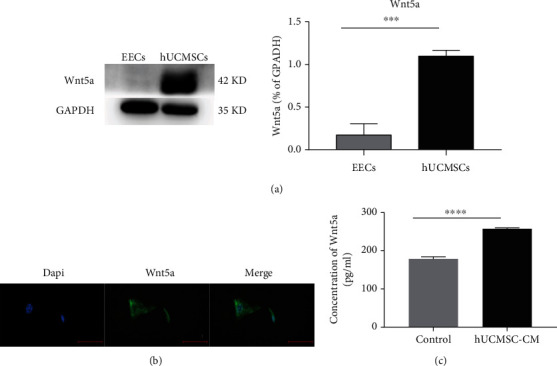
After endometrial epithelial cells (EECs) were treated with hUCMSC-CM, their proliferation and migration were measured by the CCK8 assay and the scratch assay. The activation of Wnt/-catenin signaling was measured by Western blots, fluorescent staining, and T-cell factor/lymphoid enhancer factor (TCF/LEF) luciferase. A Wnt inhibitor (XAV393) was used to inhibit the proliferation effect of hUCMSC-CM in EECs. Wnt5a expression in hUCMSC was measured by Western blots and fluorescent staining, and Wnt5a in hUCMSC-CM was detected by enzyme-linked immunosorbent assay (ELISA), to further clarify the mechanism.
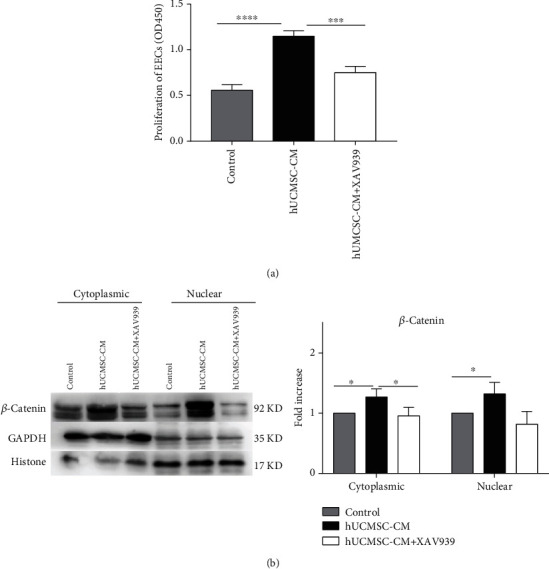
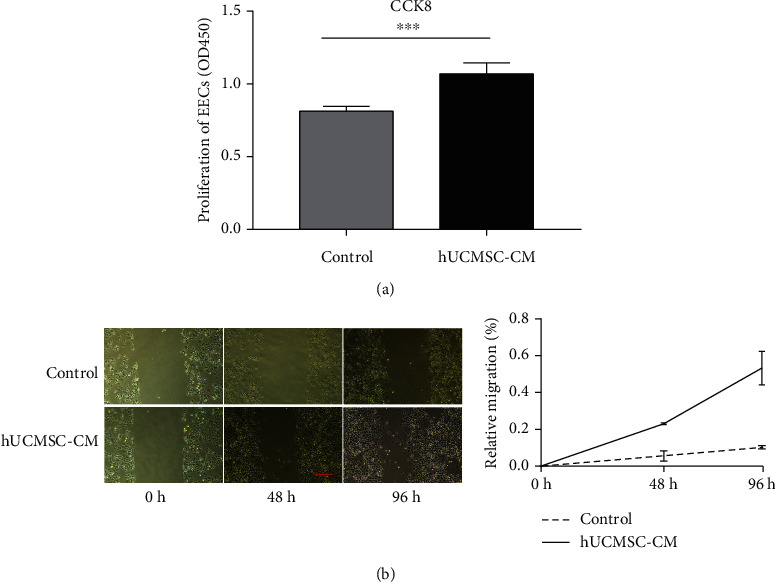
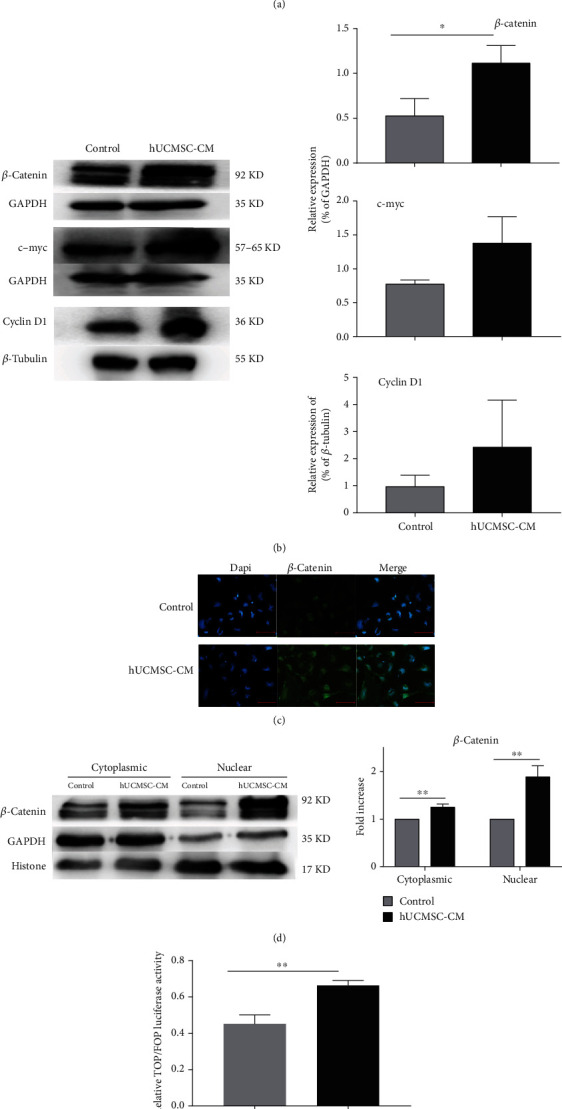
As shown by the CCK8 assay, hUCMSC-CM promoted proliferation and migration of EECs. The expression of -catenin, c-myc, and cyclin D1 increased in EECs after being treated with hUCMSC-CM. Moreover, hUCMSC-CM was found to promote -catenin delivery into nuclei by Western blot and fluorescent staining; meanwhile, the inhibitor (XAV393) could restrain this process and inhibit the effect of hUCMSC-CM on EEC proliferation. Wnt5a was detected in hUCMSCs and hUCMSC-CM, which might be a potential therapeutic target.
This study demonstrated that hUCMSC-CM promoted human endometrial cell proliferation through Wnt/-catenin signaling, and Wnt5a might be a potential activator. This would be one of the activating signal pathways in the MSC-related treatment of IUA.
间充质干细胞(MSCs)及其衍生物是治疗宫腔粘连(IUA)的有前途的方法之一;据报道,它们通过增殖子宫内膜细胞来修复子宫内膜损伤。然而,涉及的信号通路尚不清楚。本研究探讨了人脐带间充质干细胞来源条件培养基(hUCMSC-CM)在缓解 IUA 中的作用,以确定是否涉及 Wnt/-catenin 信号通路,如果涉及,确定可能的配体。
将 hUCMSC-CM 处理子宫内膜上皮细胞(EECs)后,通过 CCK8 测定法和划痕试验测定细胞增殖和迁移。通过 Western blot、荧光染色和 T 细胞因子/淋巴增强因子(TCF/LEF)荧光素酶测定法测定 Wnt/-catenin 信号通路的激活。使用 Wnt 抑制剂(XAV393)抑制 hUCMSC-CM 在 EECs 中的增殖作用。通过 Western blot 和荧光染色测定 hUCMSC 中的 Wnt5a 表达,并通过酶联免疫吸附试验(ELISA)检测 hUCMSC-CM 中的 Wnt5a,以进一步阐明机制。
CCK8 测定法显示,hUCMSC-CM 促进 EEC 的增殖和迁移。hUCMSC-CM 处理后的 EECs 中 -catenin、c-myc 和 cyclin D1 的表达增加。此外,Western blot 和荧光染色显示 hUCMSC-CM 促进 -catenin 向核内转运;同时,抑制剂(XAV393)可抑制该过程并抑制 hUCMSC-CM 对 EEC 增殖的作用。在 hUCMSCs 和 hUCMSC-CM 中检测到 Wnt5a,它可能是一个潜在的治疗靶点。
本研究表明,hUCMSC-CM 通过 Wnt/-catenin 信号通路促进人子宫内膜细胞增殖,Wnt5a 可能是潜在的激活剂。这将是 MSC 相关治疗 IUA 的激活信号通路之一。