Department of Pathology, Samsung Changwon Hospital, Sungkyunkwan University School of Medicine, Changwon, Republic of Korea.
Department of Pathology, Kangbuk Samsung Hospital, Sungkyunkwan University School of Medicine, Seoul, Republic of Korea.
PLoS One. 2022 Sep 9;17(9):e0273723. doi: 10.1371/journal.pone.0273723. eCollection 2022.
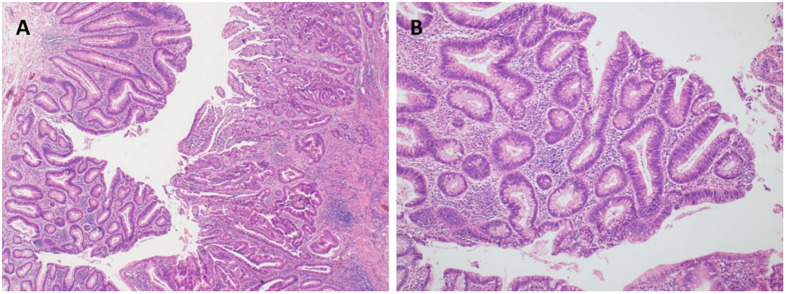
BACKGROUND/AIM: Colorectal cancer is well known for its "adenoma-carcinoma" sequential carcinogenesis. Some colorectal cancers demonstrate a residual adenoma component during progression from adenoma to invasive carcinoma. However, the clinicopathological significance of residual adenoma component remains unclear. In this study, we aimed to investigate the clinicopathologic and molecular characteristics including the KRAS mutation in colorectal cancers containing a residual adenoma component.
In this study, 498 surgically resected colorectal cancer patients were enrolled. Their detailed clinicopathologic features and results of molecular study including KRAS mutation test and microsatellite instability were analyzed.
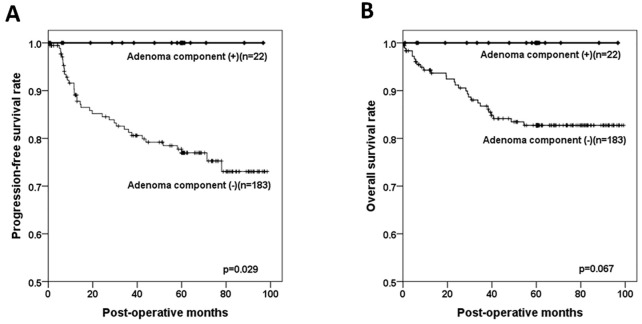
A residual adenoma component was identified in 42 (8.4%) patients with colorectal cancer. The presence of a residual adenoma component was associated with a high frequency of the KRAS mutation (65%, p = 0.031) as well as indolent clinicopathological features, including polypoid gross type (p < 0.001), well-differentiated histology (p < 0.001), low pT (p < 0.001) and pN stage (p = 0.003), absence of vascular invasion (p = 0.005), and a better progression-free prognosis (p = 0.029). The cases with an adenoma component had a 35.7% discordance rate on the KRAS mutation tests in their adenoma and carcinoma regions.
In conclusion, colorectal cancer with a residual adenoma component showed indolent clinicopathologic features and frequent KRAS mutations. Due to the discordance in the incidence of the KRAS mutation between the adenoma and carcinoma components, the adenoma component should be documented in the pathology report, and care should be taken not to include the adenoma component when collecting samples for molecular testing.
背景/目的:结直肠癌以“腺瘤-癌”序贯发生为特征。一些结直肠癌在从腺瘤进展为浸润性癌的过程中显示出残留的腺瘤成分。然而,残留腺瘤成分的临床病理意义尚不清楚。本研究旨在探讨包含残留腺瘤成分的结直肠癌的临床病理和分子特征,包括 KRAS 突变。
本研究纳入了 498 例接受手术切除的结直肠癌患者。分析了他们详细的临床病理特征和分子研究结果,包括 KRAS 突变检测和微卫星不稳定性。
在 498 例结直肠癌患者中,有 42 例(8.4%)发现有残留腺瘤成分。残留腺瘤成分的存在与 KRAS 突变的高频率相关(65%,p=0.031),以及惰性的临床病理特征相关,包括息肉样大体类型(p<0.001)、分化良好的组织学(p<0.001)、低 pT(p<0.001)和 pN 期(p=0.003)、无血管侵犯(p=0.005)以及较好的无进展生存预后(p=0.029)。腺瘤和癌组织中 KRAS 突变检测的腺瘤成分存在 35.7%的不一致率。
总之,具有残留腺瘤成分的结直肠癌表现出惰性的临床病理特征和频繁的 KRAS 突变。由于腺瘤和癌组织中 KRAS 突变的发生率不一致,腺瘤成分应在病理报告中记录,并应注意在收集分子检测样本时不要包含腺瘤成分。