Animal Welfare and Behaviour, School of Veterinary Sciences, University of Bristol, Langford, UK.
Highcroft Veterinary Referrals, 615 Wells Road, Whitchurch, Bristol, BS14 9BE, UK.
BMC Vet Res. 2022 Sep 9;18(1):341. doi: 10.1186/s12917-022-03434-x.
The Bristol Rabbit Pain Scale (BRPS) was developed using a combination of methods, focus groups and behavioural observation, that led to a composite pain scale of six categories (Demeanour, Locomotion, Posture, Ears, Eyes and Grooming) with four intensities of pain (0, 1, 2, and 3), and a total score of 0-18. The aim of this study was to assess the clinical utility, validity and reliability of the BRPS.
The clinical utility of the BRPS was tested using a questionnaire composed of ten questions each on a five-point Likert scale ranging from one (strongly disagree) to five (strongly agree). The respondents, (veterinary surgeons and veterinary nurses), were asked to assess up to four rabbits in acute pain, using the novel pain. They then completed the questionnaire which asked whether the BRPS was easy and quick to use and whether it provided information that was clinically useful. The questionnaire was tested for internal reliability using the Cronbach's alpha reliability coefficient. The construct validity (how well the tool measures the concept it was designed for) was measured by observers blindly rating 20 rabbits pre- and post-surgery whilst the criterion validity (the degree to which the tool correlates with a gold standard) was assessed by correlating BRPS scores with scores using a numerical rating scale (NRS) with a total score of 0-10. Inter-rater reliability was tested by quantifying the agreement in the pain scores given by nine participants when assessing the same 40 video clips. The intra-rater reliability was measured by testing how consistent the participants were when rating the same clips one month later.
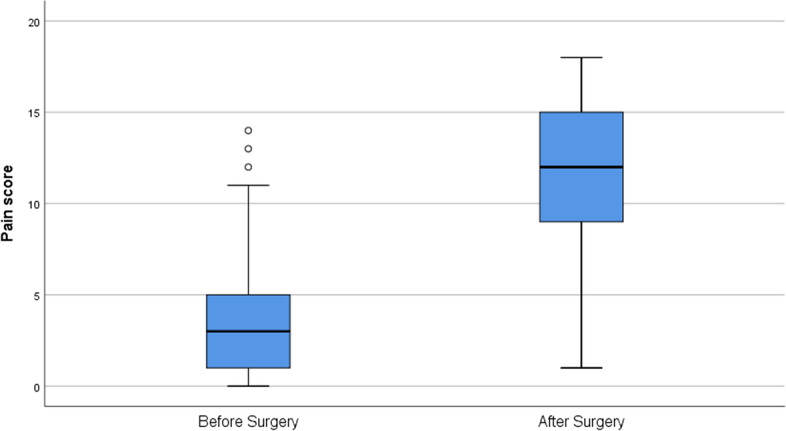
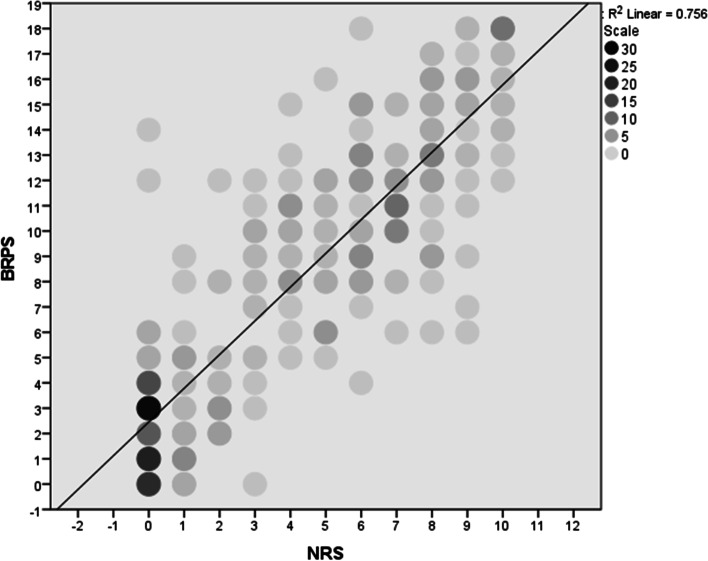
The median score of the ten questions of the clinical utility test was 4 (range 2-5). The Cronbach's alpha reliability coefficient of the clinical utility test was good (α = 0.811) demonstrating good internal consistency. The median (range) pain score of the BRPS and the NRS were 3 (0-14) and 0 (0-8) before surgery and 12 (1-18) and 7 (0-10) after surgery respectively. The BRPS demonstrated high construct validity (Z = -11.452; p < 0.001) and there was a strong correlation between the BRPS and the NRS (Rho = 0.851; p < 0.001) indicating high criterion validity. The inter-rater and the intra-rater agreements were α = 0.863 and α = 0.861 respectively, which is considered good.
This study showed that the BRPS is a suitable tool for quantifying pain in rabbits in a clinically useful, valid and reliable way.
布里斯托兔疼痛量表(BRPS)是使用多种方法(焦点小组和行为观察)开发的,这些方法导致了一个由六个类别的疼痛(行为、运动、姿势、耳朵、眼睛和梳理)和四个疼痛强度(0、1、2 和 3)组成的综合疼痛量表,总分为 0-18。本研究旨在评估 BRPS 的临床实用性、有效性和可靠性。
使用由十个问题组成的问卷来测试 BRPS 的临床实用性,每个问题的答案在 1-5 分的李克特量表上,范围从 1(非常不同意)到 5(非常同意)。受访者(兽医和兽医护士)被要求使用新的疼痛评估四只急性疼痛的兔子。然后,他们完成了一份问卷,询问 BRPS 是否易于使用且提供了有用的临床信息。使用 Cronbach's alpha 可靠性系数测试问卷的内部可靠性。通过观察者在手术前后对 20 只兔子进行盲评来衡量结构有效性(工具测量其设计目的的概念的程度),通过将 BRPS 评分与使用数字评分量表(NRS)的评分相关联来评估标准有效性(工具与金标准的相关性),NRS 的总分为 0-10。通过量化九名参与者在评估相同的 40 个视频剪辑时给出的疼痛评分的一致性来测试观察者间的可靠性。通过测试参与者在一个月后对同一剪辑的评分的一致性来衡量内部一致性。
临床实用性测试的十个问题的中位数得分为 4(范围 2-5)。临床实用性测试的 Cronbach's alpha 可靠性系数较好(α=0.811),表明内部一致性良好。BRPS 和 NRS 的中位数(范围)疼痛评分分别为手术前 3(0-14)和 0(0-8),手术后 12(1-18)和 7(0-10)。BRPS 显示出较高的结构有效性(Z=-11.452;p<0.001),并且与 NRS 之间存在很强的相关性(Rho=0.851;p<0.001),表明具有较高的标准有效性。观察者间和观察者内的一致性分别为α=0.863 和α=0.861,这被认为是良好的。
本研究表明,BRPS 是一种用于以临床有用、有效和可靠的方式定量评估兔子疼痛的合适工具。