Guan Grace, Mofaz Merav, Qian Gary, Patalon Tal, Shmueli Erez, Yamin Dan, Brandeau Margaret L
Department of Management Science and Engineering, Stanford University, Stanford, CA, USA.
Department of Industrial Engineering, Tel Aviv University, Tel Aviv, Israel.
NPJ Digit Med. 2022 Sep 9;5(1):140. doi: 10.1038/s41746-022-00683-w.
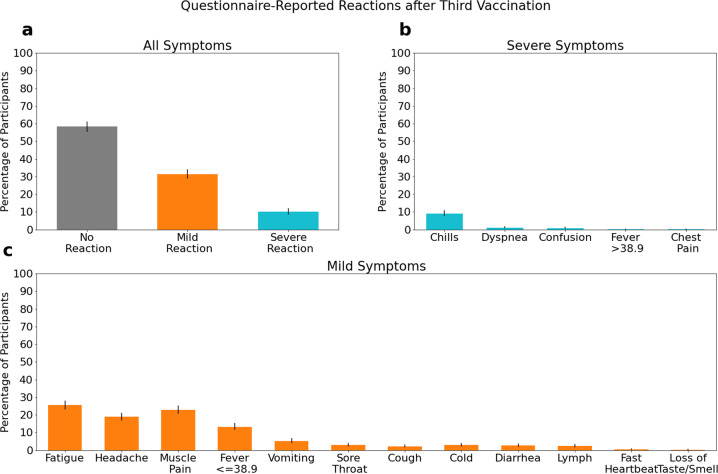
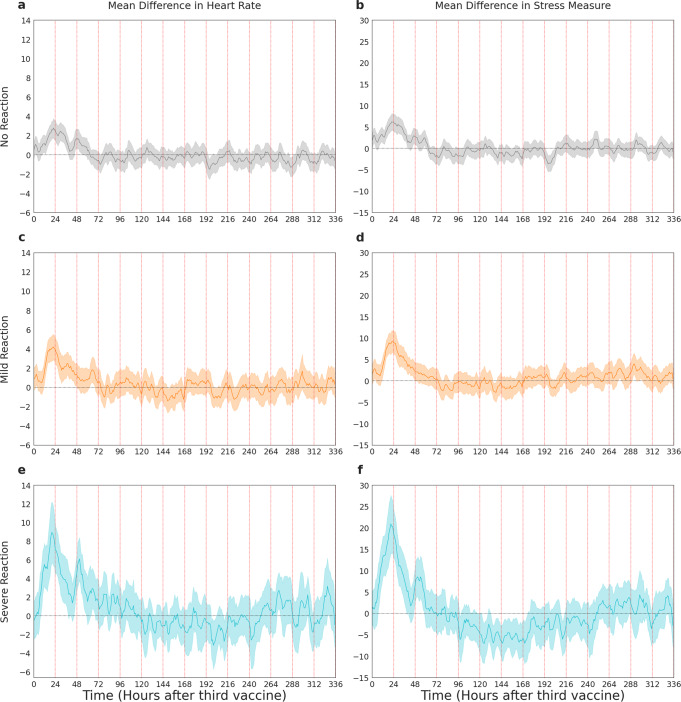
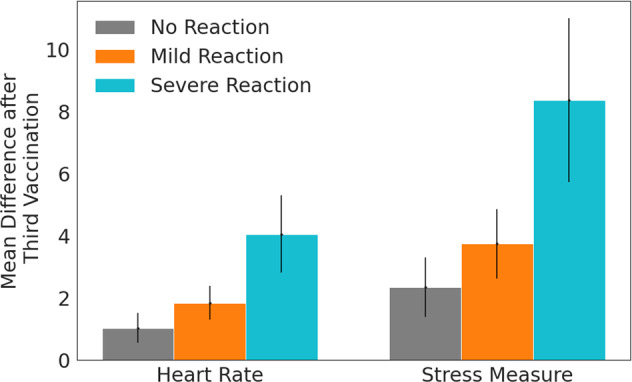
More than 12 billion COVID-19 vaccination shots have been administered as of August 2022, but information from active surveillance about vaccine safety is limited. Surveillance is generally based on self-reporting, making the monitoring process subjective. We study participants in Israel who received their second or third Pfizer BioNTech COVID-19 vaccination. All participants wore a Garmin Vivosmart 4 smartwatch and completed a daily questionnaire via smartphone. We compare post-vaccination smartwatch heart rate data and a Garmin-computed stress measure based on heart rate variability with data from the patient questionnaires. Using a mixed effects panel regression to remove participant-level fixed and random effects, we identify considerable changes in smartwatch measures in the 72 h post-vaccination even among participants who reported no side effects in the questionnaire. Wearable devices were more sensitive than questionnaires in determining when participants returned to baseline levels. We conclude that wearable devices can detect physiological responses following vaccination that may not be captured by patient self-reporting. More broadly, the ubiquity of smartwatches provides an opportunity to gather improved data on patient health, including active surveillance of vaccine safety.
截至2022年8月,全球已接种超过120亿剂新冠疫苗,但来自主动监测的疫苗安全性信息有限。监测通常基于自我报告,使得监测过程具有主观性。我们研究了以色列接受辉瑞BioNTech新冠疫苗第二剂或第三剂接种的参与者。所有参与者都佩戴佳明Vivosmart 4智能手表,并通过智能手机完成每日问卷。我们将接种疫苗后的智能手表心率数据以及基于心率变异性的佳明计算压力指标与患者问卷数据进行比较。使用混合效应面板回归去除参与者层面的固定和随机效应,我们发现即使在问卷中报告无副作用的参与者中,接种疫苗后72小时内智能手表测量值也有显著变化。在确定参与者何时恢复到基线水平方面,可穿戴设备比问卷更敏感。我们得出结论,可穿戴设备可以检测到接种疫苗后的生理反应,而这些反应可能无法通过患者自我报告捕捉到。更广泛地说,智能手表的普及为收集关于患者健康的更好数据提供了机会,包括对疫苗安全性的主动监测。