Leonard Davis School of Gerontology, University of Southern California, Los Angeles, CA, 90089, USA.
BMC Public Health. 2022 Sep 10;22(1):1720. doi: 10.1186/s12889-022-14118-4.
During the COVID-19 Pandemic, adults in the United States reported delaying medical care, which may be tied risk of infection and local policies limiting appointment. Some populations may have been more likely to delay care than others, leading to other forms of health inequality during this period. To-date there is little research on delayed care among U.S. older adult. We determine the prevalence of delayed medical care among older adults and investigate sociodemographic and health status inequalities in delaying health care.
We used data from the first public release of the nationally representative Health and Retirement Study COVID-19 Subsample (N = 3006). Using logistic regression, we assessed whether differences in delaying health care varied by age, sex, race/ethnicity, education, self-rated health (SRH), and having any Activity of Daily Living (ADL) limitation. We also conducted additional analysis that evaluated differences in delaying care by two care subtypes: doctor and dental care visits.
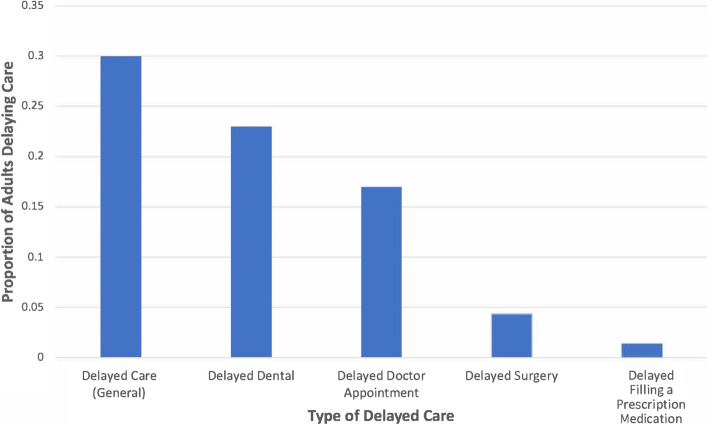
About 30% of U.S. older adults reported delaying care with the most common types of delayed care being dental or doctor visits. Adults ages 75 and older were less likely to delay care, while women, college educated, and those with poor SRH, and any ADL limitations were more likely to delay care.
Nearly one-third of older adults delayed care during the COVID-19 pandemic. The increased likelihood of delayed care among people with worse health suggests that there may be longer-term impacts on the health care system and population health from the COVID-19 pandemic, and may contribute to health inequalities in the near future.
在 COVID-19 大流行期间,美国成年人报告称推迟了医疗保健,这可能与感染风险和限制预约的当地政策有关。一些人群可能比其他人群更有可能推迟护理,从而导致这一时期出现其他形式的健康不平等。迄今为止,关于美国老年人群体延迟护理的研究很少。我们确定了老年人群体中延迟医疗保健的流行率,并调查了社会人口统计学和健康状况不平等与延迟医疗保健之间的关系。
我们使用了具有全国代表性的健康与退休研究 COVID-19 子样本(N=3006)的首次公开数据。使用逻辑回归,我们评估了延迟医疗保健的差异是否因年龄、性别、种族/民族、教育程度、自我报告的健康状况(SRH)和是否存在任何日常生活活动(ADL)限制而有所不同。我们还进行了额外的分析,评估了两种护理亚类型(医生和牙科护理就诊)的护理延迟差异。
约 30%的美国老年人报告延迟了护理,最常见的延迟护理类型是牙科或医生就诊。75 岁及以上的成年人不太可能延迟护理,而女性、受过大学教育、SRH 较差以及存在任何 ADL 限制的成年人更有可能延迟护理。
近三分之一的老年人在 COVID-19 大流行期间推迟了护理。健康状况较差的人更有可能延迟护理,这表明 COVID-19 大流行可能对医疗保健系统和人口健康产生长期影响,并可能在不久的将来导致健康不平等。