Leme Mariane Alves de Godoy, Torres-Mayanga Paulo César, Lachos-Perez Daniel, Forster-Carneiro Tânia, Miguel Miriam Gonçalves
School of Civil Engineering, Architecture and Urban Design, University of Campinas (UNICAMP), Saturnino de Brito Street 224, Campinas, São Paulo, 13083-889 Brazil.
Facultad de Industrias Alimentarias, Universidad Nacional Agraria La Molina, Av. La Molina s/n Lima 12, Lima, Perú.
Biomass Convers Biorefin. 2022 Sep 6:1-12. doi: 10.1007/s13399-022-03264-9.
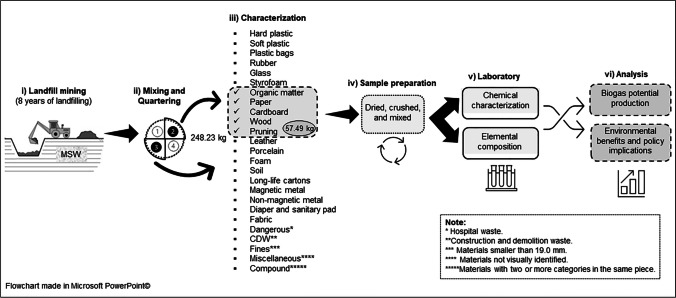
The growing demand for space and financial resources to manage current and new municipal solid waste (MSW) landfills has become a massive challenge for several countries. Additionally, landfills contribute to adverse environmental impacts such as pollution and CO (carbon dioxide) and CH (methane) emissions. This paper has analyzed the possibility of producing biogas from landfilled MSW. An easily degradable fraction of landfilled MSW with 8 years of landfilling was mined and subjected to chemical characterization and elemental composition analysis. The abbreviation for the study sample was called ED8 - Mined. The low values of lignin (24.5%) and nitrogen content (0.7%) and high values of holocellulose (75.9%) and C/N (46.1%) on dry basis were obtained resulting in materials with the potential to be used for biogas generation. Recalcitrant materials were found in greater amounts than easily biodegradable fresh MSW fractions. The reuse of energy from landfilled MSW can contribute positively to the country's environment and economy, reducing environmental liabilities and generating energy in a controlled way. In Delta A Sanitary Landfill, Southeastern Brazil, the recovery of the ED8 - Mined would reflect a significant recovery of about 100,000 tonnes of landfilled materials for annual MSW cells of about 450,000 tonnes, allowing recovery of materials and space expansion for rejects.
fx1.
管理现有及新建城市固体废弃物(MSW)填埋场对空间和财政资源的需求不断增长,这已成为多个国家面临的巨大挑战。此外,填埋场会造成如污染以及二氧化碳(CO)和甲烷(CH)排放等不利环境影响。本文分析了从填埋的城市固体废弃物中生产沼气的可能性。对填埋8年的城市固体废弃物中易于降解的部分进行挖掘,并进行化学特性和元素组成分析。研究样本的缩写为ED8 - 挖掘物。在干基上获得了低木质素值(24.5%)和氮含量(0.7%)以及高全纤维素值(75.9%)和碳氮比(46.1%),这使得这些材料有潜力用于沼气生产。发现难降解材料的含量高于易于生物降解的新鲜城市固体废弃物部分。填埋的城市固体废弃物能量的再利用可为国家的环境和经济做出积极贡献,减少环境负担并以可控方式产生能源。在巴西东南部的三角洲A卫生填埋场,回收ED8 - 挖掘物将意味着每年约450,000吨城市固体废弃物处理单元中约100,000吨填埋材料的显著回收,从而实现材料回收以及为废弃物扩展空间。
fx1。