Galli Mattia, Angiolillo Dominick J
Catholic University of the Sacred Heart, Rome, Italy.
Maria Cecilia Hospital, GVM Care and Research, Cotignola, Italy.
Front Cardiovasc Med. 2022 Aug 25;9:975969. doi: 10.3389/fcvm.2022.975969. eCollection 2022.
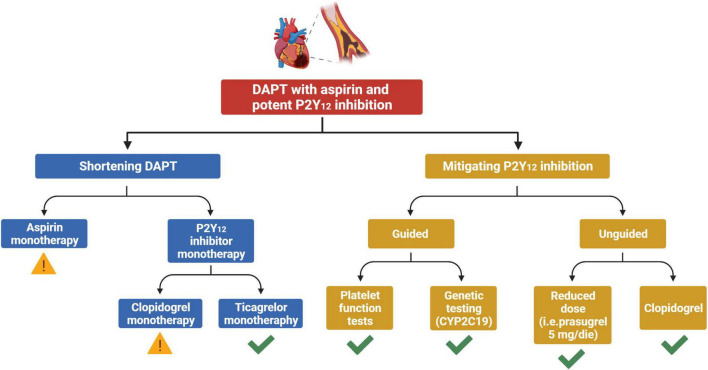
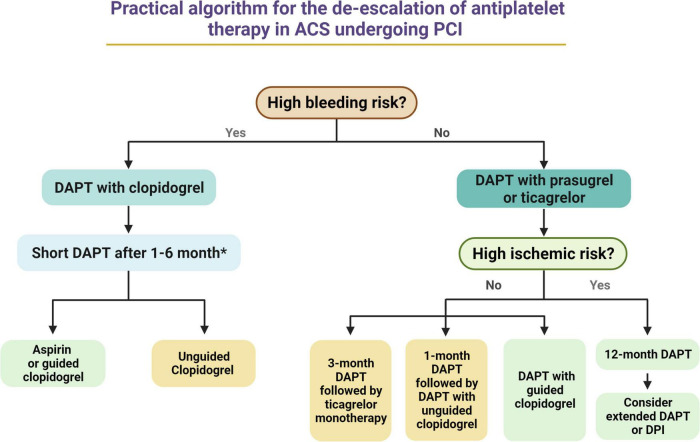
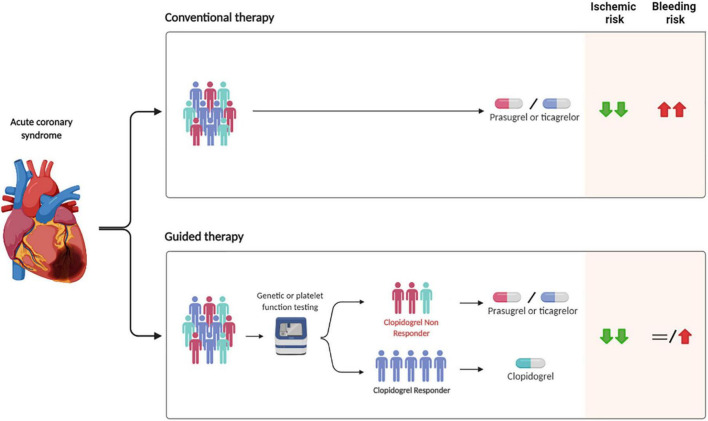
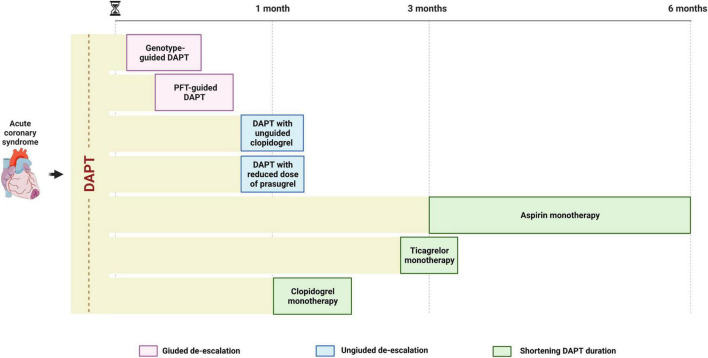
The synergistic blockade of the key platelet signaling pathways of cyclooxygenase-1 blockade and P2Y signaling by combining aspirin plus a potent P2Y inhibitor (prasugrel or ticagrelor), the so called dual antiplatelet treatment (DAPT), has represented the antithrombotic regimen of choice in patients with acute coronary syndrome (ACS) for nearly a decade. Nevertheless, the use of such antiplatelet treatment regimen, while reduced the risk of thrombotic complications, it is inevitably associated with increased bleeding and this risk may outweigh the benefit of a reduction of ischemic events in specific subgroup of patients. In light of the adverse prognostic implications of a bleeding complication, there has been a great interest in the development of antiplatelet regimens aimed at reducing bleeding without any trade-off in ischemic events. The fact that the ischemic risk is highest in the early phase after an ACS while the risk of bleeding remains relatively stable over time has represented the rationale for the implementation of a more intense antithrombotic regimen early after an ACS, followed by a less intense antithrombotic regimen thereafter. This practice, known as a "de-escalation" strategy, represents one of the more promising approaches for personalization of antithrombotic therapy in ACS. In this review we discuss the rationale, appraise the evidence and provide practical recommendations on the use of a de-escalation strategy of antiplatelet therapy in patients with an ACS.
通过联合使用阿司匹林和强效P2Y抑制剂(普拉格雷或替格瑞洛)对环氧合酶-1阻断和P2Y信号传导这两个关键血小板信号通路进行协同阻断,即所谓的双联抗血小板治疗(DAPT),在近十年间一直是急性冠状动脉综合征(ACS)患者抗血栓治疗的首选方案。然而,使用这种抗血小板治疗方案虽然降低了血栓形成并发症的风险,但不可避免地会增加出血风险,并且在特定患者亚组中,这种风险可能超过降低缺血事件的益处。鉴于出血并发症对预后的不良影响,人们对开发旨在减少出血且不影响缺血事件的抗血小板治疗方案产生了浓厚兴趣。ACS后早期缺血风险最高,而出血风险随时间相对稳定,这一事实构成了在ACS后早期实施更强化的抗血栓治疗方案、随后采用强度较低的抗血栓治疗方案的理论基础。这种做法被称为“降阶梯”策略,是ACS抗血栓治疗个体化中最有前景的方法之一。在这篇综述中,我们讨论了其理论基础,评估了证据,并就ACS患者抗血小板治疗降阶梯策略的使用提供了实用建议。