Krishna Sudhir, Prasad Ramakrishna
Indian Institute of Technology, Goa and Formerly of the National Center for Biological Sciences, Bangalore, India.
PCMH Restore Health and Wellness LLP & the Academy of Family Physicians of India, Karnataka chapter, Bangalore, India.
J Indian Inst Sci. 2022;102(2):783-789. doi: 10.1007/s41745-022-00320-1. Epub 2022 Sep 7.
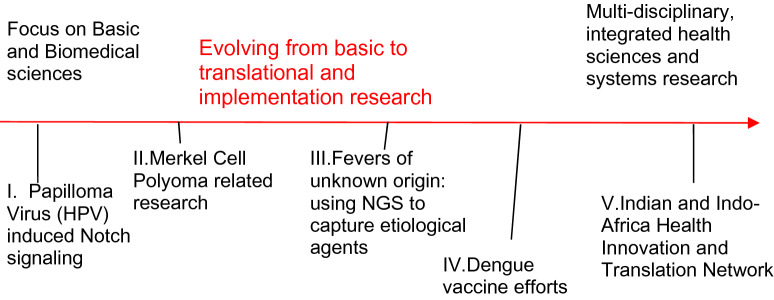
The Indian biomedical landscape has been characterized by the existence of somewhat polarized institutional structures and professional growth. While some scientific and public health challenges have been met with existing structures, there is still a large unmet scientific and public health need. Broadly, the physical separation of science, engineering, medical campuses and industry has led to silos of excellence and accomplishment with huge gaps in innovation and implementation. The lack of inter-disciplinary educational options has further reinforced the cultural underpinning of "guilds" that have found it difficult to collaborate. Strikingly, with almost a comparable number of institutions that train doctors in the allopathic or traditional disciplines such as Ayurveda, Unani etc., an "integrative medicine" framework has not emerged, apart from an over reliance on specialization at the expense of primary care. This paper is written by two physician-scientists, the first is located in a basic life science research center. The second, a practicing family physician, from the institutional anchor of a life sciences research institution. In this, we trace our experiences, primarily from a principal investigator's perspective, describing the scientific projects and try to explore the lessons learnt along the way. We will first describe the research in the lab's core area of human cervical cancer progression and our more recent effort with Dengue genomics and vaccine design. We then describe the lab's engagement with medical campuses and other agencies as well as review our various meetings and interactions so far with our colleagues from Africa to grasp what might be the "generalizable lessons" for the future. The Indian council of medical research initiated a program with Africa in health sciences. Building upon those interactions, we have taken some incremental steps in that direction and described our efforts.
印度的生物医学领域具有两极分化的机构结构和专业发展特点。虽然现有的结构应对了一些科学和公共卫生挑战,但仍存在大量未满足的科学和公共卫生需求。总体而言,科学、工程、医学园区和产业在物理上的分离导致了卓越和成就的孤岛,在创新和实施方面存在巨大差距。跨学科教育选择的缺乏进一步强化了“行会”的文化基础,使其难以开展合作。令人惊讶的是,尽管培训西医或阿育吠陀、尤纳尼等传统医学学科医生的机构数量几乎相当,但除了过度依赖以牺牲初级保健为代价的专业化外,“整合医学”框架尚未形成。本文由两位医生科学家撰写,第一位就职于基础生命科学研究中心,第二位是一名执业家庭医生,来自一所生命科学研究机构的核心单位。在此,我们主要从首席研究员的角度追溯我们的经历,描述科学项目,并试图探索一路走来学到的经验教训。我们将首先描述实验室在人类宫颈癌进展核心领域的研究以及我们最近在登革热基因组学和疫苗设计方面所做的努力。然后,我们将描述实验室与医学园区和其他机构的合作,并回顾我们迄今为止与非洲同事的各种会议和互动,以了解未来可能的“普遍适用的经验教训”。印度医学研究理事会发起了一项与非洲在健康科学领域的合作项目。基于这些互动,我们已朝着这个方向采取了一些渐进措施,并介绍了我们的努力情况。