Transmission, Reservoir and Diversity of Pathogens Unit, Pasteur Institute of Guadeloupe, Pointe-à-Pitre, France.
UMR AgroEcologie, INRAE, Bourgogne Franche-Comté University, Dijon, France.
Microbiol Spectr. 2022 Oct 26;10(5):e0124222. doi: 10.1128/spectrum.01242-22. Epub 2022 Sep 12.
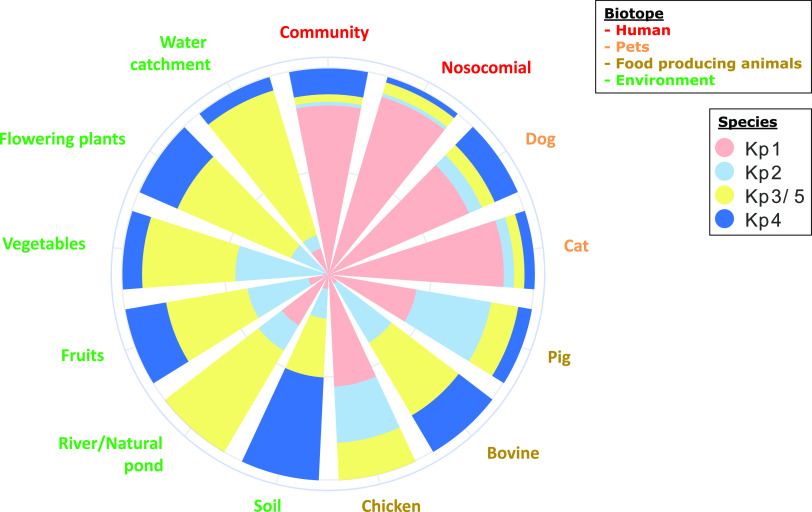
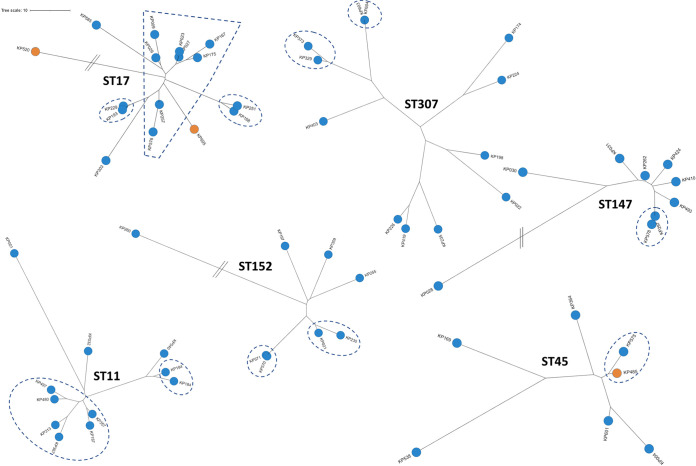
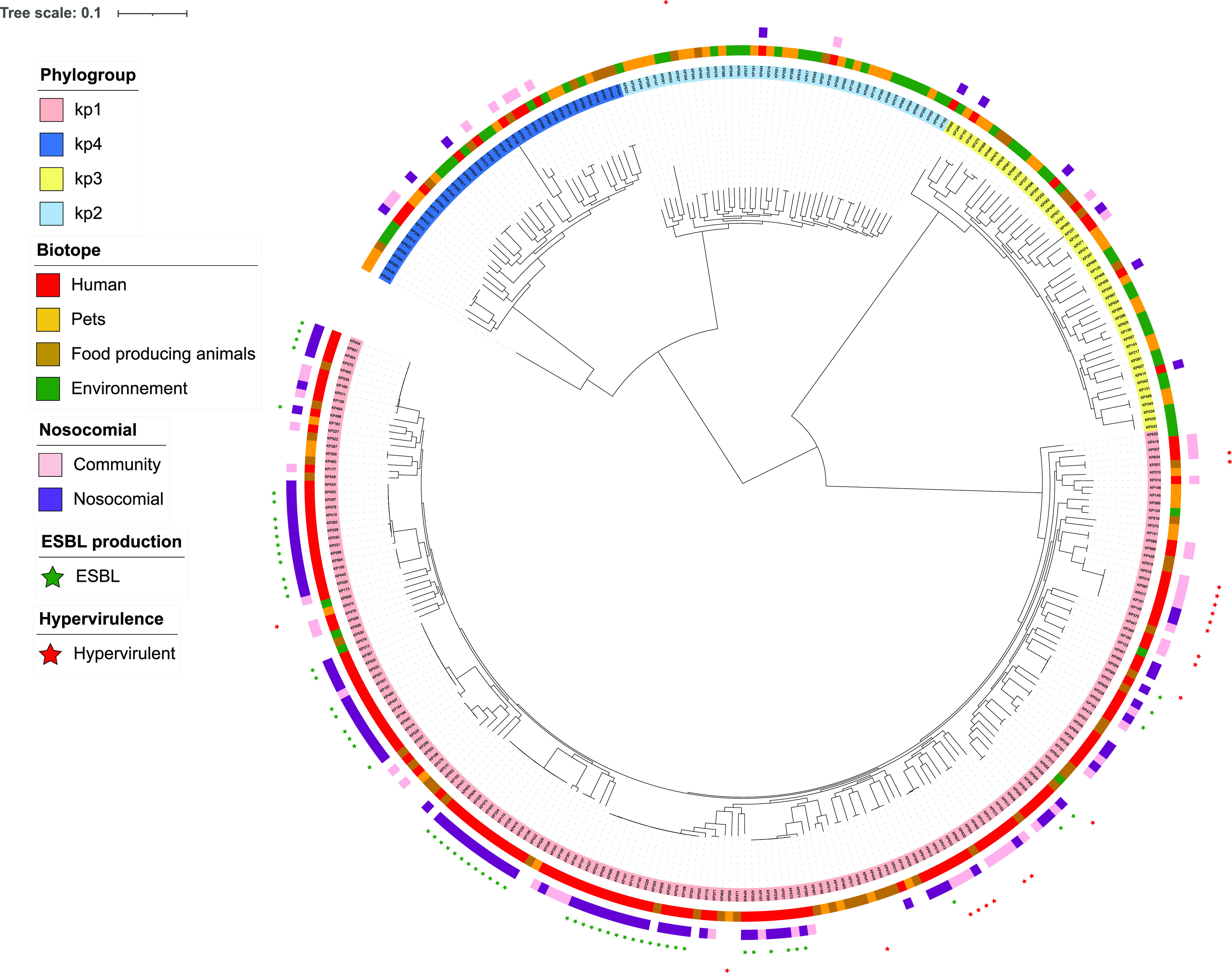
Guadeloupe (French West Indies), a Caribbean island, is an ideal place to study the reservoirs of the Klebsiella pneumoniae species complex (KpSC) and identify the routes of transmission between human and nonhuman sources due to its insularity, small population size, and small area. Here, we report an analysis of 590 biological samples, 546 KpSC isolates, and 331 genome sequences collected between January 2018 and May 2019. The KpSC appears to be common whatever the source. Extended-spectrum-β-lactamase (ESBL)-producing isolates (21.4%) belonged to K. pneumoniae (phylogroup Kp1), and all but one were recovered from the hospital setting. The distribution of species and phylogroups across the different niches was clearly nonrandom, with a distinct separation of Kp1 and Klebsiella variicola (Kp3). The most frequent sequence types (STs) (≥5 isolates) were previously recognized as high-risk multidrug-resistant (MDR) clones, namely, ST17, ST307, ST11, ST147, ST152, and ST45. Only 8 out of the 63 STs (12.7%) associated with human isolates were also found in nonhuman sources. A total of 22 KpSC isolates were defined as hypervirulent: 15 associated with human infections (9.8% of all human isolates), 4 (8.9%) associated with dogs, and 3 (15%) associated with pigs. Most of the human isolates (33.3%) belonged to the globally successful sublineage CG23-I. ST86 was the only clone shared by a human and a nonhuman (dog) source. Our work shows the limited transmission of KpSC isolates between human and nonhuman sources and points to the hospital setting as a cornerstone of the spread of MDR clones and antibiotic resistance genes. In this study, we characterized the presence and genomic features of isolates of the Klebsiella pneumoniae species complex (KpSC) from human and nonhuman sources in Guadeloupe (French West Indies) in order to identify the reservoirs and routes of transmission. This is the first study in an island environment, an ideal setting that limits the contribution of external imports. Our data showed the limited transmission of KpSC isolates between the different compartments. In contrast, we identified the hospital setting as the epicenter of antibiotic resistance due to the nosocomial spread of successful multidrug-resistant (MDR) K. pneumoniae clones and antibiotic resistance genes. Ecological barriers and/or limited exposure may restrict spread from the hospital setting to other reservoirs and vice versa. These results highlight the need for control strategies focused on health care centers, using genomic surveillance to limit the spread, particularly of high-risk clones, of this important group of MDR pathogens.
瓜德罗普(法属西印度群岛)是一个加勒比岛屿,由于其岛屿性、人口规模小和面积小,是研究肺炎克雷伯菌种复合体(KpSC)储层和鉴定人类与非人类来源之间传播途径的理想场所。在这里,我们报告了对 2018 年 1 月至 2019 年 5 月期间收集的 590 个生物样本、546 个 KpSC 分离株和 331 个基因组序列的分析。无论来源如何,KpSC 似乎都很常见。产超广谱β-内酰胺酶(ESBL)的分离株(21.4%)属于肺炎克雷伯菌(Kp1 进化枝),除一株外均从医院环境中回收。不同生态位之间物种和进化枝的分布显然是非随机的,Kp1 和 Klebsiella variicola(Kp3)明显分离。最常见的序列类型(ST)(≥5 个分离株)以前被认为是高风险多药耐药(MDR)克隆,即 ST17、ST307、ST11、ST147、ST152 和 ST45。仅 8 个与人类分离株相关的 63 个 ST 之一(12.7%)也在非人类来源中发现。总共定义了 22 个 KpSC 分离株为超级毒力:15 个与人类感染相关(所有人类分离株的 9.8%),4 个与狗相关(8.9%),3 个与猪相关(15%)。大多数人类分离株(33.3%)属于全球成功的亚谱系 CG23-I。ST86 是唯一与人类和非人类(狗)来源共享的克隆。我们的工作表明,KpSC 分离株在人类和非人类来源之间的传播有限,并指出医院环境是 MDR 克隆和抗生素耐药基因传播的基石。 在这项研究中,我们从人类和非人类来源(法属西印度群岛的瓜德罗普岛)中描述了肺炎克雷伯菌种复合体(KpSC)分离株的存在和基因组特征,以确定储层和传播途径。这是在岛屿环境中进行的第一项研究,这种理想的环境限制了外部输入的贡献。我们的数据表明,KpSC 分离株在不同隔室之间的传播有限。相比之下,我们确定了医院环境是抗生素耐药的中心,因为成功的多药耐药(MDR)肺炎克雷伯菌克隆和抗生素耐药基因在医院环境中的传播。生态屏障和/或有限的暴露可能会限制从医院环境到其他储层的传播,反之亦然。这些结果强调需要关注医疗保健中心的控制策略,使用基因组监测来限制这种重要的多药耐药病原体组中高风险克隆的传播。