Guangzhou Center for Disease Control and Prevention, Guangzhou, China.
Institute of Public Health, Guangzhou Medical University & Guangzhou Center for Disease Control and Prevention, Guangzhou, China.
Microbiol Spectr. 2022 Oct 26;10(5):e0121022. doi: 10.1128/spectrum.01210-22. Epub 2022 Sep 12.
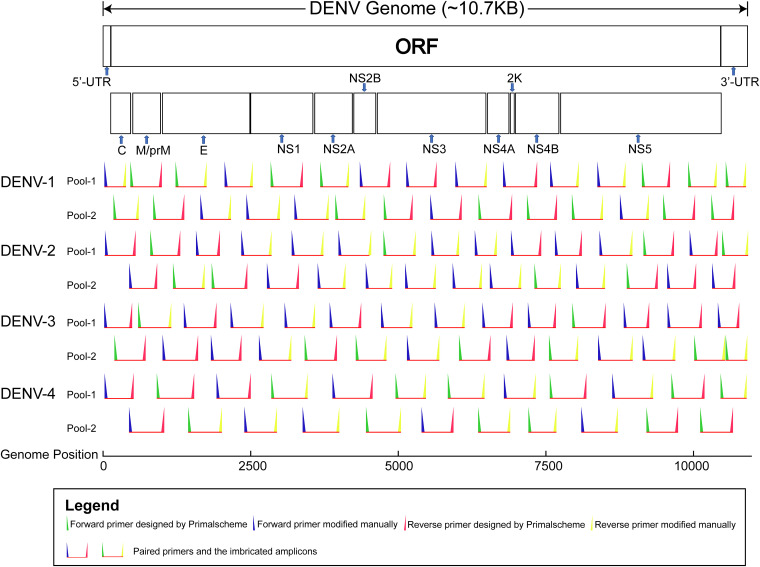
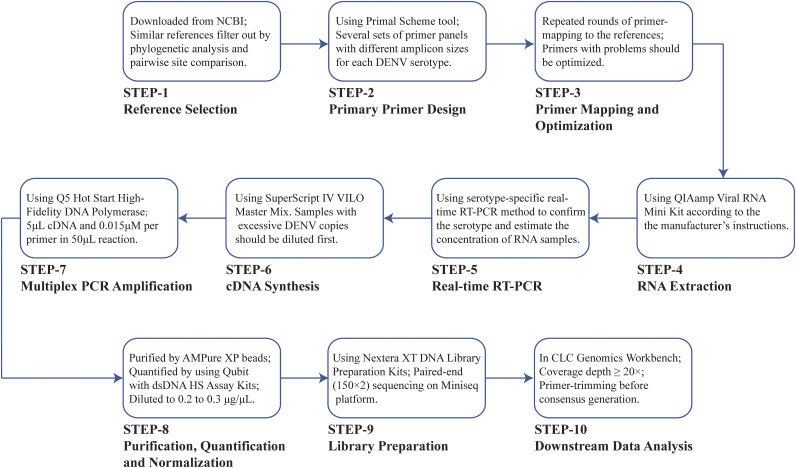
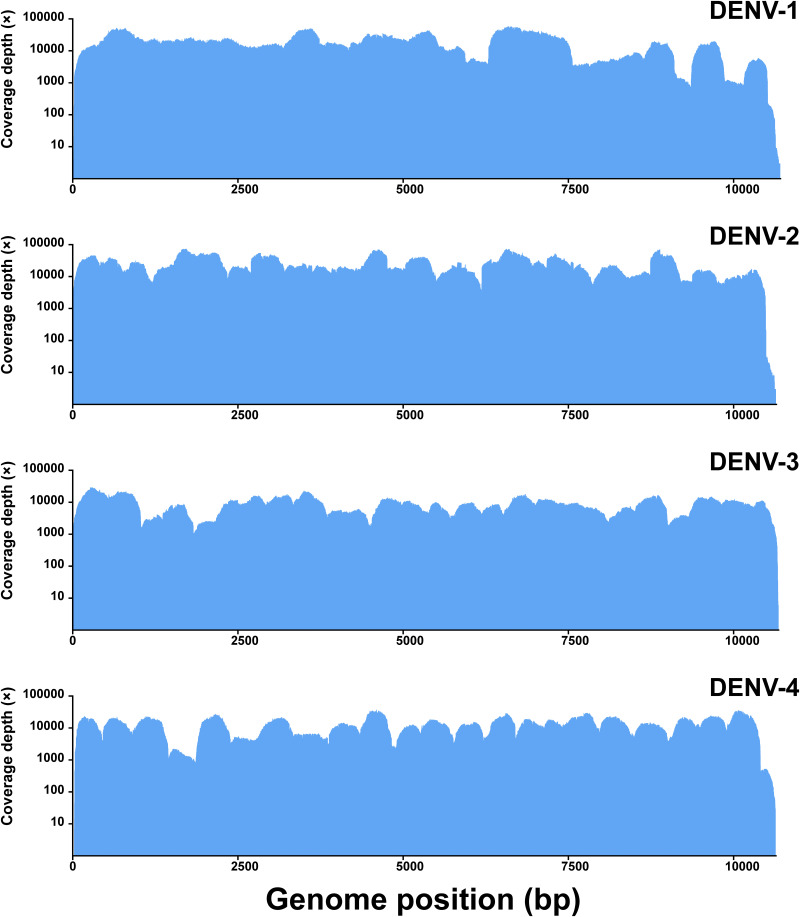
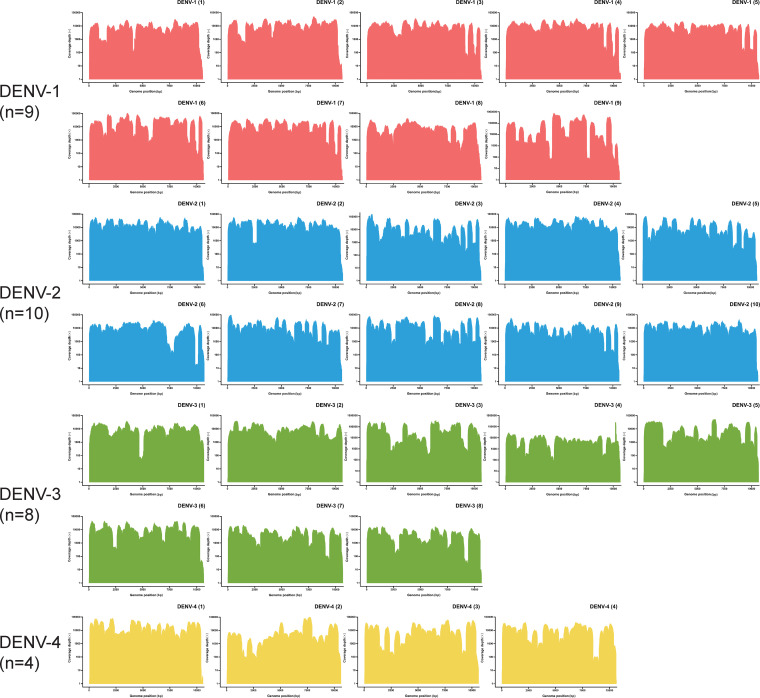
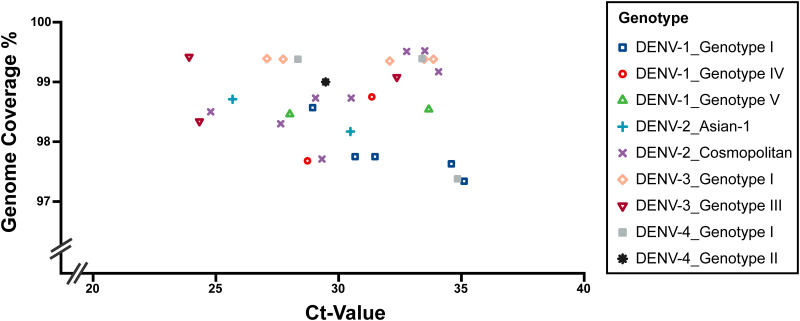
Dengue virus (DENV) is the most globally prevalent member of the genus in the family , which can be classified into four serotypes. Historically, molecular epidemiological studies of DENV depended on E gene sequencing. The development of next-generation sequencing (NGS) allowed its application to viral whole-genome sequencing (WGS). In this study, we report the improvement of the existing WGS process for DENV by optimizing the primer design procedure, designing serotype-specific primer panels and reducing the sizes of amplicons. A total of 31 DENV-positive serum samples belonging to 4 serotypes and 9 genotypes of DENV were involved in the validation of the primer panels. The threshold cycle () values of these samples ranged from 23.91 to 35.11. The validation results showed that the length of consensus sequences generated at a coverage depth of 20× or more ranged from 10,370 to 10,672 bp, with 100.00% coverage of the open reading frames and 97.34% to 99.52% coverage of the DENV genome. The amplification efficiency varied across amplicons, genotypes, and serotypes of DENVs. These results indicate that the serotype-specific primer panels allow users to obtain the whole genome of DENV directly from clinical samples, providing a universal, rapid, and effective tool for the integration of genomics with dengue surveillance. Dengue virus (DENV) is becoming the most globally prevalent arbovirus. The number of people living under the threat of DENV is increasing year by year. With the development of next-generation sequencing (NGS) technology, whole-genome sequencing (WGS) has been more and more widely used in infectious disease surveillance and molecular epidemiological studies. DENV population sequencing by NGS can increase our understanding of the changing epidemiology and evolution of the DENV genome at the molecular level, which demands universal primer panels and combination with NGS platforms. Multiplex PCR with a short-amplicon approach proved superior for amplifying viral genomes from clinical samples, particularly when the viral RNA was present at low concentrations. Additionally, DENV are known for their genetic diversity within serotype groups and geographical regions, so the primer panels we designed focused on universality, which would be useful in future local DENV outbreaks.
登革病毒(DENV)是 属中全球分布最广泛的成员,属于黄病毒科。它可以分为四个血清型。历史上,DENV 的分子流行病学研究依赖于 E 基因测序。下一代测序(NGS)的发展使其能够应用于病毒全基因组测序(WGS)。在这项研究中,我们通过优化引物设计程序、设计血清型特异性引物组和减小扩增子的大小,改进了现有的 DENV WGS 流程。总共涉及 31 份属于 4 种血清型和 9 种 DENV 基因型的 DENV 阳性血清样本,用于验证引物组。这些样本的循环阈值(Ct)值范围为 23.91 至 35.11。验证结果表明,在覆盖深度为 20×或更高的情况下生成的共识序列长度范围为 10,370 至 10,672bp,开放阅读框的覆盖率为 100.00%,DENV 基因组的覆盖率为 97.34%至 99.52%。DENV 的扩增效率因扩增子、基因型和血清型而异。这些结果表明,血清型特异性引物组允许用户直接从临床样本中获得 DENV 的全基因组,为基因组学与登革热监测的整合提供了一种通用、快速和有效的工具。登革病毒(DENV)正成为全球分布最广泛的虫媒病毒。受 DENV 威胁的人数逐年增加。随着下一代测序(NGS)技术的发展,全基因组测序(WGS)在传染病监测和分子流行病学研究中越来越广泛地应用。通过 NGS 对 DENV 种群进行测序可以提高我们对 DENV 基因组在分子水平上不断变化的流行病学和进化的认识,这需要通用的引物组并与 NGS 平台相结合。短扩增子的多重 PCR 被证明在从临床样本中扩增病毒基因组方面具有优势,尤其是在病毒 RNA 浓度较低时。此外,DENV 在血清型内和地理区域内具有遗传多样性,因此我们设计的引物组侧重于通用性,这将有助于未来的本地 DENV 爆发。