Department of Respiratory and Critical Care Medicine, Suining Central Hospital, No. 127, Desheng West Road, Chuanshan District, Suining, 629000, China.
BMC Geriatr. 2022 Sep 12;22(1):740. doi: 10.1186/s12877-022-03444-2.
BACKGROUND & AIMS: Aging is a pathophysiological process driven by a diverse set of complex biological processes, and environmental pollution plays an important role in this process. This study aimed to explore the association between serum α-Klotho levels and urinary perchlorate, nitrate, and thiocyanate levels.
This secondary dataset analysis included 4875 participants (mean age, 57.69 year; male, 49.58%; non-Hispanic White, 47.67%) from the US National Health and Nutrition Examination Survey (2007-2014). Enzyme-linked immunosorbent assay was used to quantify α-Klotho levels, and ion chromatography coupled with electrospray tandem mass spectrometry was used to quantify thiocyanate, nitrate, and perchlorate levels. Multivariate linear regression models were applied to estimate the association between perchlorate, nitrate, and thiocyanate levels and serum α-Klotho levels.
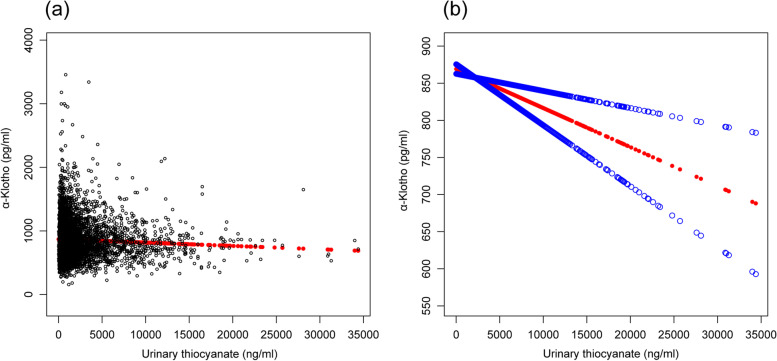
Urinary thiocyanate levels were negatively associated with α-Klotho levels (β = - 0.006; 95% confidence interval, - 0.010 to - 0.003; P = 0.0004) after adjusting for age, sex, body mass index, race, alcohol consumption, estimated glomerular filtration rate, underlying disease, physical activity, smoking status, usual energy intake, and urinary creatinine and serum cotinine levels and mutual adjustment of urinary perchlorate, urinary nitrate, and urinary thiocyanate levels. The α-Klotho level in participants in the highest quartile was higher by 50.567 ng/mL (β = 50.567; 95% confidence interval, 14.407 to 86.726; P = 0.009) than that in participants in the lowest quartile of urinary perchlorate. A linear relationship was observed between urinary thiocyanate and α-Klotho levels.
Urinary thiocyanate levels were negatively associated with serum α-Klotho levels. Urinary thiocyanate should be further investigated as a potential mediator of aging and age-related diseases.
衰老是一个由多种复杂生物过程驱动的病理生理过程,环境污染在这个过程中起着重要作用。本研究旨在探讨血清α-Klotho 水平与尿高氯酸盐、硝酸盐和硫氰酸盐水平之间的关系。
本二次数据集分析包括来自美国国家健康和营养调查(2007-2014 年)的 4875 名参与者(平均年龄 57.69 岁;男性占 49.58%;非西班牙裔白人占 47.67%)。酶联免疫吸附法用于定量α-Klotho 水平,离子色谱-电喷雾串联质谱法用于定量硫氰酸盐、硝酸盐和高氯酸盐水平。多变量线性回归模型用于估计高氯酸盐、硝酸盐和硫氰酸盐水平与血清α-Klotho 水平之间的关系。
在调整年龄、性别、体重指数、种族、饮酒、估计肾小球滤过率、基础疾病、身体活动、吸烟状况、通常能量摄入以及尿肌酐和血清可替宁水平后,尿硫氰酸盐水平与α-Klotho 水平呈负相关(β=-0.006;95%置信区间,-0.010 至-0.003;P=0.0004)。在最高四分位数的参与者中,α-Klotho 水平比最低四分位数的参与者高 50.567ng/mL(β=50.567;95%置信区间,14.407 至 86.726;P=0.009)。尿硫氰酸盐与α-Klotho 水平之间存在线性关系。
尿硫氰酸盐水平与血清α-Klotho 水平呈负相关。尿硫氰酸盐应作为衰老和与年龄相关疾病的潜在介质进一步研究。