BluePath Solutions, Los Angeles, CA, USA.
GRAIL LLC, a subsidiary of Illumina Inc currently held separate from Illumina Inc under the terms of the Interim Measures Order of the European Commission dated 20 October 2021, 1525 O'Brien Dr, Menlo Park, CA, 94025, USA.
BMC Health Serv Res. 2022 Sep 13;22(1):1155. doi: 10.1186/s12913-022-08457-6.
Cancer represents a significant source of disease burden in the United States (US), both clinically and economically. Diagnosis and treatment of cancer at earlier stages may reduce this burden. To better understand potential impacts of earlier diagnosis, healthcare costs among patients with cancer were assessed by cancer type and stage at diagnosis.
A retrospective analysis was conducted using Optum's de-identified Integrated Claims-Clinical data set with Enriched Oncology, which includes data from Medicare Advantage and commercially insured members. Adult members newly diagnosed with solid tumor cancers, cancer stage at diagnosis (diagnosed 1/1/2016-6/30/2020), and continuous enrollment for at least one month post diagnosis were identified. Patients with breast, cervical, colorectal, lung, ovarian, or prostate cancer were reported. Mean standardized costs (2020 USD) were calculated in each month on an annual and cumulative basis through four years post-cancer diagnosis. In each month, costs were calculated for those with continuous enrollment and no death reported in the month. Mean annual cost per patient was estimated by summing month one to 12 mean costs and stratifying by stage at cancer diagnosis; annual year one to four costs were summed to determine cumulative costs.
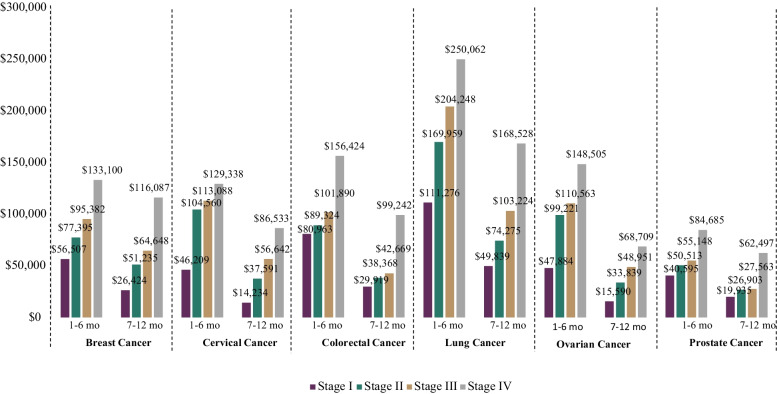
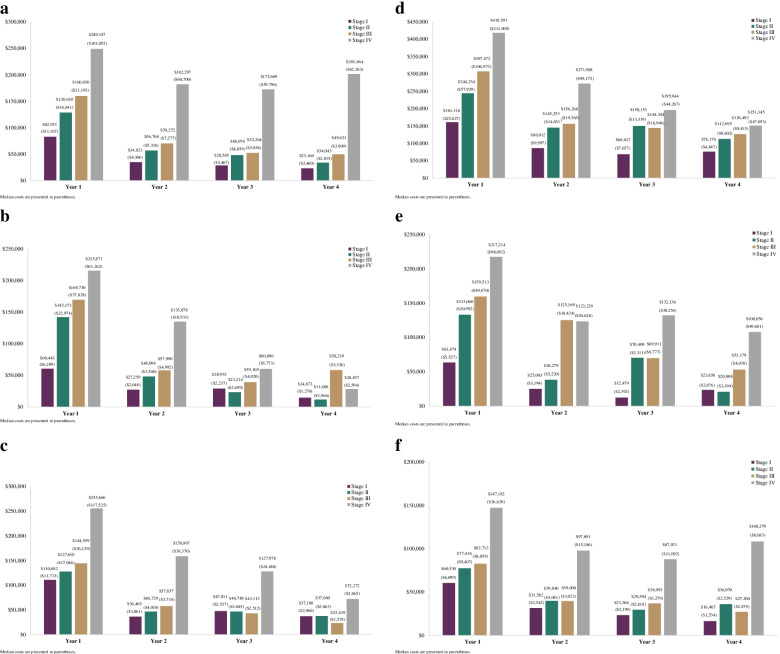
Among members diagnosed 2016-2020 with breast, cervical, colorectal, lung, ovarian, or prostate cancer, 20,422 eligible members were identified. Mean costs increased by stage of diagnosis across all cancers at the annual and cumulative level through year four post diagnosis. Cumulative mean costs grew over time at a relatively similar rate across stages I to III and more dramatically in stage IV, except for cervical and lung cancer where the rate was relatively stable or slightly fluctuated across stages and ovarian cancer where stages III and IV both increased more sharply compared to stages I and II.
Mean annual and cumulative healthcare costs through year four post cancer diagnosis were significantly higher among those diagnosed at later versus earlier cancer stages. The steeper increase in cumulative costs among those diagnosed in stage IV for many cancer types highlights the importance of earlier cancer diagnosis. Earlier cancer diagnosis may enable more efficient treatment, improve patient outcomes and reduce healthcare costs.
在美国(美国),癌症无论是在临床方面还是在经济方面都是疾病负担的重要来源。在更早的阶段诊断和治疗癌症可能会减轻这种负担。为了更好地了解早期诊断的潜在影响,根据癌症类型和诊断时的癌症分期评估了癌症患者的医疗保健费用。
使用 Optum 的去识别综合索赔-临床数据集和富集中瘤进行了回顾性分析,该数据集包括来自 Medicare Advantage 和商业保险成员的数据。确定了新诊断为实体瘤癌症的成年成员,诊断时的癌症分期(诊断日期为 2016 年 1 月 1 日至 2020 年 6 月 30 日),以及至少在诊断后一个月内持续入组。报告了患有乳腺癌、宫颈癌、结直肠癌、肺癌、卵巢癌或前列腺癌的患者。在每年和累计四年后,按癌症诊断时的分期计算每个月的标准化平均费用(2020 年美元)。在每个月中,对于连续入组且当月无死亡报告的患者计算费用。通过将第 1 至 12 个月的平均费用相加,并按癌症诊断时的分期进行分层,估计每位患者的年平均费用;按年 1 至 4 年的费用相加,确定累计费用。
在 2016 年至 2020 年期间被诊断患有乳腺癌、宫颈癌、结直肠癌、肺癌、卵巢癌或前列腺癌的成员中,确定了 20,422 名符合条件的成员。在所有癌症中,在诊断后的每年和累计水平上,随着诊断阶段的增加,平均费用也随之增加,直至四年后。随着时间的推移,I 期至 III 期的累积平均费用以相对相似的速度增长,而 IV 期则更为明显,除了宫颈癌和肺癌,在这些癌症中,各阶段的费用相对稳定或略有波动,而卵巢癌中 III 期和 IV 期的费用都比 I 期和 II 期增长更为陡峭。
在癌症诊断较晚的患者中,癌症诊断后四年内的年平均和累计医疗保健费用明显高于诊断较早的患者。许多癌症类型中,IV 期诊断患者的累积成本增长更为陡峭,这突显了早期癌症诊断的重要性。早期癌症诊断可能使治疗更有效,改善患者的预后并降低医疗保健成本。